
Reviewed · BERLIN TOURS
Berlin Battlefield Tour – Operation Berlin 1945 (Small Group)
The Battle of Berlin becomes far easier to grasp when you walk its final route. This 2.5-hour tour begins at modern Berlin Central Station and follows the Soviet advance across the Moltke Bridge, past the former Himmler House, and toward the Reichstag. You finish at Weidendammer Bridge, where one of the last desperate breakout attempts took place.
I like the small group of no more than 15 and the way the walk links ordinary streets to precise wartime events. I also like the focus on battlefield movement, not just famous buildings. The main drawback is that the tour depends on good weather, and the subject matter is grim rather than light sightseeing.
In This Review
- Key points at a glance
- A battlefield walk through modern Berlin
- Starting beside Berlin Hauptbahnhof
- Moltke Bridge and the Soviet line of advance
- The Himmler House and room-to-room fighting
- Platz der Republik and the open ground before the Reichstag
- The Reichstag, banner No. 5, and the final symbol
- Weidendammer Bridge and the last breakout
- A small group makes the history easier to follow
- What the $54.01 price gives you
- Who should book this walk
- Booking, weather, and timing advice
- Should you book Operation Berlin 1945?
- FAQ
- Where does the Berlin Battlefield Tour begin?
- Where does the tour end?
- How long does the experience last?
- What language is the tour offered in?
- How many people can join the tour?
- Does the tour include entry to the Reichstag?
- Are water and rain protection provided?
- What happens if the tour is canceled because of weather?
Key points at a glance
- The route follows the Soviet advance: Begin at Hauptbahnhof and move toward the Reichstag along the 3rd Shock Army’s axis.
- The Moltke Bridge sets the scene: Learn why this ornate red sandstone bridge became a major obstacle and combat zone.
- The Reichstag story has a human focus: Hear about Sergeants Yegorov and Kantariya and the raising of banner No. 5.
- The final stop is Weidendammer Bridge: The walk ends at one of the last intact Spree crossings during the battle.
- The group stays personal: A maximum of 15 people gives you room to hear the guide and ask questions.
- Practical extras are included: Bottled water and rain ponchos are provided if needed.
A battlefield walk through modern Berlin
Berlin can make the Second World War feel strangely distant. New government buildings, broad streets, and rebuilt public spaces cover much of the old battle zone. This walk helps you read those places as military ground, showing how the final Soviet push unfolded in the center of the city.
The tour is not a museum visit and does not include admission to the Reichstag. Its value comes from standing at the actual locations, hearing what happened there, and understanding the distances between them. You are not simply shown a famous building. You are asked to picture artillery, barricades, ruined streets, and soldiers moving through a city that had become a defensive fortress.
At $54.01 per person, this is fairly priced for a guided walk lasting about two and a half hours. You are paying for a specialist route and a guide who can connect several sites into one clear story. The value is strongest if you already have some interest in military history or twentieth-century Berlin. If you only want a quick look at the Reichstag, a free walk around the government quarter will cost less and take less time.
Other Berlin days worth putting on the list:
- Berlin: Reichstag, Dome and Government District Guided Tour
★ 4.7 · 18,288 reviews - Berlin: 1-Hour City Tour by Boat with Guaranteed Seating
★ 4.3 · 16,993 reviews - Berlin: Boat Tour Along the River Spree
★ 4.4 · 11,252 reviews
Starting beside Berlin Hauptbahnhof
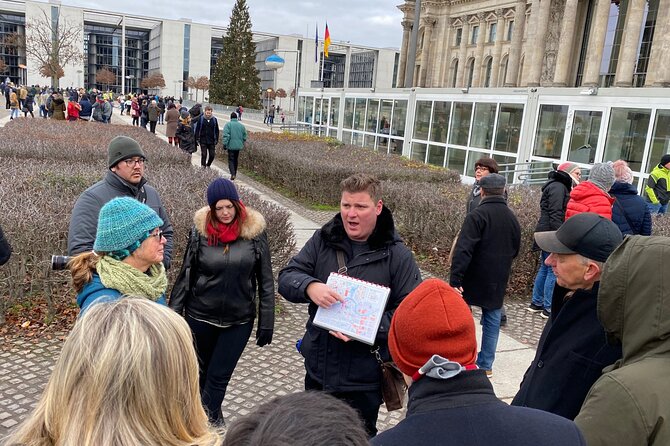
The meeting point is on the southern side of Berlin Central Station at Ella-Trebe-Straße 9. The station is modern, large, and well connected, so allow enough time to find the southern side rather than arriving at the last minute.
The walk begins with about ten minutes of introduction. This opening matters. Without it, the buildings ahead can seem like unrelated stops. The guide sets out the final stage of the war, the Soviet approach, and the German defense of central Berlin before the group starts walking.
You will want comfortable shoes. The tour covers several outdoor locations, and its value depends on moving between them rather than remaining in one spot. Bottled water is supplied, and rain ponchos are available if needed, but you should still dress for changing Berlin weather.
The tour is offered in English. Since it is limited to 15 people, the guide can keep the group together and answer questions without turning every explanation into a public speech. That smaller format is especially useful for a history walk, where visitors often want to ask about maps, military units, or the sequence of events.
Moltke Bridge and the Soviet line of advance
Your first major stop is Moltkebrücke, an ornate red sandstone bridge over the Spree. Today, its decorative appearance can hide its military importance. In April 1945, it became part of the fighting as Soviet forces pushed into the government quarter.
Here, the guide explains the axis of advance used by the Soviet 3rd Shock Army. You also learn about the problems facing both sides. The Soviets had to force their way across defended ground toward key government buildings. German troops were fighting in a shrinking area, using bridges, streets, and buildings as barriers.
This is one of the strongest parts of the walk because the bridge gives you a physical reference point. The battle was not an abstract movement on a map. It involved a crossing, a defended approach, and a short route toward the Reichstag that cost many lives.
The stop itself lasts about ten minutes. That may sound brief, but it works as an orientation point rather than a long lecture. Listen for the explanation of direction and distance. Those details help you understand why the next stops were so difficult to capture.
The Himmler House and room-to-room fighting
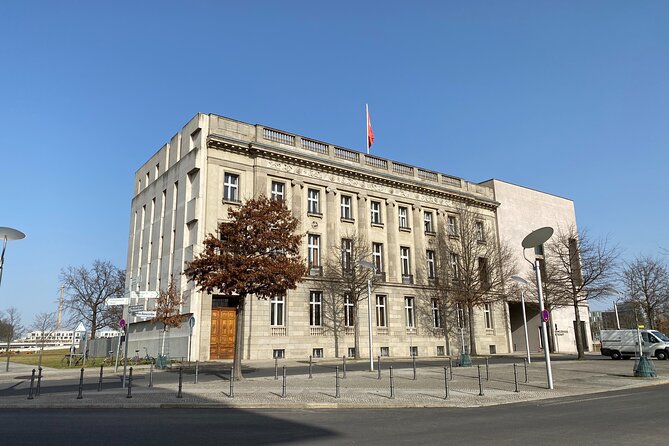
After crossing Moltke Bridge, you reach the Bundeskanzleramt area, site of the former Interior Ministry, known at the time as the Himmler House. The building was part of the old diplomatic quarter and became a major defensive position.
The guide describes a Soviet artillery barrage fired at very close range, followed by fierce fighting inside the building. This was not a clean advance from one street to the next. Soldiers had to clear rooms, corridors, and floors while defenders used the structure to slow the attack.
For me, this stop adds an important layer to the story. Visitors often picture the Battle of Berlin as a final rush toward the Reichstag, but urban combat was slow, close, and dangerous. A single building could hold up an advance, and every doorway could become a threat.
The modern setting also creates a useful contrast. You are looking at a functioning part of central Berlin while hearing how badly damaged and dangerous the same area was in 1945. The tour does not rely on grand ruins to make its point. The guide supplies the missing context.
Same city, a completely different kind of day:
- Discover Berlin Half-Day Walking Tour
★ 5.0 · 9,624 reviews - Berlin: Hop-on Hop-off Bus Tour with Live Commentary
★ 4.3 · 8,579 reviews - Berlin: Government District around the Reichstag Guided Tour
★ 4.7 · 8,447 reviews - Berlin: Reichstag, Plenary Chamber, Cupola & Government Tour
★ 4.6 · 8,422 reviews
Platz der Republik and the open ground before the Reichstag
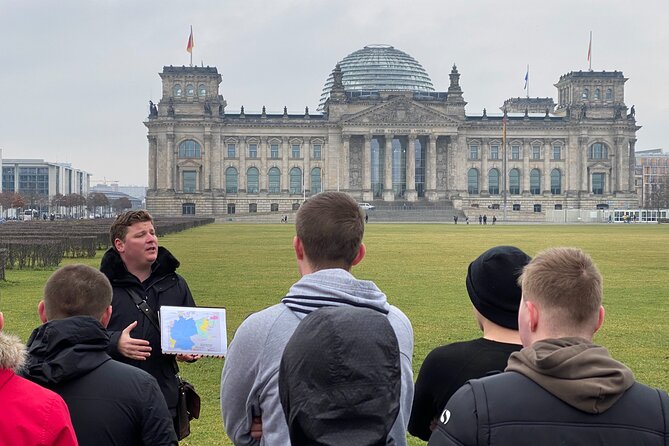
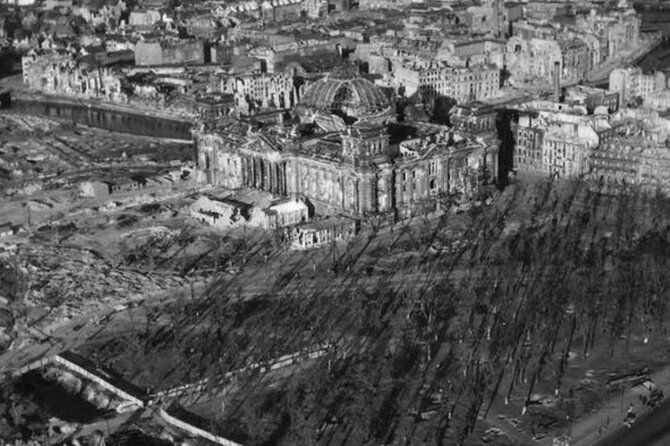
The walk continues to Platz der Republik, the former Königsplatz. Here, the group pauses to consider the open area in front of the Reichstag. In 1945, this space was described as a 300-meter moonscape that the 207th and 150th Rifle Divisions had to cross.
This is a good place to slow down and think about exposure. A broad public square may look harmless now, but open ground is a serious problem when defenders have weapons and clear lines of sight. The Soviet soldiers approaching the Reichstag could not simply walk across it. They had to cross a damaged, dangerous area under fire.
The stop also helps you understand why the Reichstag had such symbolic and military importance. It was not only a political emblem. It was the next major objective in a tightly packed area where every advance was measured in meters.
The tour gives this section about ten minutes. That is enough to establish the physical challenge, though anyone wanting a long tactical discussion may find the pace brisk. The walk covers several sites, so the guide has to keep the story moving.
The Reichstag, banner No. 5, and the final symbol
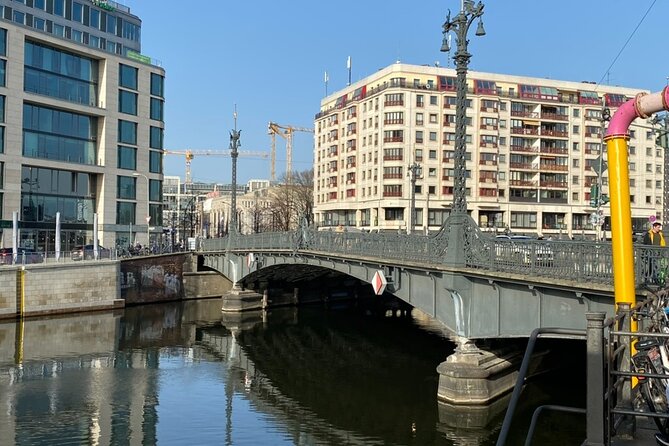
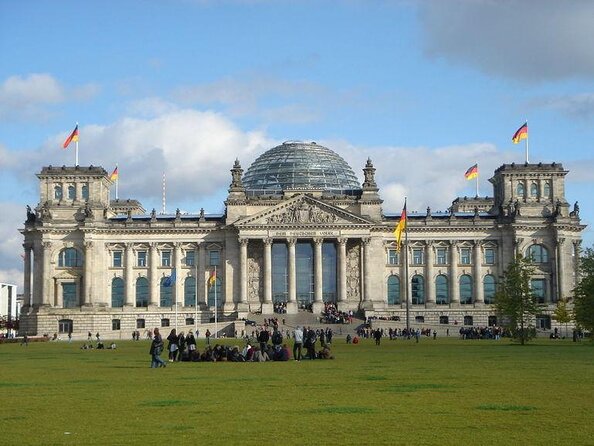
At the foot of the Reichstag, the battle story reaches its best-known moment. The guide connects the building to Hitler’s final days in the Führerbunker, only a few hundred meters away, then turns to the soldiers who raised the Soviet flag.
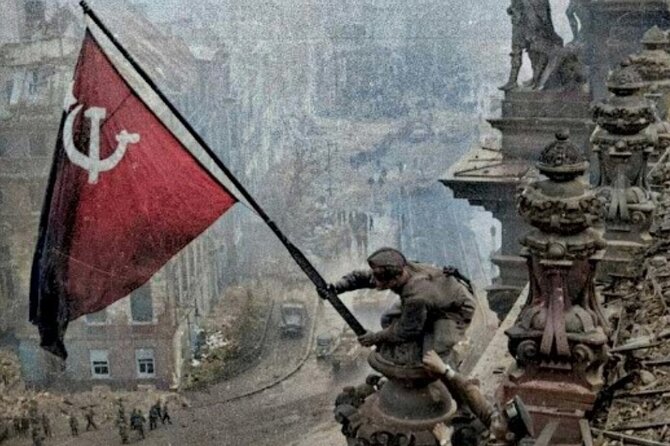
You hear about Sergeant Yegorov and Sergeant Kantariya and the raising of special banner No. 5 on the roof. That moment signified the end of the battle, though the fighting in Berlin did not stop instantly. The story carries both political symbolism and the personal detail of the men involved.
The stop lasts about twenty minutes, making it the longest pause on the route. That extra time is welcome. The Reichstag is one of Berlin’s most visited buildings, and many people arrive with only a general idea of its wartime role. This explanation places the building within the battle rather than treating it as a stand-alone photograph.
You should note that the tour takes you to the foot of the Reichstag, not inside it. Admission is free at each stop because this is an outdoor walking experience, but that does not mean you receive access to the dome or interior. If you want to visit the Reichstag dome, you will need to arrange that separately.
Weidendammer Bridge and the last breakout
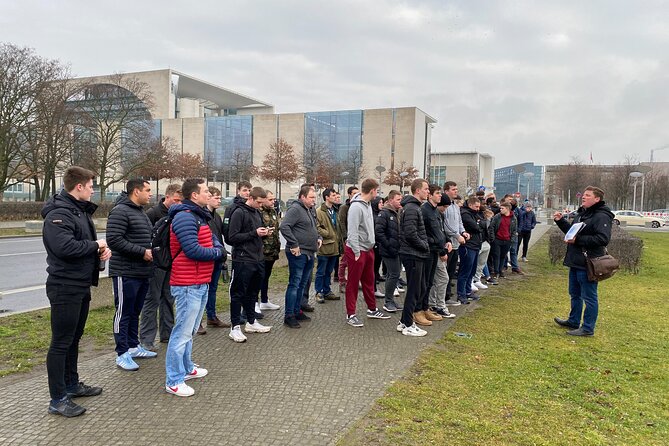
The final stop is Weidendammer Brücke, about 50 meters from Friedrichstrasse station. This is a practical ending point, with strong S-Bahn and U-Bahn connections for the rest of your day.
Historically, the bridge carries a darker story. During the last days of the Battle of Berlin, it was one of the few crossings over the Spree that remained intact. On the night of May 1, 1945, German forces attempted a breakout from the area of the Führerbunker, and the bridge became the scene of severe fighting.
Ending here gives the walk a less familiar finish than stopping at the Reichstag. The famous photograph and banner are not the final word. The battle continued in desperate, confused conditions, with people trying to escape a city that was already collapsing.
The site of the failed breakout also gives the guide a natural place to explain what happened after the Reichstag was taken. Ask how to reach your next destination before leaving. The guide can advise you, and Friedrichstrasse station makes onward travel simple.
A small group makes the history easier to follow
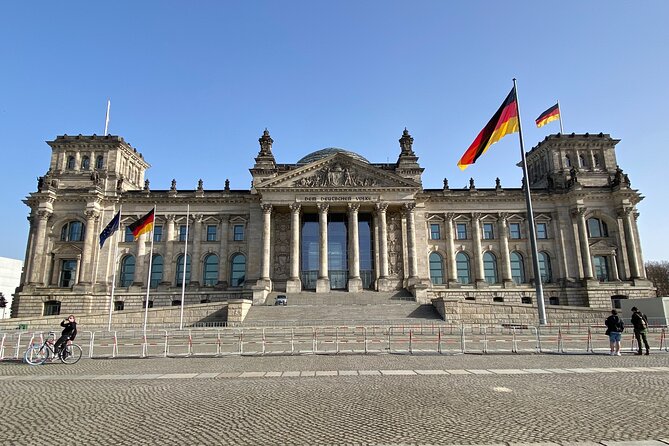
The maximum group size is 15. That is large enough to feel social but small enough for the guide to speak without shouting. It also gives you a reasonable chance to ask questions, which is important on a route built around sequence and detail.
A small group does not guarantee that every guide will handle the walk in the same way. Still, the format is a clear advantage. One person who took the tour described having detailed conversations with guide Jochen, while another praised the chance for everyone to hear and ask questions. Those details suggest that the experience works particularly well for people who want more than a set speech.
If Jochen is leading your departure, you may find the tour especially useful if you enjoy discussing the finer points of the battle. The walk suits a parent traveling with a history-focused teenager, a student, or anyone who likes to stop and ask why a particular bridge or building mattered.
The subject requires some concentration. You will hear about Soviet divisions, defensive positions, artillery, and the final days inside the bunker. If you prefer broad historical storytelling with little military detail, the route may feel more focused than you want.
What the $54.01 price gives you
The cost is $54.01 per person. For a 2-hour-30-minute guided walk, that works out to roughly $22 per hour, before placing a value on the guide’s preparation and the carefully chosen route.
You are not paying for entry tickets, since the stops are outdoor public sites. You are paying for interpretation and structure. Without a guide, you could walk from Hauptbahnhof to the Reichstag and Weidendammer Bridge, but you would miss the military logic connecting those places.
The price makes the most sense for a first visit to Berlin if you want a focused introduction to the city’s final wartime battle. It is less compelling if you already know the route, have studied the battle in detail, or only want photographs of central Berlin.
Bottled water and rain ponchos add a small practical benefit. They do not transform the value of the tour, but they show attention to the fact that this is an outdoor experience. Since poor weather can lead to cancellation, the tour is best placed on a day when you can adjust your schedule if necessary.
Who should book this walk
I would choose this tour for:
- History-focused visitors who want the Battle of Berlin explained at the actual sites.
- Families with older children or teenagers who can manage a 2.5-hour walk and enjoy asking questions.
- Repeat visitors who have already seen the major landmarks and want a more specific subject.
- Visitors who prefer small groups rather than large coach tours or crowded city walks.
- People interested in military geography, especially how bridges, open ground, and government buildings shaped the final fighting.
I would think twice if you want a relaxed sightseeing stroll. The route covers serious combat, room-to-room fighting, artillery, mass casualties, and a failed breakout. It is not suitable for someone hoping for a cheerful overview of Berlin’s landmarks.
Most people can participate, and service animals are allowed. The tour operates near public transportation, but the supplied information does not give exact details about step-free access at every point. If that matters to you, ask before booking.
Booking, weather, and timing advice
Confirmation is provided when you book, and the tour is usually reserved well ahead of the date, with an average booking time of 27 days in advance. That is a useful signal to plan early if your Berlin dates are fixed.
You can cancel for a full refund up to 24 hours before the start time. Changes or cancellations inside that 24-hour window are not accepted for a refund. Cutoff times use local Berlin time, so check the exact start time rather than relying on your home time zone.
Good weather is required. If poor weather forces cancellation, you are offered another date or a full refund. The same applies if the minimum number of participants is not met, with the option of another experience or a full refund.
The start and finish are in different parts of central Berlin. That is helpful for sightseeing because you do not have to return to the starting station, but it means you should plan around the ending at Friedrichstrasse. The tour itself is in English and uses a mobile ticket.
Should you book Operation Berlin 1945?
Book it if you want to understand how the final Battle of Berlin unfolded on the ground. The route is compact, the group is limited to 15, and the stops build a clear line from the Soviet approach at Moltke Bridge to the Reichstag and the final fighting at Weidendammer Bridge.
I especially like the combination of famous sites and less familiar battlefield details. The Reichstag provides the symbolic climax, but the Himmler House and Weidendammer Bridge give the tour its sharper edge. You leave with more than a photograph of the flag story.
Skip it if you want interior access to the Reichstag, a general city tour, or a gentle walk with little discussion of combat. For the right audience, though, $54.01 is a fair price for a focused English-language history walk led in a small group.
FAQ
Where does the Berlin Battlefield Tour begin?
The tour begins at Ella-Trebe-Straße 9, on the southern side of Berlin Central Station, also called Hauptbahnhof.
Where does the tour end?
It ends at Weidendammer Brücke, about 50 meters from Friedrichstrasse S-Bahn and U-Bahn station.
How long does the experience last?
The tour lasts approximately 2 hours and 30 minutes.
What language is the tour offered in?
The tour is offered in English.
How many people can join the tour?
The maximum group size is 15 participants.
Does the tour include entry to the Reichstag?
No. The tour visits the Reichstag building from the outside, at its foot. Admission tickets are not required for the outdoor stops.
Are water and rain protection provided?
Yes. Bottled water and rain ponchos, if needed, are provided.
What happens if the tour is canceled because of weather?
You will be offered a different date or a full refund if poor weather causes the experience to be canceled.
Just added around Berlin
- Love and War in Berlin: Self-Guided Story Puzzle Walk★ 5.0 · 7 reviews
- Rickshaw Tours Berlin – Groups of up to 16 people with several rickshaws★ 4.0 · 97 reviews
- Walking on the Wall: 3-Hour Tour in Berlin★ 4.5 · 34 reviews
- eSIM for Germany and 34 European Countries★ 4.5 · 16 reviews
- Warnemuende Shore Excursion: Berlin Private Sightseeing Tour from Rostock★ 5.0 · 4 reviews
- Your ticket to The Wall Museum Berlin★ 3.0 · 60 reviews
- Warnemuende Shore Excursion: Private Berlin Tour★ 4.5 · 27 reviews
- Berlin’s Gay, Lesbian, and Queer Scene Small-Group Walking Tour★ 4.5 · 66 reviews
Berlin Tours, compared.

Reichstag, Dome and Government District Guided Tour
Read our review →
1-Hour City Tour by Boat with Guaranteed Seating
Read our review →


Reichstag, Plenary Chamber, Cupola & Government Tour
Read our review →

