
Reviewed · BERLIN TOURS
Berlin and National Socialism: Berlin under Nazism
Berlin’s Nazi past is scattered across a modern city. This four-hour tour helps you connect the sites, from the Reichstag and Soviet war memorial to the former Führerbunker and the Topography of Terror. The value is not just seeing places, but understanding how they fit together.
I like the Spanish-language guiding and the broad route. Guides including Julia, Celia, and Helena are praised for clear explanations, visual material, historical context, and useful Berlin tips. I also like that the tour includes both major memorials and less obvious stops such as Tempelhof.
The main drawback is the pace. Six stops in about four hours means some visits are brief, with only 5 minutes at the Sinti and Roma memorial and 15 minutes at the Topography of Terror. You’ll also need to pay separately for Berlin’s AB public transport ticket.
In This Review
- Key points at a glance
- Making sense of Berlin’s Nazi past
- Starting at the Berlin TV Tower
- The Bundestag and the problem of political memory
- Remembering the Sinti and Roma victims
- The Soviet Memorial in Tiergarten
- Tempelhof, from aviation hub to historical site
- The Topography of Terror
- The Führerbunker site and the value of an empty place
- Reaching the Memorial to the Murdered Jews of Europe
- What the four-hour format feels like
- Price, transport, and planning advice
- Who will get the most from this tour
- Should you book Berlin under Nazism?
- FAQ
- Where does the tour begin?
- What time does the tour start?
- Where does the tour end?
- How long does the experience last?
- What language is the tour conducted in?
- Which places are visited?
- Are admission tickets included?
- Is public transportation included?
- How large is the group?
- Can I cancel for a full refund?
Key points at a glance
- A citywide Nazi-era route: Connect Berlin’s government quarter, war memorials, former airport, Nazi headquarters, and bunker site in one morning.
- Spanish-speaking guides: Julia, Celia, and Helena are among the guides praised for warmth, detail, historical context, and practical suggestions.
- A serious subject handled with care: The tour focuses on persecution, war, dictatorship, and memory without treating these sites as ordinary sightseeing stops.
- Paid admissions included: The listed admission fees are covered, while free outdoor sites require no ticket.
- A small-group format: The group can include up to 25 people, large enough for energy but still manageable.
- Plan for public transport: Your AB transport ticket is not included, and the route begins near the Berlin TV Tower and ends by the Memorial to the Murdered Jews of Europe.
Making sense of Berlin’s Nazi past
I recommend taking this tour early in your Berlin visit if the Third Reich is a major reason for coming. The route gives you a framework for later visits to places such as the Memorial to the Murdered Jews of Europe, which is near the finishing point.
The subject is difficult, and that is part of the point. You are not simply looking at old buildings. You are examining how a dictatorship used government offices, police institutions, propaganda, transport systems, and military power.
The tour also helps correct a common misunderstanding about Berlin. The city was not left as a preserved Nazi museum. Buildings were destroyed, rebuilt, renamed, repurposed, or reduced to traces. In several places, the absence of a visible structure is itself part of the story.
The guides appear to be a major part of the experience. Julia is praised for using photographs and videos to place events in their setting. Celia is repeatedly described as warm, detailed, and passionate about Berlin. Helena is noted for making the four-hour route engaging even in cold and rainy weather.
Guide assignments can change, so you should not book on the assumption that one particular person will lead your departure. Still, the repeated strengths are clear: explanations in Spanish, a serious approach, answers to questions, and practical advice for the rest of your stay.
Other Berlin days worth putting on the list:
- Berlin: Reichstag, Dome and Government District Guided Tour
★ 4.7 · 18,288 reviews - Berlin: 1-Hour City Tour by Boat with Guaranteed Seating
★ 4.3 · 16,993 reviews - Berlin: Boat Tour Along the River Spree
★ 4.4 · 11,252 reviews
Starting at the Berlin TV Tower
The meeting point is by the Berlin TV Tower at Panoramastraße 1A, with a 10 a.m. start. This is a useful central location, but give yourself enough time to find the exact meeting area around a major landmark.
Beginning here places you in the middle of present-day Berlin before the tour turns toward the past. The contrast matters. The city around Alexanderplatz is modern and busy, while the tour asks you to picture Berlin as the center of a dictatorship and later a ruined capital.
The route ends near the Memorial to the Murdered Jews of Europe, so you finish close to another major site of remembrance. That makes the morning easy to extend on your own, though the tour does not say that admission to any additional attraction is included.
The Bundestag and the problem of political memory
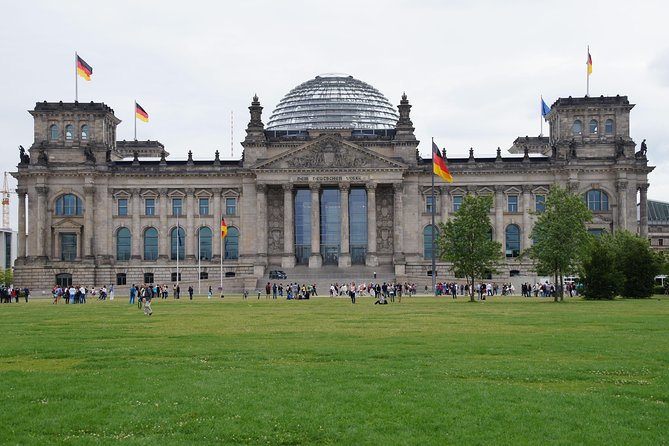
The first stop is the Bundestag, the home of Germany’s modern parliament. You receive about 20 minutes here, and admission is listed as free.
The building’s wartime and postwar history is central to the stop. It was badly damaged, protected from the weather, and partly repaired in the 1960s. A full reconstruction came only after German reunification on October 3, 1990, under architect Norman Foster. The building was completed in 1999 and returned to use as the meeting place of parliament.
That timeline gives you a quick lesson in how Germany dealt with its past. The building was not simply restored to look as it had before the war. Its later form reflects reunification and a new democratic Germany.
Do not expect this stop to mean a guided visit inside the parliamentary building. The information provided describes a visit to the Bundestag area, not a reserved interior tour or dome entry. The 20-minute visit is best understood as an orientation stop, with the guide explaining the building’s role and changes over time.
Remembering the Sinti and Roma victims
The Monument to the Sinti and Roma Victims of National Socialism is a brief but important stop. About five minutes are allotted, and admission is included.
The monument honors the estimated 220,000 to 500,000 Sinti and Roma murdered in the Nazi genocide, known as Porraimos. Its inclusion broadens the tour beyond the most familiar story of Nazi persecution.
Five minutes is not enough for a long personal visit or a detailed reading of every element. I would treat the stop as an introduction, then return later if you want more time for quiet reflection.
This is one reason a guide adds value. A short stop can otherwise pass too quickly, especially when a memorial is understated. A clear explanation helps you understand who is being remembered and why this site belongs in a tour of Berlin under Nazism.
Same city, a completely different kind of day:
- Discover Berlin Half-Day Walking Tour
★ 5.0 · 9,624 reviews - Berlin: Hop-on Hop-off Bus Tour with Live Commentary
★ 4.3 · 8,579 reviews - Berlin: Government District around the Reichstag Guided Tour
★ 4.7 · 8,447 reviews - Berlin: Reichstag, Plenary Chamber, Cupola & Government Tour
★ 4.6 · 8,422 reviews
The Soviet Memorial in Tiergarten
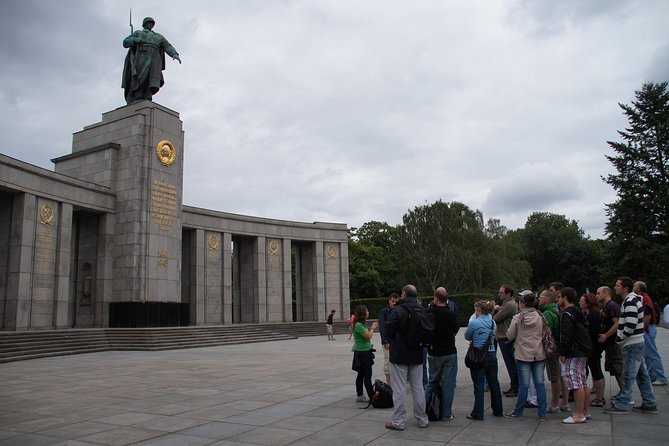
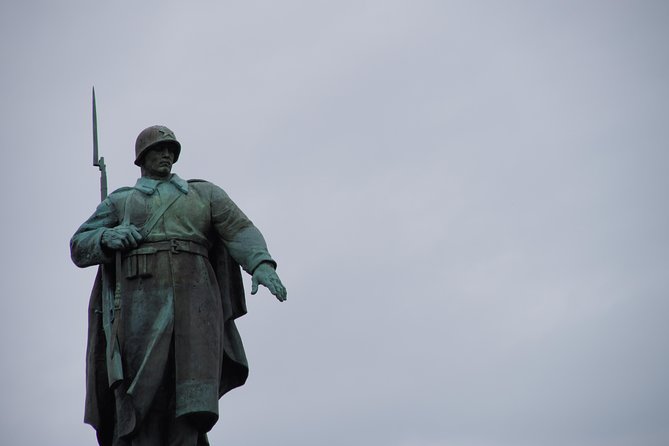
The Soviet Memorial in Tiergarten takes about 15 minutes and requires no admission ticket. It commemorates Soviet war dead, especially the roughly 80,000 Soviet soldiers who died during the Battle of Berlin in April and May 1945.
This stop shifts the focus from Nazi persecution to the war’s final military phase. It also shows how Berlin’s public spaces became places of political memory after the conflict.
The memorial is one of several Soviet war memorials in Berlin. Its location in Tiergarten makes it easy to connect the end of the war with the physical destruction of the capital and the collapse of the Nazi government.
You may find the stop especially useful if you know the war mainly from the Western Allied perspective. The Soviet role in the defeat of Nazi Germany was enormous, and the memorial gives that part of the story a visible place in central Berlin.
Tempelhof, from aviation hub to historical site
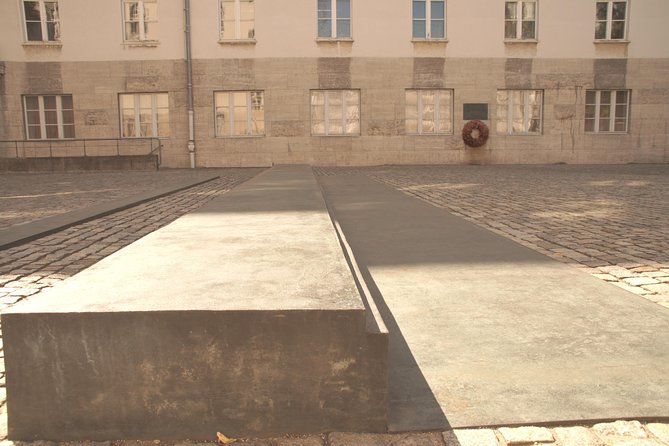
Tempelhof receives about 25 minutes. The airport was one of the most important in the early twentieth century and, in 1926, had ten flights each day, making it the largest airport in Europe at that time.
The stop adds a different kind of context. Nazi-era Berlin was not only about offices, prisons, battlefields, and memorials. It was also a city shaped by major infrastructure and grand plans for modern transport.
The information available does not promise an interior airport tour or a specific exhibit. You should expect the guide to use Tempelhof as a historical location and explain its place in Berlin’s development.
That makes this stop less emotionally concentrated than the memorials, but it gives the day some variety. It also helps you see how ordinary urban functions, such as air travel and monumental construction, could exist alongside dictatorship and repression.
The Topography of Terror
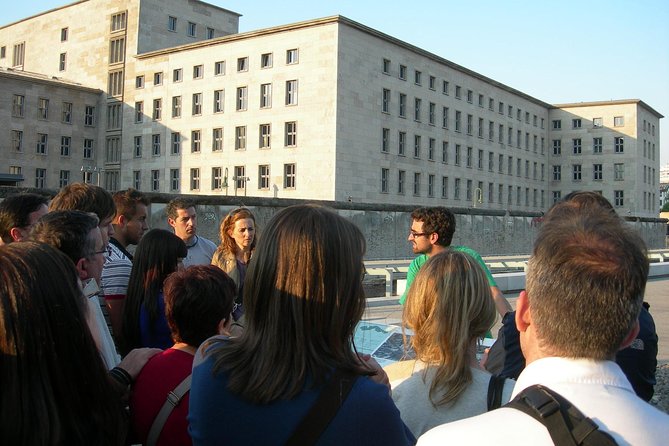
The Topography of Terror is an indoor and outdoor history museum, with about 15 minutes assigned to the tour. Admission is included.
The museum is one of the most direct stops on the route because it deals with the institutions of Nazi terror. Its setting is tied to the former headquarters of the Gestapo and SS, making the location itself part of the lesson.
Fifteen minutes is short for a museum. You will not have time to study every panel or absorb the full exhibition at an easy pace. If the subject matters to you, plan to return independently after the tour and allow much longer.
Still, a guided introduction can make a later solo visit more productive. You will have the basic timeline and institutional context, rather than walking into the exhibition without knowing how its parts connect.
The museum also helps keep the tour from becoming a parade of famous names and dramatic ruins. It directs attention toward systems of persecution and the people who operated them.
The Führerbunker site and the value of an empty place
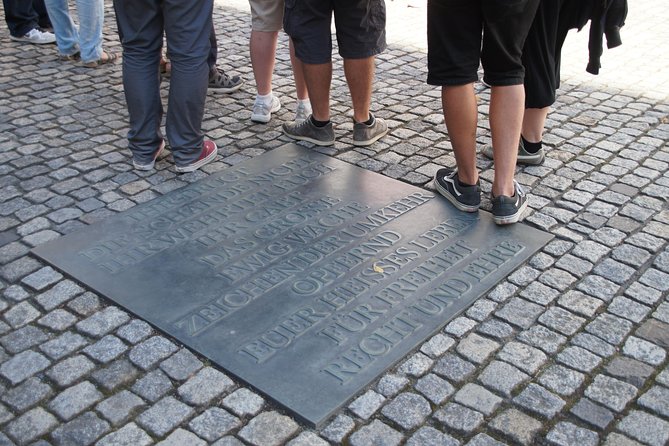
The tour spends about 15 minutes at the area of Hitler’s bunker, where he spent his final hours alive. There is no admission charge.
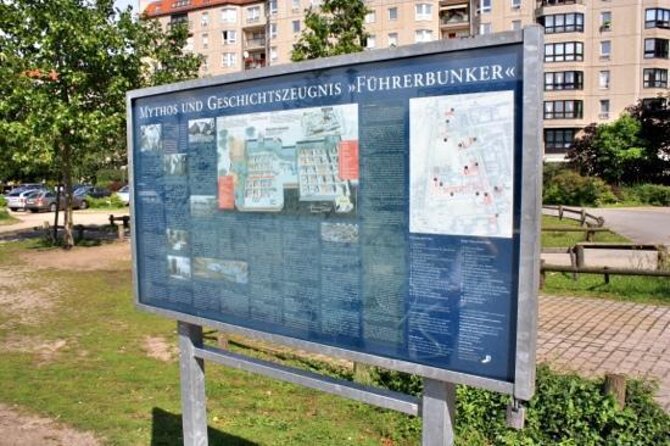
The site is notable because the bunker is not presented as a visitor attraction. You see the area associated with it, while the guide explains what happened there during the final days of the regime.
This is a useful approach. The bunker has attracted a great deal of fascination, but there is no grand underground room waiting to be toured here. The stop works best when treated as a lesson in the collapse of the Nazi government, not as a chance to seek dramatic remnants.
A guide can also help keep the focus on historical facts and consequences. The location is easy to misunderstand if you approach it only as a place linked to Hitler. The larger story is the destruction caused by the regime and the final ruin of the city it ruled.
Reaching the Memorial to the Murdered Jews of Europe
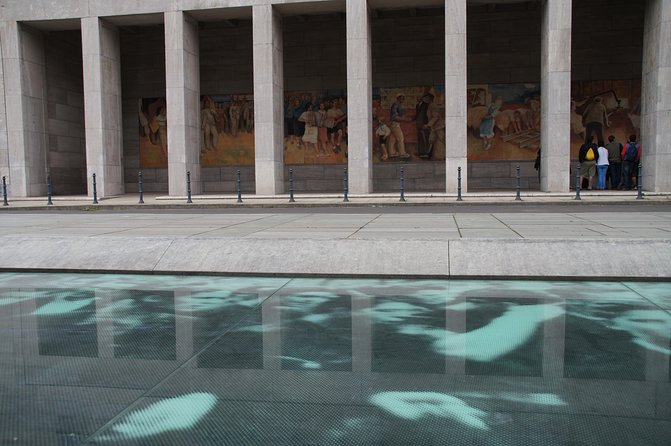
The tour ends at the Memorial to the Murdered Jews of Europe on Cora-Berliner-Straße. This is a strong endpoint because the memorial brings you back to the victims and to Germany’s continuing effort to remember the Holocaust.
The memorial is not listed as a formal timed stop with a separate admission. Instead, it is the ending location, giving you the option to continue on your own afterward.
You can use the end of the tour as a moment to review the morning. You have moved from parliament and wartime commemoration to persecution, police terror, military defeat, dictatorship, and remembrance.
The finish is also practical. You are left near one of Berlin’s central memorial areas, rather than being returned to the starting point. If you prefer tours that end close to more sightseeing, this arrangement works well.
What the four-hour format feels like
Four hours is long enough to cover a serious amount of ground, but not long enough for leisurely visits at every site. The schedule adds up to roughly 95 minutes of stated stop time, leaving the rest for transport, introductions, and movement between locations.
That explains the tour’s character. It is a guided overview, not a slow museum day. You will see many places and gain a connected explanation, then decide which ones deserve a second visit.
The route is likely to feel active rather than exhausting for most people, since the itinerary uses several locations across Berlin and includes public transportation. You should wear comfortable shoes and prepare for weather, especially because portions take place outside.
The group limit is 25 people. That is not a private tour, and the experience may feel less personal at the upper limit. It is still small enough for a guide to address questions more easily than on a large coach excursion.
Price, transport, and planning advice
At $25.54 per person, the tour offers a solid value if you want a structured introduction in Spanish. The price covers the listed admission tickets, though several stops are free anyway. You are paying mainly for the guide’s time, the route planning, and the explanations that connect otherwise scattered sites.
The separate AB transport ticket is an important extra cost. The meeting point is near public transportation, and you should arrange the required ticket before or during the tour according to Berlin’s local transport rules.
The tour is often booked about 36 days ahead, so advance planning makes sense if your dates are fixed. Confirmation is received at booking, and free cancellation is available until 24 hours before the start time. Changes or cancellations made inside that 24-hour window are not accepted for a refund.
Who will get the most from this tour
I would choose this experience if you want to understand the Third Reich in Berlin without spending your first days working out the geography alone. It is especially suitable for history enthusiasts, first-time visitors, and Spanish speakers who want more than brief English-language information at each site.
It also suits you if you like a guide who explains context rather than simply pointing at buildings. The strongest descriptions of Julia, Celia, and Helena emphasize detailed teaching, empathy, visual aids, and answers to questions.
I would hesitate if you want extensive time inside museums, a private conversation with the guide, or a tour focused only on Holocaust memorials. The itinerary covers a wider period and a wider set of themes, including parliament, aviation, Soviet military memory, and the fall of the Nazi regime.
Families and older participants should consider the four-hour length and the outdoor portions. The activity states that most people can participate, but it does not provide a detailed accessibility description, so ask the operator directly if you have specific mobility needs.
Should you book Berlin under Nazism?
Book it if you want a clear, respectful introduction to Berlin’s Nazi era and prefer learning in Spanish. The combination of Julia, Celia, or Helena style guiding, a 25-person maximum, included admissions, and a route covering six important locations gives you a lot for the price.
Go in with realistic expectations. Several stops are short, the transport ticket costs extra, and the tour cannot replace a full visit to the Topography of Terror or the city’s major memorials.
For most visitors with a serious interest in twentieth-century Germany, I think it is a worthwhile first step. Use the tour to build your map and historical timeline, then return to the places that deserve more time.
FAQ
Where does the tour begin?
It begins at the Berlin TV Tower, Panoramastraße 1A, 10178 Berlin, Germany.
What time does the tour start?
The scheduled start time is 10:00 a.m.
Where does the tour end?
It ends at the Memorial to the Murdered Jews of Europe, Cora-Berliner-Straße 1, 10117 Berlin, Germany.
How long does the experience last?
The tour lasts approximately four hours.
What language is the tour conducted in?
A Spanish-speaking guide is included.
Which places are visited?
The route includes the Bundestag, Memorial to the Sinti and Roma Victims of National Socialism, Soviet Memorial in Tiergarten, Tempelhof, Topography of Terror, and the Führerbunker area.
Are admission tickets included?
Admission tickets are included where specified. The Bundestag, Soviet Memorial, Tempelhof, and Führerbunker area are listed without an admission charge, while admission to the Sinti and Roma memorial and Topography of Terror is included.
Is public transportation included?
No. The AB transport ticket is not included in the tour price.
How large is the group?
The activity has a maximum of 25 participants.
Can I cancel for a full refund?
Yes. You can cancel at least 24 hours before the experience start time for a full refund. Cancellations or changes made less than 24 hours before the start time are not refunded.
Just added around Berlin
- Love and War in Berlin: Self-Guided Story Puzzle Walk★ 5.0 · 7 reviews
- Rickshaw Tours Berlin – Groups of up to 16 people with several rickshaws★ 4.0 · 97 reviews
- Walking on the Wall: 3-Hour Tour in Berlin★ 4.5 · 34 reviews
- eSIM for Germany and 34 European Countries★ 4.5 · 16 reviews
- Warnemuende Shore Excursion: Berlin Private Sightseeing Tour from Rostock★ 5.0 · 4 reviews
- Your ticket to The Wall Museum Berlin★ 3.0 · 60 reviews
- Warnemuende Shore Excursion: Private Berlin Tour★ 4.5 · 27 reviews
- Berlin’s Gay, Lesbian, and Queer Scene Small-Group Walking Tour★ 4.5 · 66 reviews
Berlin Tours, compared.

Reichstag, Dome and Government District Guided Tour
Read our review →
1-Hour City Tour by Boat with Guaranteed Seating
Read our review →


Reichstag, Plenary Chamber, Cupola & Government Tour
Read our review →

