Reviewed · BERLIN TOURS
Berlin: 75-minute Trabi Safari
The best thing about this tour is that you do not simply look at Berlin’s Cold War past from a pavement. You drive through it in a Trabant, the little plastic-bodied car once made in East Germany. The convoy passes the Brandenburg Gate, Checkpoint Charlie, the Berlin Wall, and East Berlin landmarks while your guide talks through the city by radio.
I like the hands-on history and the instant fun. You learn the car’s column shift and two-stroke quirks, then become part of a slow-moving parade that makes people smile and lift their cameras. The main drawback is the price: $93 per person is a lot for 75 minutes, especially when the experience is priced partly for its novelty.
In This Review
- Key points to know before you book
- Why a Trabant is the real attraction
- Starting at TrabiWorld on Zimmerstraße
- Getting comfortable with the column shift
- Potsdamer Platz and the city’s divided center
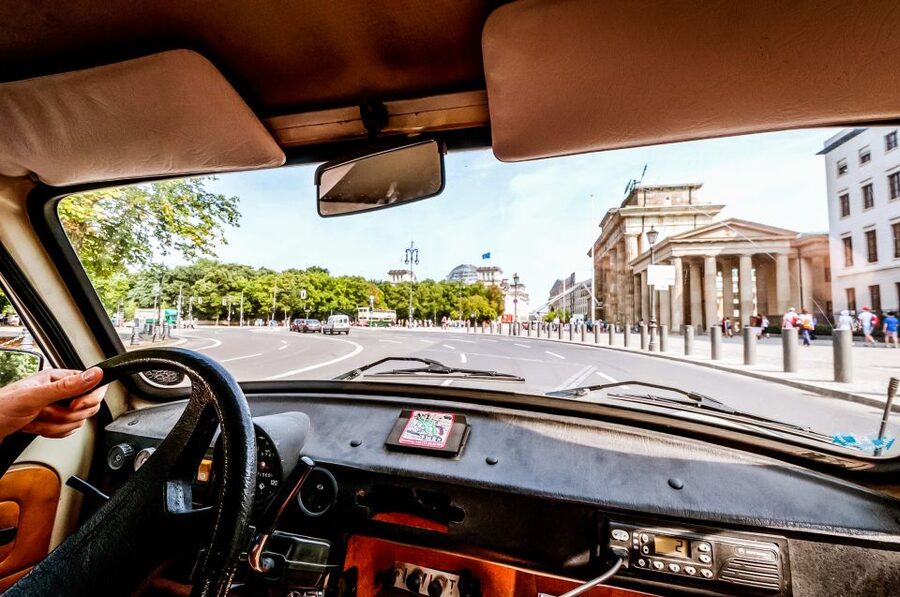
- Brandenburg Gate and Unter den Linden
- Berlin Cathedral, Red City Hall, and the TV Tower
- The Wall, East Side Gallery, and Oberbaum Bridge
- Checkpoint Charlie and the Cold War story
- What the 75 minutes feel like
- Is $93 a fair price?
- Practical tips for a smoother safari
- Who will enjoy it most?
- Should you book the Trabi Safari?
- FAQ
- Where does the Trabi Safari start?
- How long does the tour last?
- How much does the tour cost?
- Do I drive my own Trabant?
- How many people can fit in one Trabant?
- What driving license do I need?
- Do passengers and children need tickets?
- Is the car manual?
- What sights does the route pass?
- What is included in the booking?
Key points to know before you book
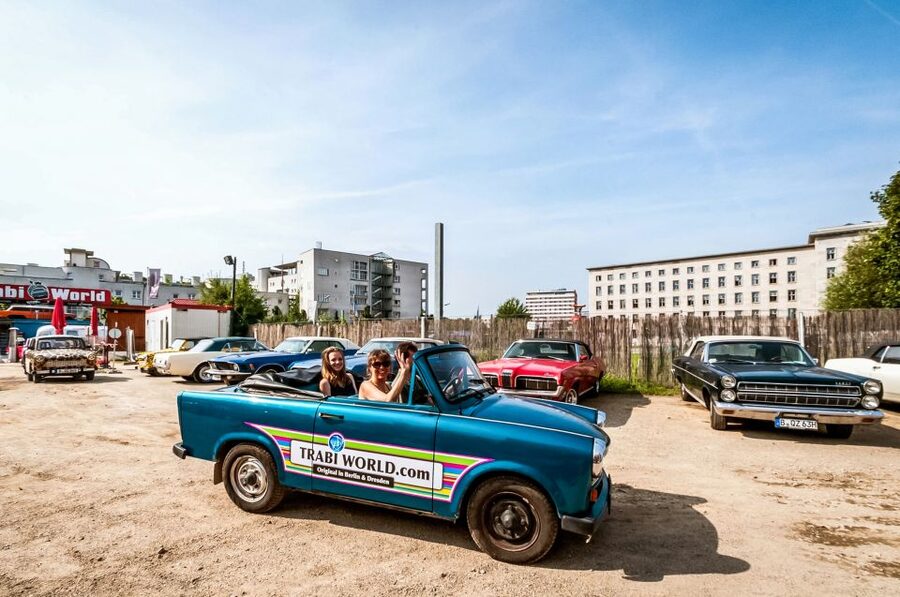
- You drive your own Trabant: Each booking gets a private car, not a shared vehicle, with room for up to four people or 330 kilograms.
- The controls are part of the adventure: Expect a manual gearbox, column-mounted shifter, light power, and a car that takes a little practice.
- The route covers major Berlin sights: You pass Potsdamer Platz, the Brandenburg Gate, Unter den Linden, Berlin Cathedral, the Red City Hall, TV Tower, East Side Gallery, Oberbaum Bridge, and Checkpoint Charlie.
- The convoy system keeps beginners comfortable: A guide leads from the front, radios operate in every car, and the group waits if traffic lights split the convoy.
- Thomas, Axel, Simon, Harold, and others guide tours: Names vary by departure, but the guides are known for clear instructions, humor, and practical help.
- You receive a souvenir license: Every new driver gets a Trabant driver’s license at the end.
Why a Trabant is the real attraction
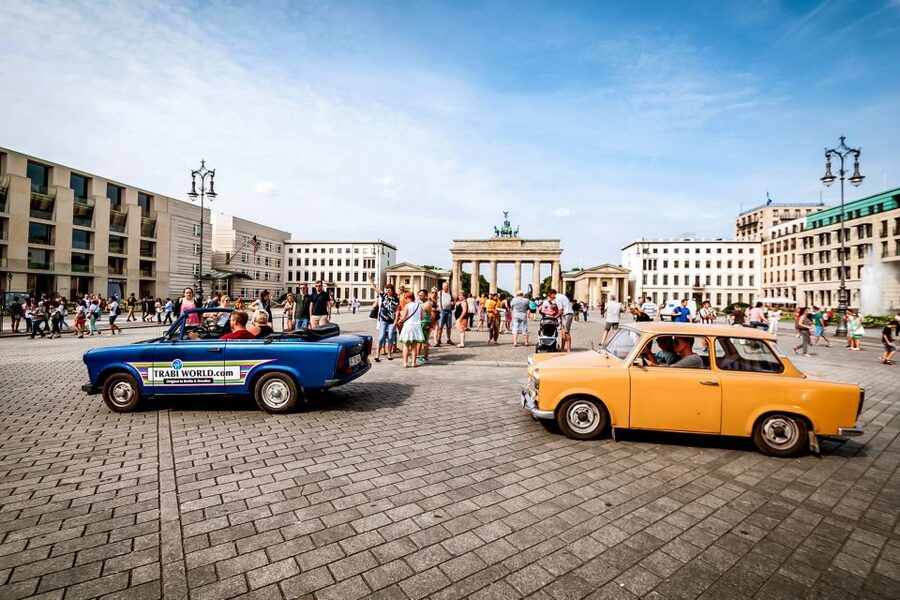
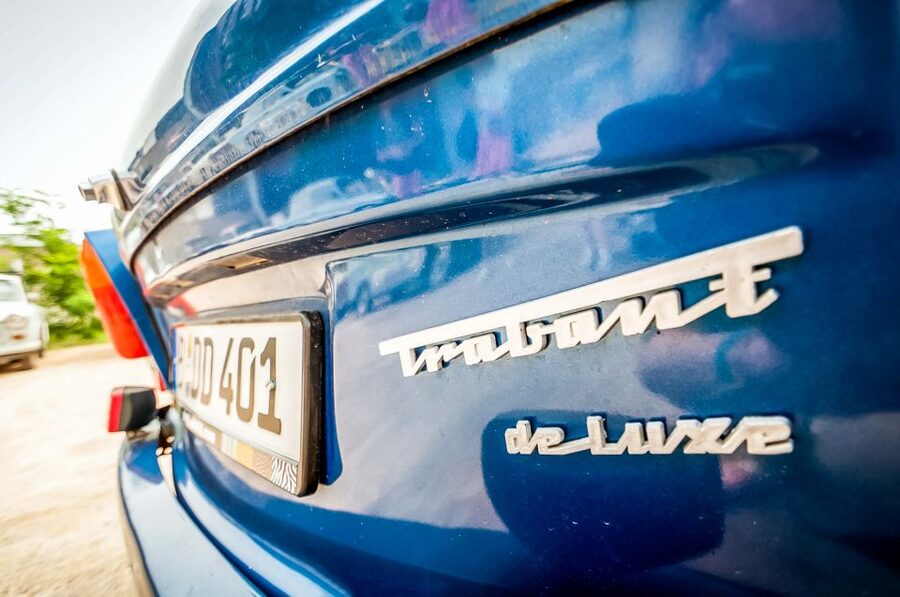
The Trabant was the everyday car of the former German Democratic Republic, or GDR. It was not designed to impress. Its body used duroplast, a hard plastic material, and its small two-stroke engine produced a modest 25 horsepower. The car’s reputation for awkward engineering is now part of its charm.
That makes this more than a standard sightseeing circuit. You are not sitting high in a coach while someone else handles the traffic. You are concentrating on the clutch, steering, gear changes, and the next turn while Berlin moves past your windscreen.
The first few minutes can feel strange. The gear lever is mounted behind the steering wheel, and anyone used to a modern car will need to rethink familiar movements. Drivers who have not driven a manual car for years may need extra patience. Left-hand-drive driving also takes some getting used to if you normally drive on the other side of the road.
That initial uncertainty is central to the experience. The tour is not about speed. It is about learning to nurse an old car through a modern capital, then laughing when you finally manage a smooth gear change.
A few more Berlin trips to weigh up
- Düsseldorf: Altbier-Safari Beer Walking Tour
★ 4.4 · 1,150 reviews - Dresden: 2 hour 15-Minute Trabi Safari
★ 4.9 · 197 reviews - Hamburg: Safari tour in St. Pauli
★ 4.9 · 11 reviews
Starting at TrabiWorld on Zimmerstraße
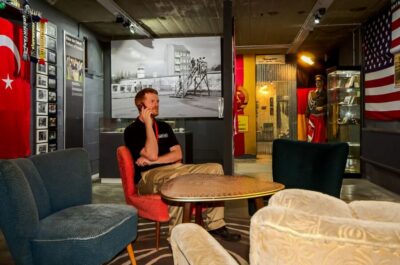
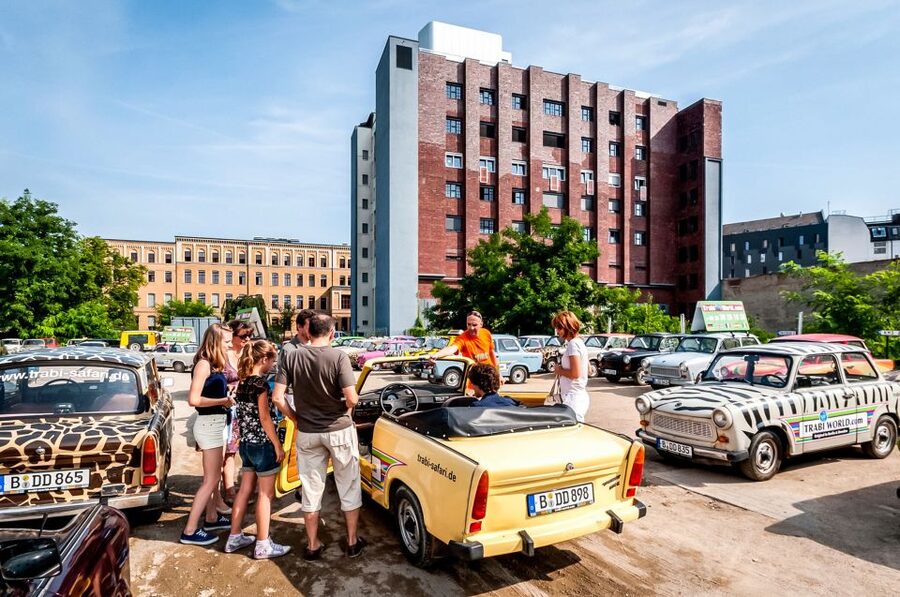
The meeting point is TrabiWorld, Zimmerstraße 97 to 100, at the corner of Wilhelmstraße. This location is close to several important Cold War sites, including Checkpoint Charlie, so the setting fits the subject before the engine even starts.
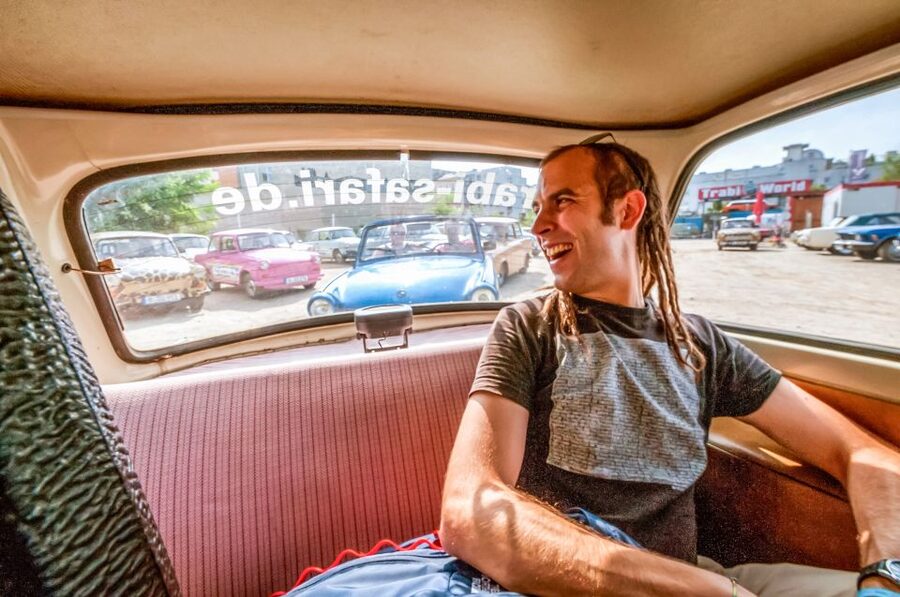
Your guide gives a technical introduction before the convoy leaves. You learn the basics of the two-stroke engine, the manual gearbox, and the controls. The staff also explain what to do if you need assistance, lose contact with the group, or get separated by traffic.
That briefing matters. A Trabant is not a difficult car in the sense of requiring advanced driving skills, but it is unfamiliar. You need to know how the shifter works and how the convoy operates before entering city traffic. The guides have been praised for being patient and clear, especially with drivers who have never used a column shift or driven a left-hand-drive car.
English and German are available. Live radio commentary is provided inside each car, so you can hear the guide while driving. This is useful because the Trabant itself is noisy, and normal conversation between the cars would not work well.
Getting comfortable with the column shift
The first part of the route is your adjustment period. You will be watching the road, listening to the radio, and trying to remember which movement selects each gear. The car is slow enough that you have time to settle in, but Berlin traffic still demands attention.
The controls are not polished. That is the point, but it can also be tiring. One driver described the clutch, brakes, exhaust, and cobbled streets in comically grim terms. You should treat such comments as a warning not to expect a smooth luxury ride.
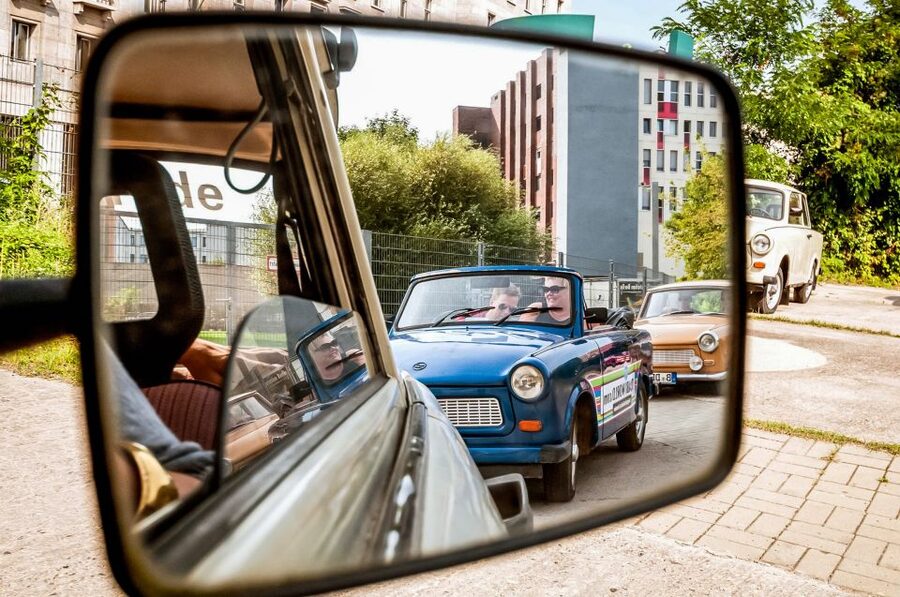
Most people get used to the car quickly. The tour guides lead at a manageable pace and keep the convoy together. If a red light breaks the line, the cars wait around the next corner. You are not expected to navigate Berlin alone.
If two people in your car want to drive, a stop halfway through the 75-minute route can allow you to change places. Confirm the arrangement when you arrive, since the precise stop and timing can depend on the tour.
Potsdamer Platz and the city’s divided center
Potsdamer Platz gives you an early look at how sharply Berlin has changed. It was once cut through by the Wall and became an empty border zone during the division of the city. Today, it is a modern central district with major buildings and busy roads.
Seeing it from a Trabant creates an odd contrast. You are driving a car associated with East Germany through a part of the city rebuilt after reunification. The route does not give you a long museum-style explanation at every stop, but the guide’s radio commentary helps connect the view outside with Berlin’s past.
This is also where the tour works well as a first-day activity. You pass several central districts in a short time and get a basic sense of how the city fits together. It is not a substitute for visiting the sights properly, but it can help you decide where to return later.
Same city, a completely different kind of day:
- Berlin: Reichstag, Dome and Government District Guided Tour
★ 4.7 · 18,288 reviews - Berlin: 1-Hour City Tour by Boat with Guaranteed Seating
★ 4.3 · 16,993 reviews - Berlin: Boat Tour Along the River Spree
★ 4.4 · 11,252 reviews - Discover Berlin Half-Day Walking Tour
★ 5.0 · 9,624 reviews
Brandenburg Gate and Unter den Linden
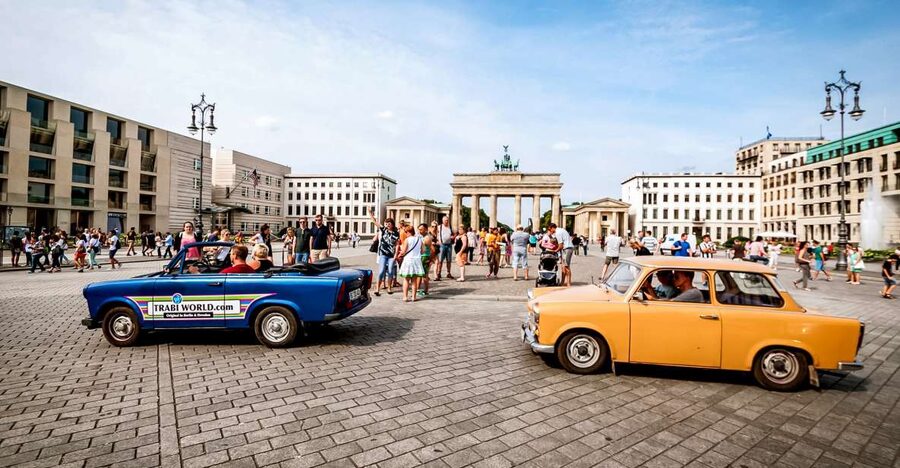
The Brandenburg Gate is one of Berlin’s defining sights, and passing it in a bright Trabant is far more theatrical than walking past in an ordinary group. The guide may pause or position the convoy for photographs, and guides have taken pictures of participants beside the cars at major landmarks.
Unter den Linden then carries you along one of the capital’s historic avenues. The route gives you a moving view rather than a close examination. You will not have time to study every building, but the commentary helps you notice the relationship between the boulevard, the gate, and the older center.
The Trabant draws attention here. People on the streets may smile, wave, or take pictures. You should be ready to become part of other people’s Berlin photographs. That is fun for most participants, but anyone seeking a quiet, anonymous sightseeing tour may find the attention a little much.
Berlin Cathedral, Red City Hall, and the TV Tower
The route continues through the central area, passing Berlin Cathedral, the Rotes Rathaus, or Red City Hall, and the TV Tower. These landmarks show different sides of Berlin: royal and religious architecture, civic government, and the unmistakable high-rise symbol of East Berlin.
From inside the Trabant, you get a broad survey rather than extended visits. The car keeps moving, and the guide’s voice supplies the context. If this is your first Berlin visit, the sequence is useful because it connects the main sights in a way that can be hard to grasp from a map.
If you have already taken a hop-on bus tour, the views may not be new. The difference is the car itself. The safari turns familiar landmarks into a playful history lesson and gives you an active role in the route.
The Wall, East Side Gallery, and Oberbaum Bridge
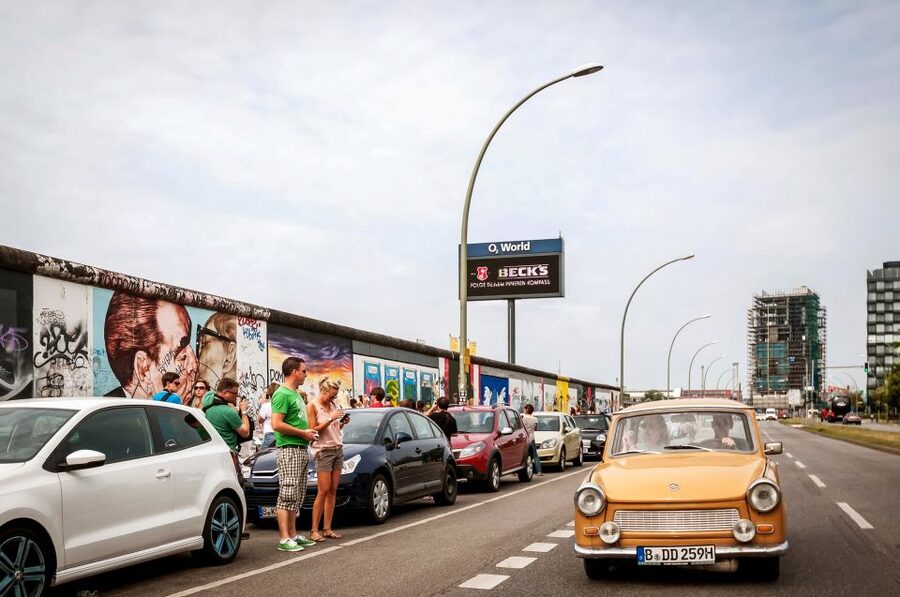
The Berlin Wall is where the experience gains its strongest sense of place. The convoy passes sections of the Wall and the artwork of the East Side Gallery, where painted murals cover a long surviving stretch.
This part of the route is especially worthwhile because the Trabant is tied so closely to East German daily life. You are not merely seeing a Wall memorial from a tour vehicle. You are sitting in an object from the society that once existed behind it.
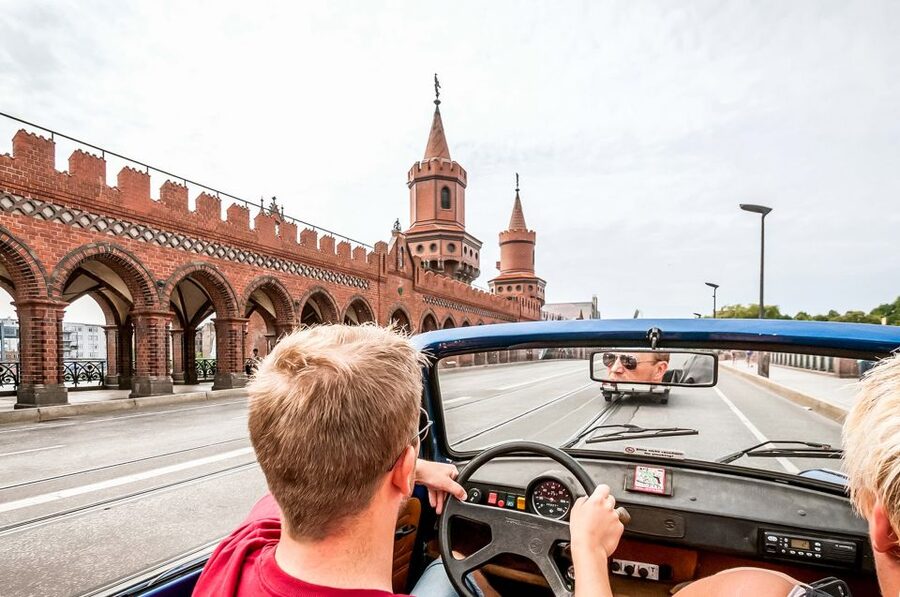
The Oberbaum Bridge links former East and West Berlin across the Spree. Its distinctive towers and brickwork make it one of the city’s memorable crossings. Driving over or near it in a line of Trabants gives the tour a strong visual finish, though traffic and red lights can affect how long you spend at each sight.
The experience is best understood as a moving introduction. You should plan separate visits to the East Side Gallery and other Wall sites if you want time for photographs, murals, and detailed interpretation.
Checkpoint Charlie and the Cold War story
Checkpoint Charlie is close to the starting area and is one of Berlin’s most famous Cold War locations. The former crossing point is now surrounded by museums, shops, and heavy tourist traffic, but it remains an important place to discuss the city’s divided past.
The Trabi adds a little historical tension here. This was once a border crossing between East and West, and the car you are driving represents the East German side of that story. The guide can explain the setting while you experience the practical limitations of the vehicle.
Do not expect the checkpoint stop to feel like a solemn memorial visit. The safari is lighthearted, and the cars attract attention. That mix of humor and history is exactly what makes the activity unusual, but it may not suit you if you want a quiet, serious study of the Cold War.
What the 75 minutes feel like
Seventy-five minutes is a good length for the car. You get enough time to see a wide slice of central Berlin without reaching the point where the cramped cabin becomes too much.
The route is not a fast zip around town. The Trabant is modestly powered, and city traffic controls the pace. You may occasionally reach fourth gear, but this is a chugging sightseeing tour, not a driving thrill ride.
The car can hold up to four people, subject to a total weight limit of 330 kilograms. That arrangement is practical for families or groups, but space is limited. Tall passengers should think carefully before booking. People around 1.8 to 1.9 meters tall have found the back seats tight, and stretching before and after the ride is sensible.
Every person needs a ticket, including drivers, co-drivers, passengers, and children. Children can receive a free ticket, but they still need to be included in the booking. Drivers must be at least 18, hold a class B license, and be fully fit to drive.
Is $93 a fair price?
At $93 per person, this is not a budget way to see Berlin. You can visit many major sights more cheaply by public transport or on foot. Even other guided city tours may give you more commentary time for less money.
The value comes from the combination of driving, history, attention from the public, and the unusual vehicle. You receive technical instruction, a guide leading the convoy, radio commentary, fuel, free mileage, and a Trabant driver’s license. Third-party vehicle damage insurance is included, but the deductible is 850 euros, so read the insurance terms carefully.
I would call the price fair for someone who specifically wants to drive a Trabant. It is harder to justify if you only want a general introduction to Berlin. The experience carries a novelty premium, but that novelty is not a minor extra. It is the entire reason the tour feels different from a bus, walking, or boat circuit.
Practical tips for a smoother safari
Book this near the beginning of your stay if you want a quick orientation to central Berlin. The route passes enough major sights to help you get your bearings, and you can return later to places that deserve more time.
Sunday may be a calmer choice, since lighter traffic can make the driving easier. Still, traffic conditions vary, and the car remains part of the challenge.
Bring your valid driver’s license. Wear comfortable clothes, and avoid assuming the rear seat will suit tall adults. If you have not driven a manual car for decades, tell the staff during the briefing and listen closely to the instructions.
A manual Trabant is the standard expectation, but some departures have included automatic or electric cars for people who cannot drive stick. This should not be assumed for every booking, so ask TrabiWorld in advance if it is essential.
Afterward, consider visiting the Trabi Museum at TrabiWorld. It adds useful context to the car you have just driven and helps explain why this small, imperfect machine became such a strong symbol of the GDR.
Who will enjoy it most?
I would choose this for drivers, car fans, families with older children, and anyone who likes history served with humor. It is also a good option if you want to see Berlin without spending the whole day walking, though the cramped cabin and driving demands still require physical comfort and concentration.
It works particularly well for couples or friends who can share the driving. You can take turns, laugh at the controls, and compare how each person handles the car.
I would hesitate if you dislike manual driving, feel anxious in city traffic, need a roomy vehicle, or want detailed time at each landmark. The guide helps, but you are still responsible for driving a decades-old car through Berlin.
Should you book the Trabi Safari?
Book it if you want an experience rather than simply a sightseeing route. The guide-led convoy, live radio, Wall landmarks, and Trabant itself combine into a memorable 75 minutes. Guides such as Thomas, Axel, Simon, and Harold have been praised for keeping the mood funny while taking safety and convoy control seriously.
Skip it if $93 feels too steep for a short tour or if you would rather spend your time inside museums and memorials. For the right person, though, this is one of Berlin’s most amusing ways to connect the city’s present streets with its former East German life.
FAQ
Where does the Trabi Safari start?
The meeting point is TrabiWorld, Zimmerstraße 97 to 100, at the corner of Wilhelmstraße in Berlin.
How long does the tour last?
The Trabi Safari lasts 75 minutes.
How much does the tour cost?
The listed price is $93 per person.
Do I drive my own Trabant?
Yes. Each booking receives its own personal Trabant, and it is not shared with people from other bookings. Several cars travel together in the same convoy.
How many people can fit in one Trabant?
A Trabant can carry up to four people, with a total maximum weight of 330 kilograms or 727 pounds.
What driving license do I need?
Drivers must be at least 18 years old and hold a class B driving license. You must also be fully fit to drive.
Do passengers and children need tickets?
Yes. Every participant needs a ticket, including the driver, co-driver, passengers, and children. Children can receive a free ticket.
Is the car manual?
The experience includes an introduction to the Trabant’s manual gearbox and column-mounted gear change. Automatic or electric cars have been available on some departures, but you should confirm availability if you cannot drive a manual car.
What sights does the route pass?
The route can pass Potsdamer Platz, Brandenburg Gate, Unter den Linden, Berlin Cathedral, the Red City Hall, the TV Tower, East Side Gallery, Oberbaum Bridge, and Checkpoint Charlie.
What is included in the booking?
Technical instruction, a guide at the front of the convoy, live radio commentary in each car, fuel and free mileage, a Trabant driver’s license, and third-party vehicle damage insurance are included. The insurance has an 850 euro deductible.
Just added around Berlin
- Love and War in Berlin: Self-Guided Story Puzzle Walk★ 5.0 · 7 reviews
- Rickshaw Tours Berlin – Groups of up to 16 people with several rickshaws★ 4.0 · 97 reviews
- Walking on the Wall: 3-Hour Tour in Berlin★ 4.5 · 34 reviews
- eSIM for Germany and 34 European Countries★ 4.5 · 16 reviews
- Warnemuende Shore Excursion: Berlin Private Sightseeing Tour from Rostock★ 5.0 · 4 reviews
- Your ticket to The Wall Museum Berlin★ 3.0 · 60 reviews
- Warnemuende Shore Excursion: Private Berlin Tour★ 4.5 · 27 reviews
- Berlin’s Gay, Lesbian, and Queer Scene Small-Group Walking Tour★ 4.5 · 66 reviews
Berlin Tours, compared.
Reichstag, Dome and Government District Guided Tour
Read our review →
1-Hour City Tour by Boat with Guaranteed Seating
Read our review →


Reichstag, Plenary Chamber, Cupola & Government Tour
Read our review →