
Reviewed · WALKING TOURS
Augsburg: Illuminated Guided Evening Walking Tour
Augsburg changes character after sunset. On this 1.5-hour evening walk, the town hall, churches, fountains, and grand buildings along Maximilianstraße take on a softer, more theatrical look. You get the city’s key sights without spending a full day on your feet.
I like the route for two clear reasons: the three fountains and major churches give the walk plenty of visual variety, and the guide adds useful stories about Augsburg’s Renaissance, Baroque, and Rococo buildings. The main drawback is that the tour is conducted in German, so it is best for you if you can follow spoken German with reasonable ease.
In This Review
- Key points to know before you book
- Why Augsburg is especially appealing at night
- Starting at the illuminated town hall
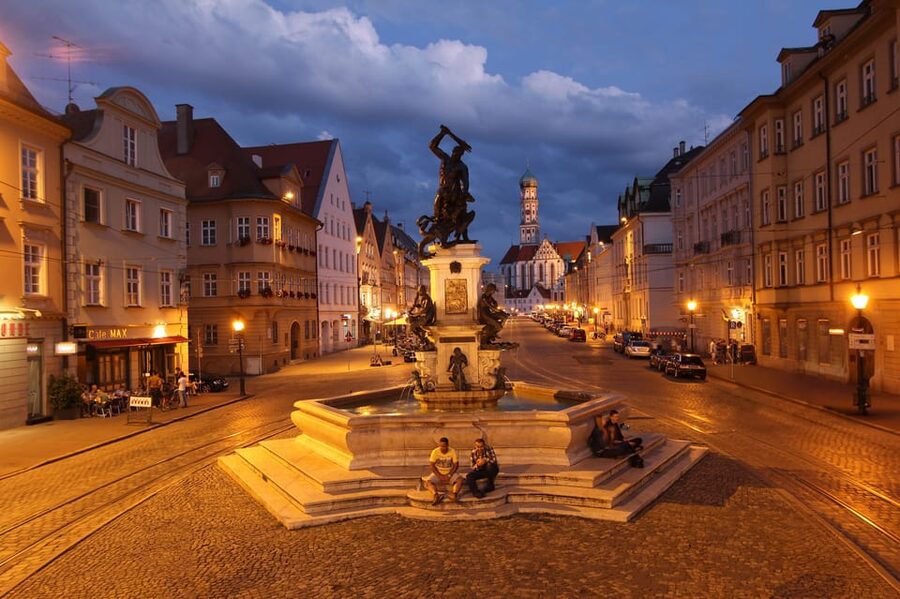
- Three fountains that give the walk its rhythm
- The cathedral and St. Ulrich and Afra Basilica
- Walking the Imperial Mile on Maximilianstraße
- Renaissance, Baroque, and Rococo in one compact walk
- What the guide adds to the evening
- Group size, walking pace, and comfort
- Is the price good value?
- Who should book this Augsburg evening walk?
- My booking advice
- FAQ
- Where does the Augsburg evening walking tour meet?
- How long does the tour last?
- What price should I expect to pay?
- What language is the tour conducted in?
- Is the walking tour wheelchair accessible?
- What should I bring?
- Which sights are included?
- Can I cancel for a full refund?
- Do I have to pay when I reserve?
Key points to know before you book
- Augsburg after dark: See the town hall, cathedral, basilica, fountains, and historic streets under evening lights.
- Maximilianstraße focus: Walk along the Imperial Mile, lined with colored houses, Fugger residences, and former palaces.
- Strong historical range: The route brings together Renaissance, Baroque, and Rococo architecture in a compact city-center walk.
- German-speaking guide: The tour is live and guided, but no other language is listed.
- Accessible format: The walk is wheelchair accessible, and the route has been adjusted for a participant with limited mobility.
- Simple meeting point: Meet at the main entrance of Augsburg’s town hall.
Why Augsburg is especially appealing at night
Augsburg can be easy to overlook beside Bavaria’s better-known cities. That is part of its appeal. The center has major civic buildings, churches, fountains, and grand residences close together, so a short evening walk gives you a useful introduction without a long transfer or a complicated schedule.
Light does practical work here. It draws your eye to carved façades, rooflines, statues, and the warm colors of the buildings. You are not simply ticking off monuments in daylight. You are seeing how the city presents its public face after the shops close and the streets become calmer.
I especially like evening tours in places with a strong architectural center. You can spend the day in museums or nearby sights, then use this walk to get your bearings. It also gives you something worthwhile to do after dinner, though the tour itself should not be treated as a meal outing or a nightlife experience. The information provided focuses on buildings, fountains, churches, and city history.
A few more Germany trips to weigh up
- Discover Berlin Half-Day Walking Tour
★ 5.0 · 9,624 reviews - Berlin: Third Reich and Cold War 2 Hour Walking Tour
★ 4.9 · 6,830 reviews - Munich: Third Reich & WWII Walking Tour
★ 4.6 · 6,181 reviews
Starting at the illuminated town hall
The meeting point is the main door of the town hall, an easy place to identify in the center. That makes the opening straightforward: you do not need to hunt for a small office, a hotel lobby, or an out-of-the-way street.
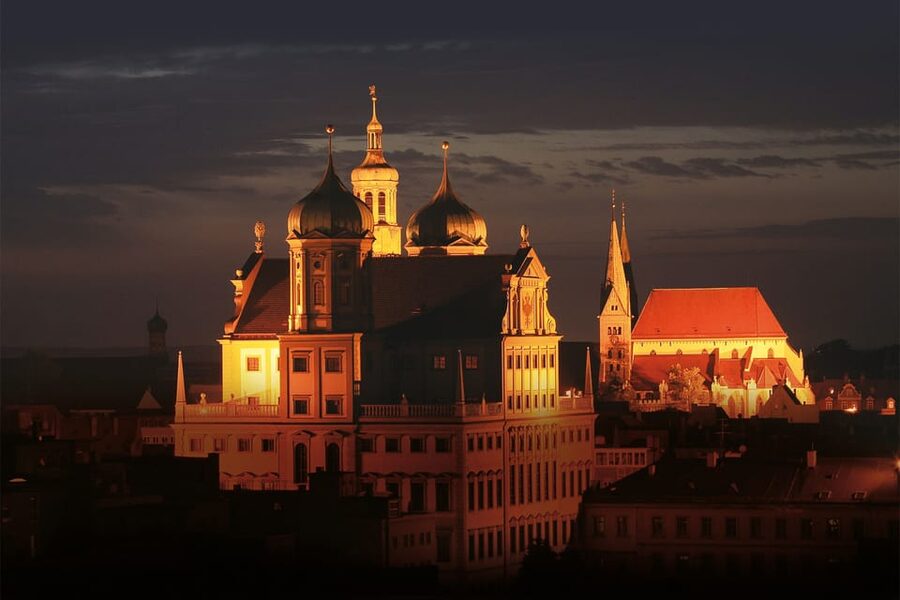
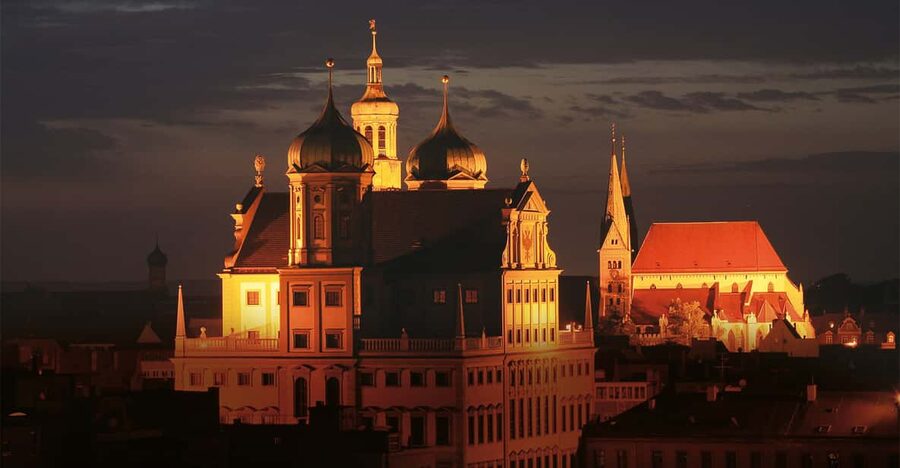
The town hall is also a fitting first sight. Augsburg’s civic identity comes into view immediately, and the illuminated building provides a strong visual start to the route. Your guide begins the walk here and then leads you toward the city’s other major landmarks.
This first stop is more than a place to gather. It helps set up the contrast that runs through the tour: Augsburg as a city of public power, religious institutions, wealthy families, and ambitious architecture. You will see that contrast again along Maximilianstraße, where churches and grand residences share the same central corridor.
If you arrive early, use the time to make sure you are at the main entrance rather than simply somewhere in the town hall square. The meeting instructions are specific, and the evening setting makes a precise meeting point useful.
Three fountains that give the walk its rhythm
The tour includes three magnificent fountains, one of its most appealing features. Fountains add a welcome change from looking at façades. They bring sculpture, movement, and open space into a walking route otherwise filled with streets and buildings.
The fountains also help show Augsburg’s civic pride. Large public fountains were not casual decoration. They announced wealth and ambition, and their placement in the city center made them part of daily public life. At night, their lighting can make details easier to notice from a short distance, although the exact effect will depend on the evening conditions.
Expect these stops to work as short pauses rather than long visits. The supplied details do not promise entry into the fountains or a separate interior presentation. Their value is in the guide’s explanation and in the way they connect Augsburg’s public spaces with its architectural story.
For you, this means the tour should feel varied. You move from the town hall to open civic monuments, then toward churches and grand houses. That is a better balance than a walk made up only of street façades.
The cathedral and St. Ulrich and Afra Basilica
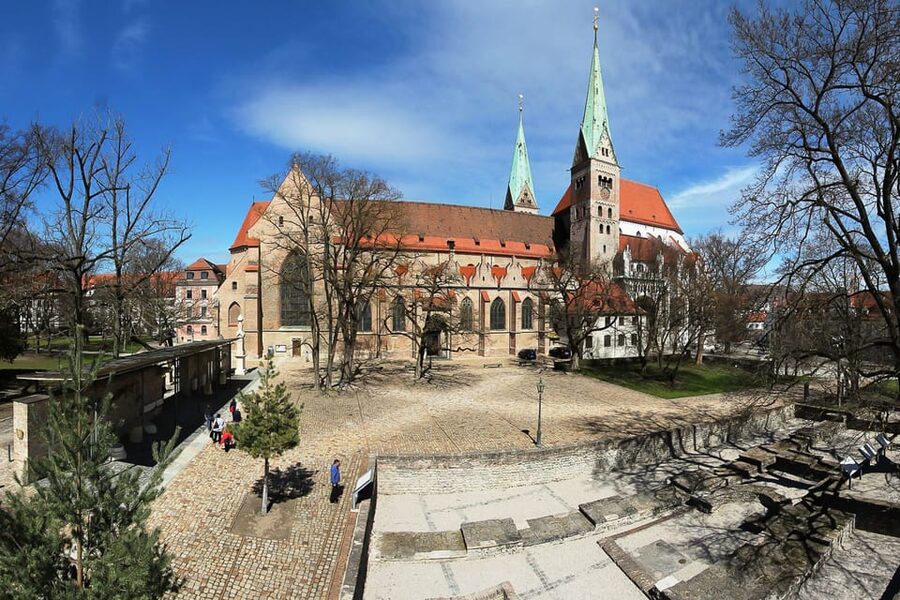
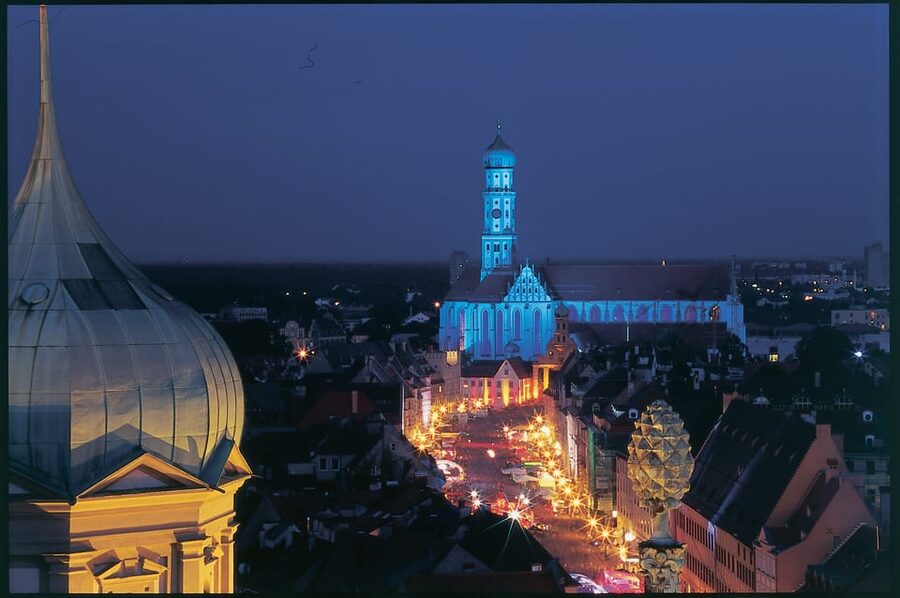
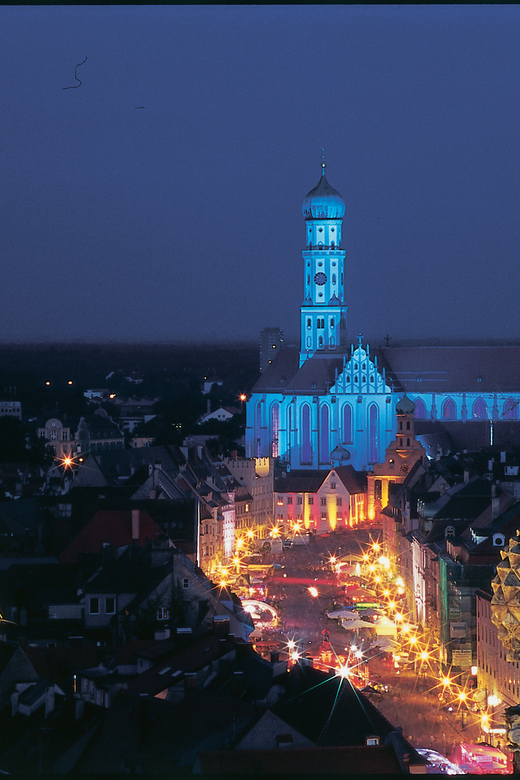
Two of the tour’s key religious landmarks are Augsburg Cathedral and the Basilica of St. Ulrich and Afra. Both are presented from the evening streets, with the lighting drawing attention to their exterior forms.
These churches add a different scale to the walk. The town hall and fountains speak to civic life. The cathedral and basilica bring in Augsburg’s religious importance and give the route a more solemn side. Their presence also helps you understand why the city center contains such a broad mix of architectural work.
Do not book this activity expecting a long interior tour. The description centers on seeing the buildings illuminated and hearing stories from the guide. If your main goal is to study church interiors, you will need separate time during daylight hours, assuming the buildings are open.
Still, the evening view has its own value. Church façades can look less like static monuments and more like part of a living city when you see them lit against the darker streets. The guide’s comments are meant to add context as you walk, rather than turn the outing into a formal lecture.
Same city, a completely different kind of day:
- Berlin: Reichstag, Dome and Government District Guided Tour
★ 4.7 · 18,288 reviews - Berlin: 1-Hour City Tour by Boat with Guaranteed Seating
★ 4.3 · 16,993 reviews - Hamburg: Sex and Crime in St. Pauli Tour for Ages 18+
★ 4.7 · 15,447 reviews - Hamburg: 1.5-Hour Harbor and Speicherstadt Day Cruise
★ 4.6 · 14,200 reviews
Walking the Imperial Mile on Maximilianstraße
The route’s most memorable stretch is likely Maximilianstraße, described as Augsburg’s most beautiful promenade and known here as the Imperial Mile. This is where the tour shifts from individual monuments to a long urban sequence.
You will see colored houses, Fugger houses, and palaces connected with Renaissance, Baroque, and Rococo design. That range matters. Instead of viewing Augsburg as a city with one fixed architectural style, you can watch its appearance change across different periods and building traditions.
The Fugger houses are a particularly useful part of the story. The name points to the influence of the Fugger family, whose wealth shaped Augsburg’s buildings and public life. The tour does not promise access to private rooms or a full visit inside these residences, so you should think of them as important street-level sights supported by the guide’s explanations.
Maximilianstraße is also where the colored façades should make the evening lighting especially effective. You might find that some details disappear in the dark, but the broader impression of the street can become stronger. Towers, rooflines, fountains, and façades read clearly when the guide keeps you moving and places the architecture in context.
This section should suit you if you enjoy city design as much as individual monuments. It is less about one spectacular object and more about how Augsburg’s main promenade brings several eras into one view.
Renaissance, Baroque, and Rococo in one compact walk
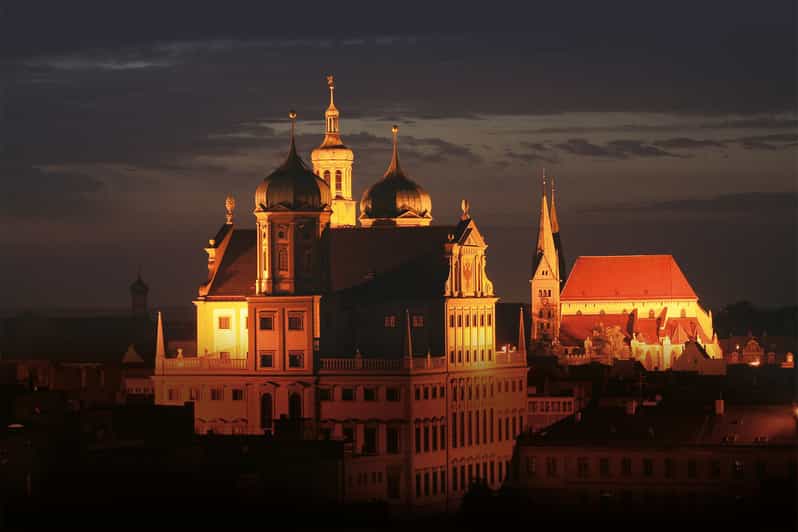
A useful feature of this experience is the way it introduces several architectural styles without requiring a long museum visit. Renaissance buildings often suggest order, proportion, and the confidence of a wealthy city. Baroque design tends to bring more movement and display, while Rococo can add lighter decoration and finer detail.
You do not need to be an architecture specialist to benefit. A good guide can point out differences that are easy to miss when you walk alone. The comments help you look at windows, façades, decorative elements, and the relationship between a palace and the street around it.
The walk is also a practical first lesson in Augsburg’s development. Instead of receiving a list of dates, you see how later styles sit beside earlier ones. That makes the city easier to explore on your own the next day.
The level of detail will depend on the guide and on how well you understand German. The tour has received a 4.6 rating from 67 bookings, with particularly strong praise for the guides’ city and historical knowledge. That suggests the commentary is a central reason to book, not an extra added to a scenic stroll.
What the guide adds to the evening
The guide is live and German-speaking. The strongest aspect of the experience is the chance to hear local stories while standing in front of the buildings, rather than trying to connect names and dates from a map.
The available feedback points to guides who know Augsburg well and can provide access to areas that are not usually open. That detail is worth treating carefully: such access may depend on the guide, the date, and local conditions. It is a pleasant possibility, not a feature you should assume is guaranteed every time.
The guide’s flexibility also matters. On one walk, a participant who was not able to walk easily received a route adjusted to suit the group’s needs. The tour is listed as wheelchair accessible, and this example suggests that practical route decisions are taken seriously.
Another evening took place during a street festival, when the center was unusually busy. The guide still managed to provide useful information and good views. You should not assume every evening will be quiet, but the tour appears able to adapt when city events affect the route.
On another occasion, the group was divided into two smaller groups so everyone could hear more easily. Again, this may not happen on every departure, but it shows an awareness of group size and sound. Smaller groups are especially helpful on an evening walk, when street noise can make a soft-spoken guide hard to follow.
Group size, walking pace, and comfort
The tour lasts 90 minutes, which is long enough to cover the principal center without becoming an exhausting half-day commitment. You should still wear comfortable shoes, as requested. The supplied information does not give a precise walking distance or a full list of stops, so you should plan for continuous city walking with pauses for explanations.
The route is wheelchair accessible, but accessible does not mean every moment will feel effortless for every participant. Historic city centers can include uneven paving, crowded sections, or changes in route caused by public events. The guide’s reported willingness to adjust the walk is encouraging, but if you have specific mobility needs, make them clear when booking or at the start.
A 90-minute format works well for mixed groups. People who want a quick introduction get the main sights, while those staying longer in Augsburg can use the tour as a framework for later exploration. If you prefer to stop for photographs every few minutes, the pace may feel brisk. If you like a clear route with steady commentary, it should suit you better.
Because the tour is in German, language is the most important comfort question. You can enjoy the lights and buildings without understanding every sentence, but the historical value depends on following the guide. German speakers will get the full benefit.
Is the price good value?
The stated price is $20 per person. The local breakdown is €14 for the tour plus a €3 administration fee, which is the clearest way to understand what you are paying for. Currency conversion can change the dollar amount, so check the final price at booking.
For that cost, you receive a 90-minute guided walk, a live guide, and the city-center route. I consider that fair value if you want context for Augsburg’s main sights and prefer not to organize the evening yourself. The price is less compelling if you only want to see the illuminated buildings, since you can view public streets and exterior landmarks without joining a tour.
The guide is the main value. You are paying for the connections between the town hall, fountains, churches, Fugger houses, and the styles along Maximilianstraße. You are also paying for a planned route that makes good use of a short evening window.
Reserve now and pay later is available, which helps if your schedule is still changing. You can cancel up to 24 hours in advance for a full refund. Those terms reduce the risk of booking before you know exactly how your Augsburg evening will unfold.
Who should book this Augsburg evening walk?
I would recommend it to you if you are spending at least one night in Augsburg, speak German, and want a quick introduction to the historic center. It is particularly useful early in a stay, since the route helps you decide which buildings and streets deserve a closer look in daylight.
It also suits people who like architecture but do not want a specialist lecture. The mix of fountains, churches, civic buildings, and palaces keeps the subject moving. Families and mixed-age groups may appreciate the 90-minute length, though the information provided does not specify a child-focused format.
The activity is a good match for anyone who has already spent the day sightseeing and wants an easy evening plan. It is less suitable if you want a long interior visit, a food tour, extensive photography time, or commentary in English.
Keep your expectations grounded. The experience is a guided city walk, not a theatrical performance or a private tour with guaranteed special access. Its appeal comes from the city center itself, the evening light, and a guide who can explain what you are seeing.
My booking advice
Book this tour if the German-language format works for you and you want to understand Augsburg’s main streets rather than simply pass through them. The strongest reasons are the illuminated town hall, the three fountains, the Cathedral and St. Ulrich and Afra Basilica, plus the architectural sweep of Maximilianstraße.
Skip it if you need English commentary or if your priority is entering monuments. In that case, use the $20 as a guide for what a structured walk is worth, then explore the center independently and arrange daytime visits separately.
For most German-speaking visitors with an evening free, I think the short format and central meeting point make this an easy choice. Wear good shoes, arrive at the town hall’s main door, and let the city’s fountains, churches, and colored façades do much of the visual work.
FAQ
Where does the Augsburg evening walking tour meet?
Meet at the main door of Augsburg’s town hall.
How long does the tour last?
The walking tour lasts 1.5 hours.
What price should I expect to pay?
The listed price is $20 per person. The stated local price is €14 per person plus a €3 administration fee.
What language is the tour conducted in?
The live tour guide speaks German. No other tour language is listed.
Is the walking tour wheelchair accessible?
Yes. The activity is listed as wheelchair accessible.
What should I bring?
Bring comfortable shoes for the walking route.
Which sights are included?
The route includes the illuminated town hall, Augsburg Cathedral, the Basilica of St. Ulrich and Afra, three magnificent fountains, the Fugger houses, and palaces along Maximilianstraße.
Can I cancel for a full refund?
Yes. You can cancel up to 24 hours in advance for a full refund.
Do I have to pay when I reserve?
No. Reserve now and pay later is available, so you can hold your place without paying immediately.
Just added around Germany
- Aachen old town tour – GERMAN (public)★ 5.0 · 24 reviews
- Aachen Private Walking Tour With A Professional Guide★ 5.0 · 11 reviews
- Cologne Highlights: Exclusive Private Tour★ 5.0 · 5 reviews
- Bremen Private Walking Tour With A Professional Guide★ 5.0 · 7 reviews
- Private Walking Tour through the Fascinating Bremen’s City Center★ 5.0 · 5 reviews
- Explore Cologne’s best Street Art Quarter★ 4.5 · 4 reviews
- Bremen Exploration Private Game and City Tour on your Phone★ 4.5 · 7 reviews
- e-Scavenger hunt Bremen: Explore the city at your own pace★ 4.0 · 24 reviews
Walking Tours, compared.

Berlin’s Best: 2 Hour Walking Tour Third Reich and the Cold War
Read our review →
Third Reich Berlin: Hitler and WWII Walking Tour
Read our review →Browse the lists this tour appears in