Reviewed · PRIVATE
Albert Einstein in Berlin Private Guided Tour
Albert Einstein’s Berlin story is more than a science lesson. It is a tale of bold ideas, Jewish identity, public fame, and a narrow escape from Nazi Germany. This private tour links those threads as you walk from Brandenburg Gate through Unter den Linden, Bebelplatz, Humboldt University, and the New Synagogue.
I like the way the tour connects Einstein’s work to real places, especially the university where he presented his field equations of general relativity. I also like the choice of three lengths, from a quick central walk to a full Berlin and Potsdam day. The main drawback is that the two-hour option does not include entry to the New Synagogue, and the seven-hour plan involves a train ride and an uphill walk.
In This Review
- Key points at a glance
- Why Einstein’s Berlin story matters
- Starting at Brandenburg Gate and walking Unter den Linden
- Bebelplatz and the warning signs of 1933
- Humboldt University and Einstein’s famous equations
- The New Synagogue and Einstein’s Jewish identity
- Extending the day to Potsdam and Einstein Tower
- Comparing the two, three, and seven-hour choices
- Is $181 per person good value?
- Who will get the most from this tour?
- Practical details that shape the day
- Should you book the Albert Einstein Berlin tour?
- FAQ
- Where does the tour meet?
- How long does the tour last?
- Which languages are available?
- Is the tour private?
- Is the tour wheelchair accessible?
- Is entry to the New Synagogue included?
- Is the New Synagogue open every day?
- Does the seven-hour option include train tickets to Potsdam?
- Are Einstein Tower and Potsdam bus tickets included?
Key points at a glance

- Einstein’s 1915 breakthrough: See Humboldt University, where he presented the field equations of general relativity.
- A personal Berlin story: Learn where Einstein lived from 1914 to 1932 and why he left as anti-Semitism grew.
- The New Synagogue: The three and seven-hour options include the synagogue and its museum, though the dome is closed.
- Potsdam by train: The longest tour includes train tickets and entry to the Albert Einstein Science Park.
- A striking modernist building: See Einstein Tower, designed by Erich Mendelsohn to test ideas linked to relativity.
- Private, multilingual guiding: Choose from English, German, French, Spanish, Italian, Russian, or Polish.
Why Einstein’s Berlin story matters
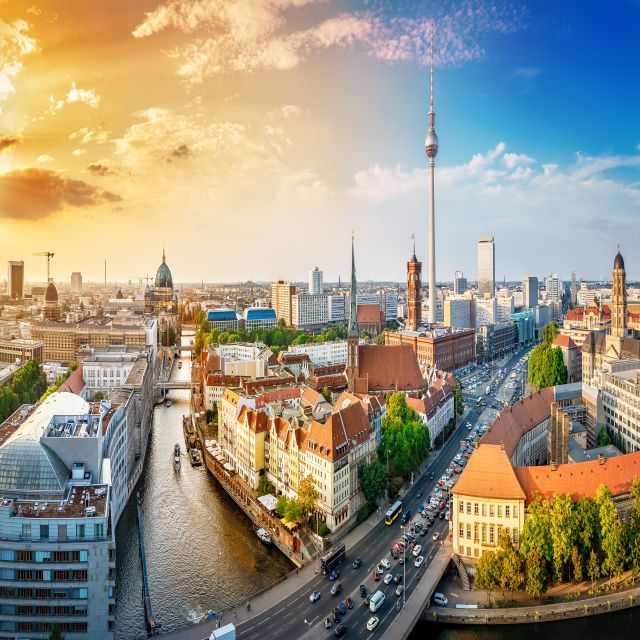
Einstein arrived in Berlin in 1914, at a time when the city was a major center for science, culture, and politics. He remained until 1932, and those years included his greatest scientific triumphs as well as growing pressure on Jewish Germans.
You will hear about his work, his public life, and his connection to music. At the New Synagogue, you learn that Einstein played violin in the Jewish orchestra and served as its first violin. That detail helps bring him down from the pedestal of genius. He was not only a physicist in a lecture hall. He was also a musician and a visible member of Berlin’s Jewish community.
The tour also places Einstein’s departure in a stark political setting. He left Berlin permanently only a few months before the Nazi book burning at Bebelplatz on May 10, 1933. That timing gives the walk real weight. You are not simply following an old celebrity address book. You are seeing how a city changed around a man who had every reason to fear what came next.
A few more Berlin trips to weigh up
- Berlin: Private Reichstag and Glass Dome Tour
★ 4.8 · 2,226 reviews - Berlin Private Complete History All Day Walking Tour
★ 5.0 · 474 reviews - Private Walking Tour Berlin Third Reich Hitler and World War II
★ 5.0 · 360 reviews
Starting at Brandenburg Gate and walking Unter den Linden
Your guide meets you in front of Hotel Adlon Kempinski at Unter den Linden 77. Do not go inside the hotel. It is only the meeting point, and hotel staff are not assigned to the tour.
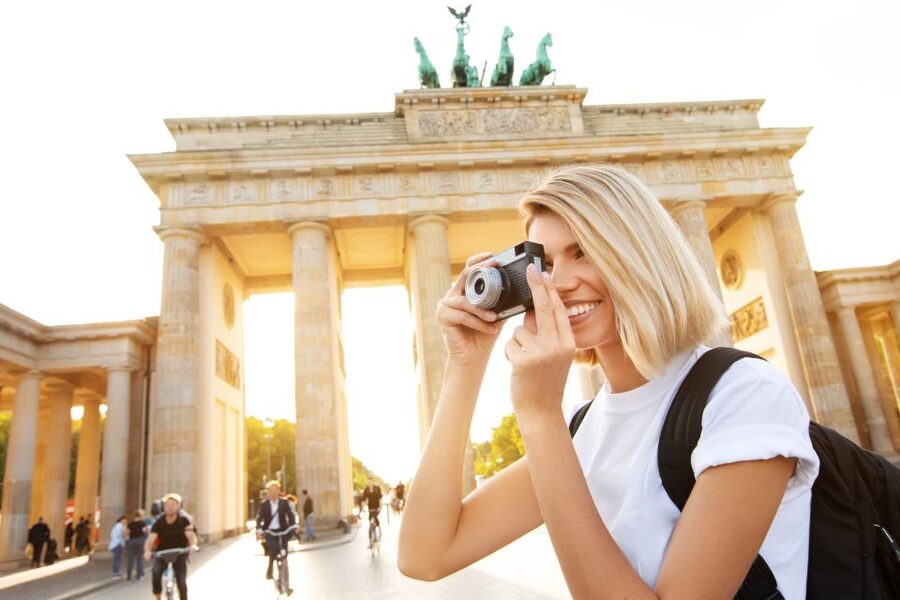
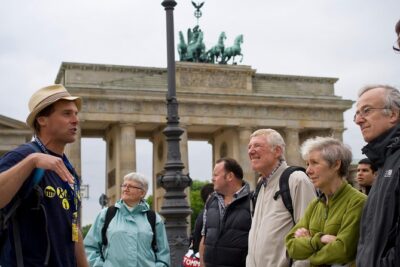
The walk begins at Brandenburg Gate, one of Berlin’s clearest symbols of peace and freedom. It is a fitting place to start a story about a scientist whose ideas crossed borders, and a Jewish citizen who was forced to leave his country.
From there, you continue along Unter den Linden toward Berlin’s historic center. This is a central route, so you get a useful introduction to the city as well as Einstein’s story. The private format matters here. You can ask your guide to pause over the parts that interest you, whether that means Einstein’s private life, his scientific work, or the political events that drove him away.
You will pass one branch of the Einstein coffee shop chain. It is not a major Einstein memorial, so keep your expectations in check. It is best understood as a small modern reference to his name rather than a direct link to his life.
Bebelplatz and the warning signs of 1933

The tour stops at Bebelplatz, the site of the May 10, 1933 Nazi book burning. A memorial here recalls the public destruction of books by Jewish and politically unwelcome writers.
This stop gives the Einstein story a difficult but necessary setting. Einstein had already left Berlin forever by this point, but only shortly before the event. The walk explains how anti-Semitism in Germany became a direct threat to Jewish citizens, including one of the country’s most famous scientists.
I find this part especially useful because it avoids treating Einstein as an isolated genius. His scientific fame did not protect him from the politics of the period. The public memorial also gives you a place to stop, look, and connect his personal decision to leave with the larger collapse of civil life.
The route is not presented as a museum tour with a long series of objects. Much of its value comes from the guide’s explanation of what happened at each location. That makes the quality of the guide important. Sylvia, one of the guides associated with this experience, has been praised for bringing history to life and for sharing her own connection to history. Your assigned guide may be different, but the private format gives you a good chance to get a personal, conversational explanation.
Humboldt University and Einstein’s famous equations
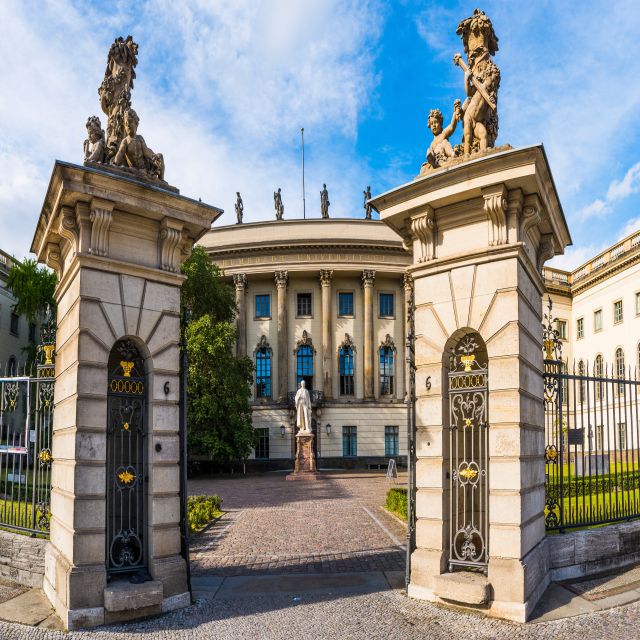
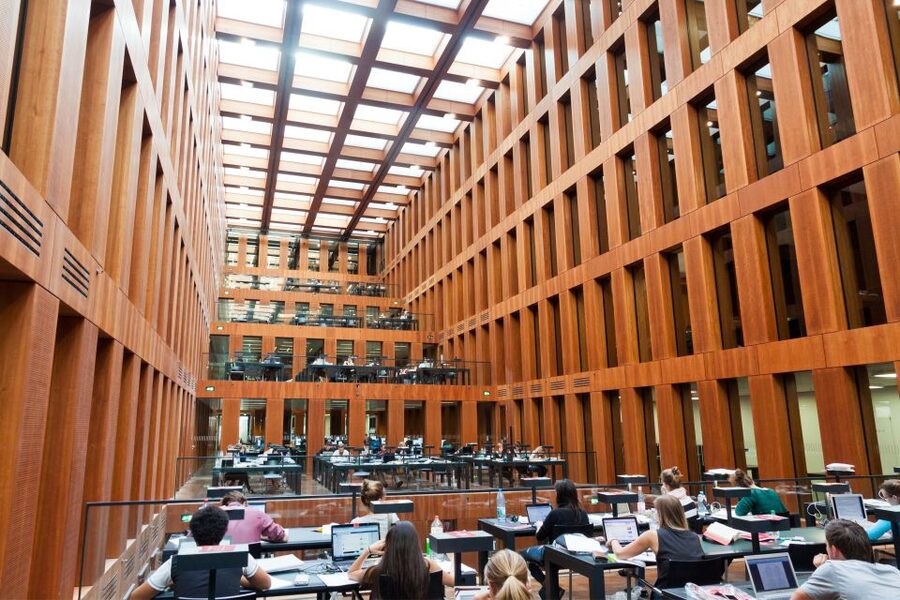
One of the strongest stops is Humboldt University, formerly known as the Royal Prussian Academy of Sciences. On November 25, 1915, Einstein presented his field equations of general relativity here.
You do not need a physics degree to appreciate the location. The guide explains the importance of the work in plain terms and places it in the setting where Einstein shared it. This is the point where the tour moves from general biography to a precise moment in scientific history.
The stop works well for both science fans and first-time visitors who know Einstein mainly from the famous photograph and the equation associated with him. You can expect interesting facts and myths about his life and work, with the guide helping separate popular stories from better-supported history.
The university is also a reminder that Einstein’s Berlin was an academic city. His achievements were tied to institutions, lectures, colleagues, and public debate. Seeing the building helps you understand that his work was not created in an abstract vacuum.
Same city, a completely different kind of day:
- Berlin: Reichstag, Dome and Government District Guided Tour
★ 4.7 · 18,288 reviews - Berlin: 1-Hour City Tour by Boat with Guaranteed Seating
★ 4.3 · 16,993 reviews - Berlin: Boat Tour Along the River Spree
★ 4.4 · 11,252 reviews - Discover Berlin Half-Day Walking Tour
★ 5.0 · 9,624 reviews
The New Synagogue and Einstein’s Jewish identity
The two-hour tour lets you see the New Synagogue from outside, while the three and seven-hour options include a guided visit inside the New Synagogue, also known as Centrum Judaicum. Admission includes the museum.
The synagogue was built in the mid-19th century as the main place of worship for Berlin’s Jewish community. It was badly damaged during Kristallnacht and later reconstructed. The building’s survival and restoration make it an important stop in its own right, even apart from Einstein.
Inside, the guide places Einstein’s Jewish identity in the setting of German Jewish life during the rise of Adolf Hitler and the Nazi Party. You learn about his connection to the synagogue’s Jewish orchestra, where he played first violin.
Be aware that the dome is closed for viewing. The synagogue is also closed on Saturdays and some public and Jewish holidays. If your visit falls on one of those days, the indoor portion may not be available. On the seven-hour option, the plan may be adjusted with extra sightseeing in Potsdam.
For many people, this is the most personal part of the tour. Humboldt University explains Einstein’s public achievement. The New Synagogue helps explain the identity that made him a target as Germany changed.
Extending the day to Potsdam and Einstein Tower
The seven-hour option adds Potsdam to the Berlin walk. You receive a round-trip train ticket from Berlin, then continue to the Albert Einstein Science Park. Trains run every 20 to 30 minutes, so the exact flow of the day is adjusted around the rail schedule.
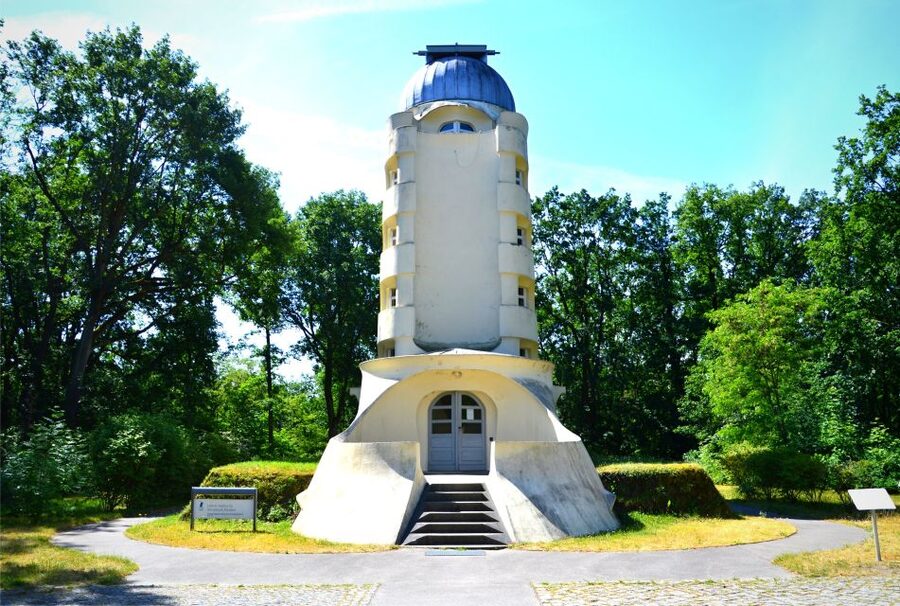
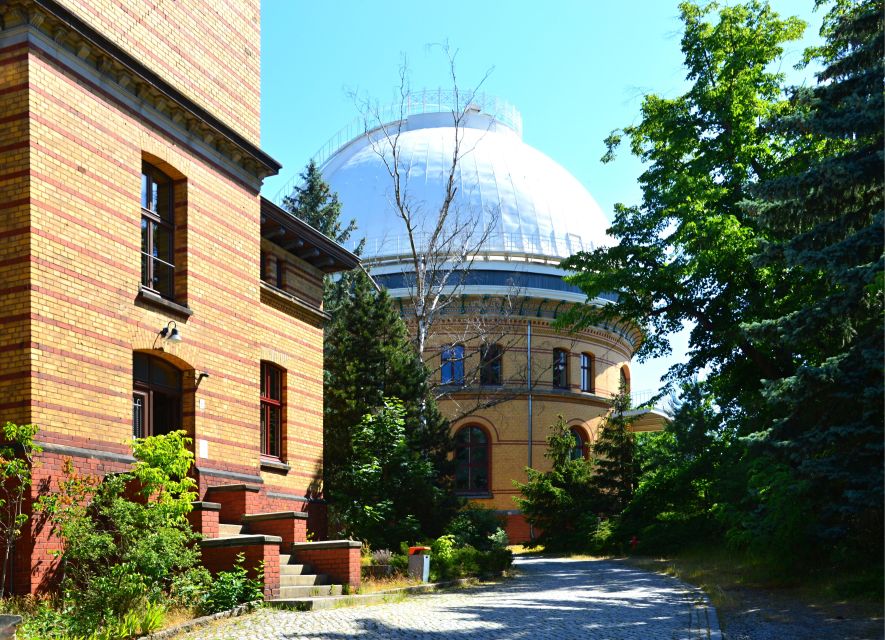
At Potsdam’s Science Park, you can learn more about Einstein’s life and work and see Einstein Tower, or Einsteinturm. The tower was designed by Erich Mendelsohn as an architectural symbol of modernism and was built to help prove Einstein’s theory of relativity. Einstein himself visited once.
The tower is an excellent reason to choose the longer tour if architecture interests you as much as science. Its design is a physical response to a new scientific age, rather than a conventional monument to a famous person.
Admission to the Albert Einstein Science Park is included with the seven-hour tour, but admission to Einstein Tower is not. That distinction matters when you compare the price and plan your day.
You will walk for about 10 minutes uphill from Potsdam Train Station to the science park. Wear comfortable shoes. A bus can cover the route, but bus tickets are extra, and the bus does not run on Saturdays, Sundays, or public holidays. This is a small but important practical detail. The seven-hour tour is not a mostly seated outing. It combines city walking, a train journey, and an uphill approach.
If time allows, the guide may also show you Einstein’s Forum and other Potsdam highlights before the return train to Berlin. The schedule depends on the train and the time available, so do not treat every extra sight as guaranteed.
Comparing the two, three, and seven-hour choices
The two-hour option is best if you want a focused introduction to Einstein and the central Berlin locations. You see Brandenburg Gate, walk along Unter den Linden, stop at Bebelplatz, visit the area around Humboldt University, and see the New Synagogue from outside.
Its key advantage is efficiency. You can fit it into a busy Berlin schedule, and the route stays in the central area. Its clear limitation is that New Synagogue admission is not included. If the synagogue matters to you, the short option may feel incomplete.
The three-hour option adds a guided visit to the New Synagogue and museum. For most people, this is the best balance. You get the scientific side at Humboldt University and the personal, religious, and political side at the synagogue without committing a full day to Potsdam.
The seven-hour option is for people who want the full Einstein trail across both cities. It includes the New Synagogue, train tickets, the Science Park, and free admission to the park. You also get the chance to see Einstein Tower and other Potsdam sights if time permits.
The seven-hour plan offers the most content, but it also demands the most energy. You need to allow for train timing, walking, and the uphill path from the station. If you dislike changing locations during a tour, choose three hours instead.
Is $181 per person good value?
At $181 per person, this is not a budget walk. The price makes more sense for visitors who value a private guide, a chosen language, and a tour shaped around their interests.
The value is strongest when two or more people share the private experience. You are paying for a guide who can explain the science at your level, connect the political story to the locations, and answer questions without a large group slowing things down.
The three-hour option may offer the best value for many visitors. It includes the New Synagogue and museum, which adds a meaningful indoor stop without the extra transport and walking of Potsdam.
The seven-hour option includes round-trip train tickets and free admission to the Albert Einstein Science Park. Those inclusions reduce some of the added cost, but remember that bus tickets in Potsdam and admission to Einstein Tower are separate.
The tour also offers free cancellation up to 24 hours before the start and a reserve-now, pay-later option. These policies help if your Berlin plans are still moving around, but they do not change the basic question: choose this for the personal guiding and focused subject, not simply for the number of sights.
Who will get the most from this tour?
I would recommend it to anyone interested in science, Jewish history, modern European history, or Berlin’s intellectual life. It also works well for parents with older children who know Einstein’s name but want to understand the person behind it.
The private setup suits visitors who prefer questions and discussion over a fixed group script. You can choose English, Russian, Italian, German, French, Spanish, or Polish.
The tour is wheelchair accessible, though the seven-hour route includes a 10-minute uphill walk to the Science Park. If mobility is a concern, ask about the Potsdam section before booking, since the optional bus is not included and does not run on weekends or public holidays.
I would skip it if you want a general Berlin highlights tour. The route is built around Einstein, his Jewish identity, and the political crisis that ended his Berlin years. That focus is the point, but it will not cover every major Berlin sight.
Practical details that shape the day
The tour lasts from two to seven hours, depending on the option you select. Starting times vary, so check availability for the date you want.
Wear comfortable shoes for every version. The central walk follows several city streets, and the Potsdam extension adds the uphill route to the Science Park.
The New Synagogue is closed on Saturdays and some public and Jewish holidays. The dome is not open for viewing, and the museum is included only with the three and seven-hour options.
The tour is offered as a private group experience with a live guide. Guide Sylvia has received particularly warm praise for her friendly style and ability to make history feel immediate. Since guide assignments can vary, treat her name as a useful indication of the style available, not a promise that she will lead your tour.
Should you book the Albert Einstein Berlin tour?
Book it if you want a focused story rather than a standard sightseeing circuit. The three-hour option is my pick for most visitors because it combines Einstein’s scientific achievement at Humboldt University with the New Synagogue’s account of his Jewish identity and Berlin’s changing politics.
Choose two hours if your schedule is tight and you mainly want the central walk. Choose seven hours if Einstein Tower and Potsdam are essential, and you are comfortable with trains, extra walking, and a full day of moving between sites.
The best reason to book is the connection between places. You see where Einstein presented his work, where his Jewish community worshiped, and where the political climate forced him to leave. That is a worthwhile Berlin story, told on foot and with enough flexibility to make the subject your own.
FAQ
Where does the tour meet?
You meet the guide in front of Hotel Adlon Kempinski Berlin at Unter den Linden 77, 10117 Berlin. Do not enter the hotel, since it is only the meeting point and hotel staff are not informed about the tour.
How long does the tour last?
You can choose a two-hour, three-hour, or seven-hour option. Starting times depend on availability.
Which languages are available?
The live guide can conduct the tour in English, Russian, Italian, German, French, Spanish, or Polish.
Is the tour private?
Yes. The experience is arranged for a private group.
Is the tour wheelchair accessible?
Yes, the activity is listed as wheelchair accessible. The seven-hour Potsdam option includes a 10-minute uphill walk from Potsdam Train Station to the Albert Einstein Science Park.
Is entry to the New Synagogue included?
Entry is included with the three-hour and seven-hour options. It is not included with the two-hour option.
Is the New Synagogue open every day?
No. The synagogue is closed on Saturdays and some public and Jewish holidays. The dome is also closed for viewing.
Does the seven-hour option include train tickets to Potsdam?
Yes. The seven-hour option includes round-trip train tickets from Berlin to Potsdam and free admission to the Albert Einstein Science Park.
Are Einstein Tower and Potsdam bus tickets included?
No. Admission to Einstein Tower is not included. Bus tickets in Potsdam are also extra, and the bus does not run on Saturdays, Sundays, or public holidays.
Just added around Berlin
- Love and War in Berlin: Self-Guided Story Puzzle Walk★ 5.0 · 7 reviews
- Rickshaw Tours Berlin – Groups of up to 16 people with several rickshaws★ 4.0 · 97 reviews
- Walking on the Wall: 3-Hour Tour in Berlin★ 4.5 · 34 reviews
- eSIM for Germany and 34 European Countries★ 4.5 · 16 reviews
- Warnemuende Shore Excursion: Berlin Private Sightseeing Tour from Rostock★ 5.0 · 4 reviews
- Your ticket to The Wall Museum Berlin★ 3.0 · 60 reviews
- Warnemuende Shore Excursion: Private Berlin Tour★ 4.5 · 27 reviews
- Berlin’s Gay, Lesbian, and Queer Scene Small-Group Walking Tour★ 4.5 · 66 reviews
Private, compared.


Berlin Private Complete History All Day Walking Tour
Read our review →
Munich Private Tour with a Local – Highlights & Hidden Gems
Read our review →
Private Walking Tour Berlin Third Reich Hitler and World War II
Read our review →
Your private 3-hour Hamburg driving tour with a former policeman
Read our review →
Private Berlin: Iconic Sights and Hidden Gems Walking Tour
Read our review →