Reviewed · WALKING TOURS
Aachen classic walking tour
Aachen’s story begins with hot sulphur springs, Roman baths, Charlemagne, and the coronation of Holy Roman emperors. This 1.5-hour walking tour brings those layers together in a compact route led in Italian by Sara, a certified native Italian-speaking guide.
I like the way the tour connects famous sights to small details, from the steam of the Elisenbrunnen to the strange characters of the Puppet Fountain. I also like Sara’s storytelling style, which past reviews describe as prepared, friendly, funny, and full of anecdotes. The main catch is clear: monuments are viewed from outside, so you will not receive an interior explanation inside the cathedral or other buildings.
In This Review
- Key points at a glance
- Why Aachen makes a good short history walk
- Starting at the Elisenbrunnen and the old Roman springs
- Roman remains and the city beneath your feet
- Fountains, puppets, and the texture of the old town
- Charlemagne’s Aachen at the Palatine Chapel
- Granus Tower, the Rathaus, and imperial power
- What you will and will not see inside
- How the Italian-language format affects the experience
- Is $29 a fair price for 90 minutes?
- Who should book this Aachen walking tour?
- Should you book the Aachen classic walking tour?
- FAQ
- Where does the Aachen classic walking tour meet?
- How long does the tour last?
- What language is the tour conducted in?
- Who guides the tour?
- How much does the tour cost?
- What is included in the tour?
- Does the tour include entry to Aachen Cathedral?
- Does the tour include the Treasury Chamber?
- Can I reserve now and pay later?
- What is the cancellation policy?
Key points at a glance
- Roman Aachen begins at the Elisenbrunnen, where sulphurous thermal water still recalls the ancient baths of Aquae Granni.
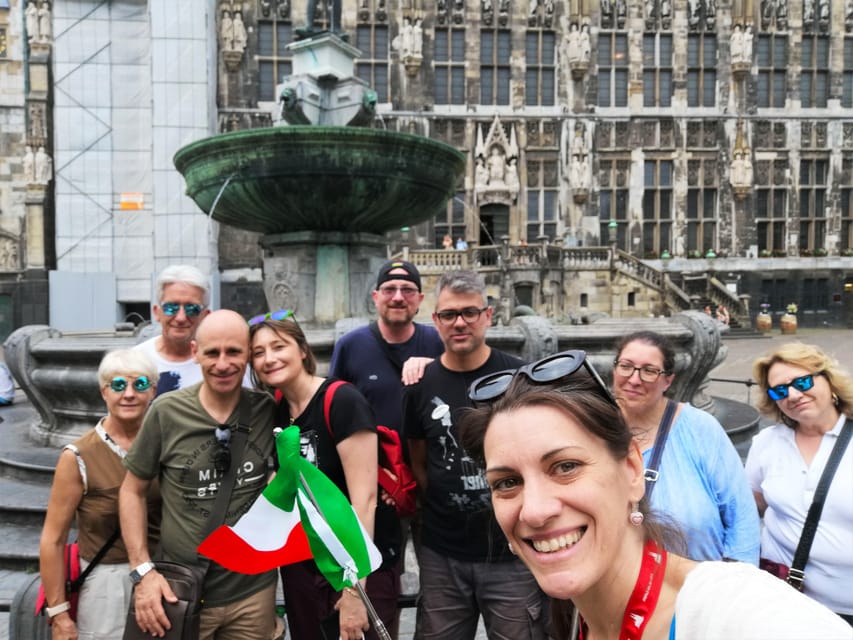
- Sara leads the tour in Italian, bringing a native speaker’s ease and a personal storytelling style to the walk.
- Charlemagne’s cathedral is the central sight, with the Palatine Chapel, imperial coronations, and the tomb of Charlemagne all part of the story.
- The route mixes grand monuments with playful details, including the Coin Fountain, Puppet Fountain, and Nobis Printen.
- The old town is covered on foot in 90 minutes, including the Rathaus, Market Square, Couven Museum, towers, and courtyards.
- The $29 price is reasonable for a private-feeling cultural introduction, but less so if you want interior access or a long cathedral visit.
Why Aachen makes a good short history walk
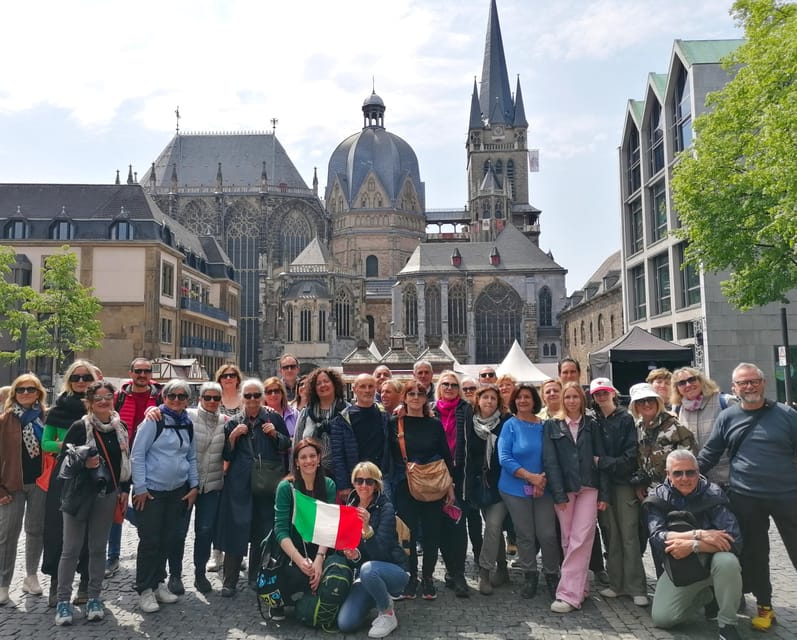
Aachen is easy to underestimate. It is often treated as a stop between larger German cities, yet its importance reaches from Roman thermal culture to the court of Charlemagne and the political center of medieval Europe.
The city’s name in Roman times was Aquae Granni, a reference to its hot springs and the Celtic god Grannus. The Roman connection gives the walk a useful starting point. You are not simply looking at attractive old buildings. You are following the reason people came here in the first place: warm, mineral-rich water.
Charlemagne later made Aachen his favored residence and political center. The city then became the coronation site of the emperors of the Holy Roman Empire. That makes the route unusually focused. In a short distance, you move from bathhouse culture to imperial power, religious ceremony, trade, and modern European identity.
I would choose this tour if you have only part of a day in Aachen and want the city’s main story before exploring on your own. It gives you a framework that makes the old town easier to understand.
A few more Germany trips to weigh up
- Discover Berlin Half-Day Walking Tour
★ 5.0 · 9,624 reviews - Berlin: Third Reich and Cold War 2 Hour Walking Tour
★ 4.9 · 6,830 reviews - Munich: Third Reich & WWII Walking Tour
★ 4.6 · 6,181 reviews
Starting at the Elisenbrunnen and the old Roman springs
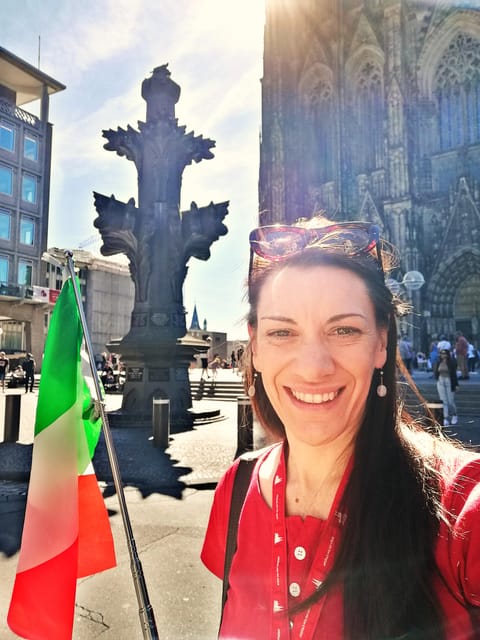
The meeting point is in front of the tourist board. Look for the guide carrying an Italian flag. This is a useful arrangement in a busy central area, especially if you are arriving without much time to get oriented.
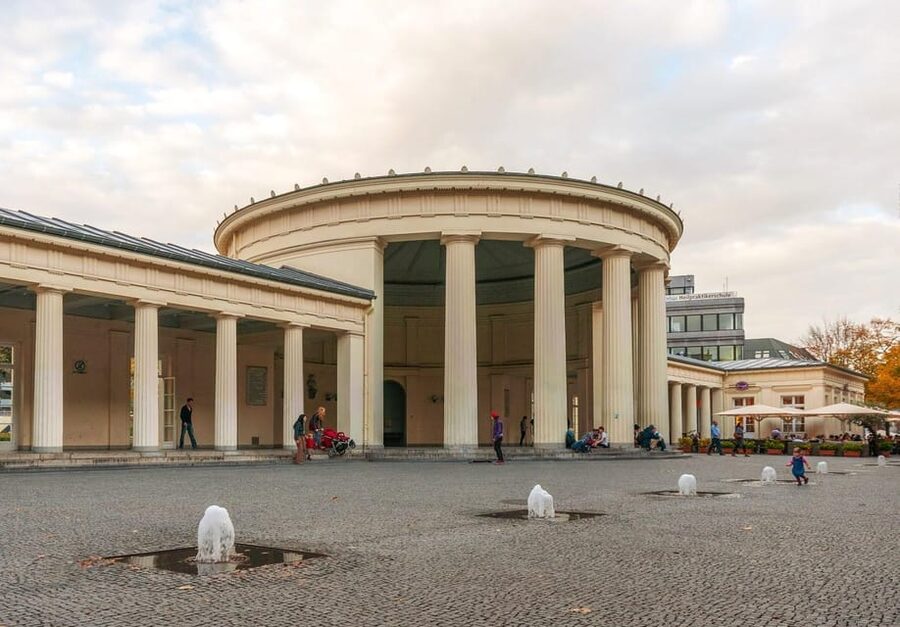
The first stop is the Elisenbrunnen, or Elisa Fountain, a grand neoclassical structure at the entrance to the old town. Its sulphurous vapors point to Aachen’s thermal springs, which are described as the hottest in north-central Europe.
The fountain is more than a decorative beginning. It explains the city’s original appeal. Romans came for the baths, and 18th-century nobility later returned to Bad Aachen for the waters. The name Bad Aachen reflects this spa tradition.
You will not spend the tour soaking in the baths, of course. The value here is the connection between the water under the streets and the city above them. Aachen’s story starts with a natural resource, then grows into a royal and religious center.
Roman remains and the city beneath your feet
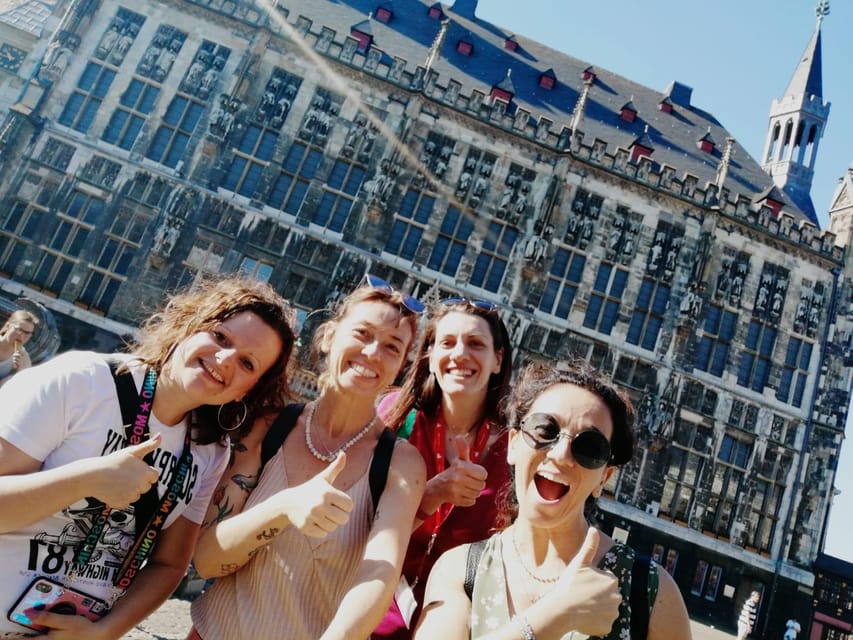
The itinerary includes an archaeological site, bringing the Roman period into view before the walk turns toward Charlemagne. The supplied details do not specify how extensive the visible remains are, so you should think of this as a historical stop rather than a full museum visit.
That distinction matters. A guided explanation can help you picture Aquae Granni, but the route is not designed as a long archaeological study. You get the essential context and then continue through the living city.
The Coin Fountain comes next. Small civic monuments like this often reward a pause because they show how Aachen presents its own past in public spaces. Sara’s style appears well suited to these stops. Her stories are reported as interesting without becoming dull, and her anecdotes help break up a sequence of dates and names.
The route also includes Nobis Printen. Printen is a traditional Aachen specialty, and its appearance on the walk gives you a local food reference alongside the political and religious history. The tour does not list a tasting, so do not expect food to be included. Still, it is a helpful name to know if you want to look for a local treat after the walk.
Fountains, puppets, and the texture of the old town
Aachen’s old town is not presented only through major monuments. The Puppet Fountain adds a lighter note to the route. Its figures can be read as a playful look at Aachen’s people, trades, and civic life.
This is one of the things I like about the itinerary. A city becomes easier to remember when you move between emperors and puppets, Roman remains and pastry, grand halls and street-level details.
The route continues through Am Hof, an old-town area close to the cathedral and the central historic buildings. You will also see the Couven Museum from outside. The museum is associated with Aachen’s 18th-century domestic culture, and its presence helps shift the story from medieval imperial power to later urban life.
The walk does not promise entry to the Couven Museum. If you want to see its interiors, you would need to arrange that separately. The same rule applies to the cathedral and other listed monuments.
Same city, a completely different kind of day:
- Berlin: Reichstag, Dome and Government District Guided Tour
★ 4.7 · 18,288 reviews - Berlin: 1-Hour City Tour by Boat with Guaranteed Seating
★ 4.3 · 16,993 reviews - Hamburg: Sex and Crime in St. Pauli Tour for Ages 18+
★ 4.7 · 15,447 reviews - Hamburg: 1.5-Hour Harbor and Speicherstadt Day Cruise
★ 4.6 · 14,200 reviews
Charlemagne’s Aachen at the Palatine Chapel
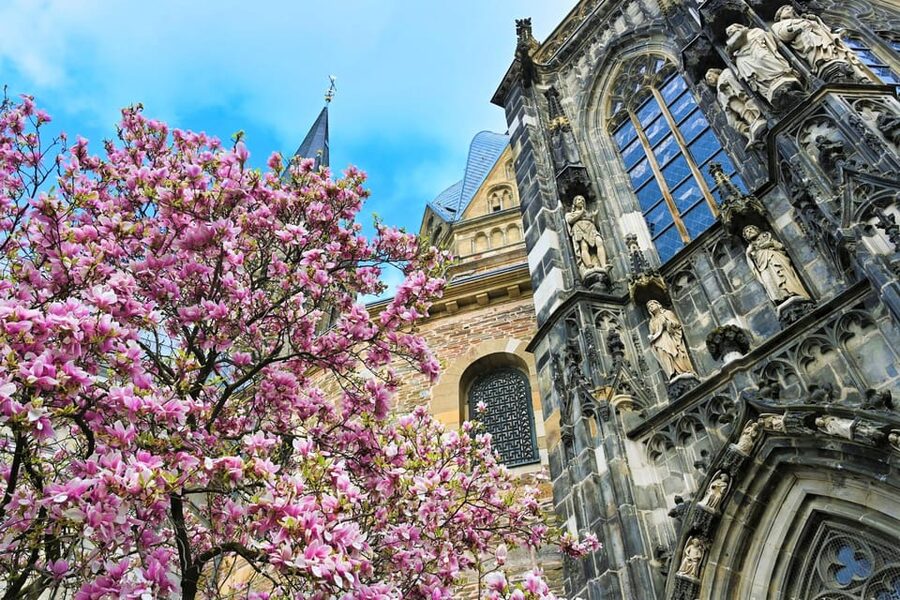
The architectural heart of the walk is Aachen Cathedral, especially the Palatine Chapel. You see the chapel and cathedral from the outside, while Sara explains their place in Charlemagne’s city.
The Palatine Chapel was part of Charlemagne’s palace complex. It was not simply a church for ordinary parish life. It was tied to the ruler’s court, worship, and political authority. That combination helps explain why Aachen became such a powerful medieval center.
The cathedral is recognized as the first UNESCO World Heritage Site in Germany. It is also the final resting place of Charlemagne and holds important treasures and artworks. Those facts make the exterior explanation worthwhile, but they also point to the tour’s main limitation.
You cannot fully appreciate the interior decoration, the chapel’s proportions, or the treasury from the street. One review specifically notes disappointment that explanations inside the monuments were not possible. I would treat this tour as an introduction, then decide if you want to return for an interior visit.
That approach may be especially useful for first-time visitors. Sara can give you the background before you go inside, so the cathedral’s role is clear rather than reduced to a quick photograph.
Granus Tower, the Rathaus, and imperial power
Granus Tower is another reminder that Aachen’s medieval center was part of a fortified and royal complex. The itinerary places it alongside the Rathaus and the palace courtyard, creating a useful sequence of buildings rather than isolated sights.
The Rathaus, or historic City Hall, occupies the site of the former palatine hall from the eighth and ninth centuries. Aachen’s modern town hall was built on its foundations. This is a strong example of how the city layered later civic government onto Charlemagne’s political center.
At the Market Square and Charles Fountain, the tour turns toward public power and civic identity. Markets were places for trade, but they were also stages for ceremony and authority. Charlemagne’s name remains visible in the city, and the fountain helps keep that connection in the public eye.
The political story continues in the Palatine Courtyard. Aachen sat at the heart of Europe during the medieval period, and the city’s importance did not come only from religion. Rulers gathered here, decisions were made here, and emperors were crowned here.
Sara’s storytelling seems to be the main reason this material works in a short format. The strongest comments about her describe a guide who is well prepared, approachable, and passionate without making the visit feel stiff. One account also praises her for linking the Roman period through later eras, including the Second World War. The exact depth of that wider coverage can vary, but you can expect the tour to place Aachen in a broad historical frame.
What you will and will not see inside
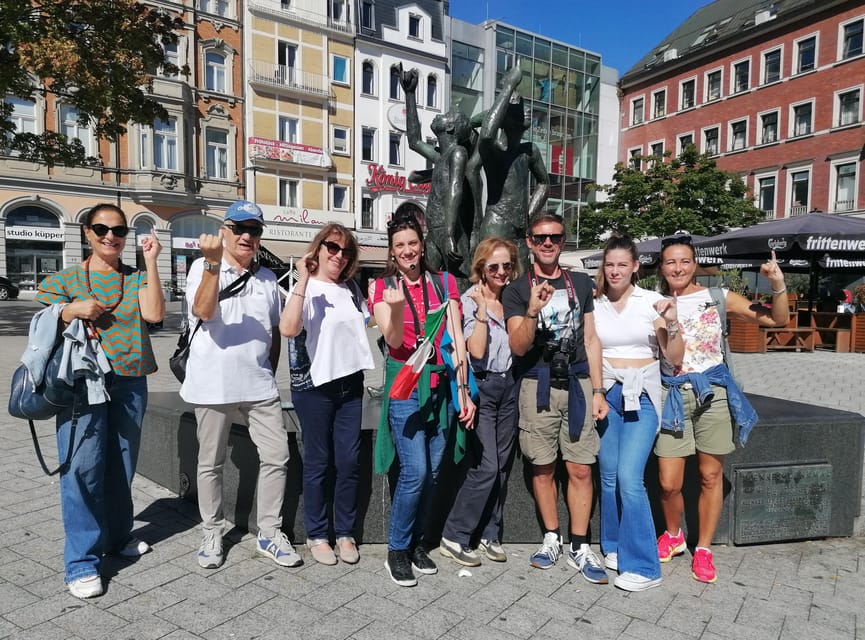
The itinerary names the Treasury Chamber and the Palatine Chapel or Cathedral. In practical terms, this means they are important subjects of the walk, not guaranteed interior visits.
The included service is a walking guided tour of monuments from the outside. That wording should guide your expectations. You will see the buildings, hear their history, and learn how they fit together, but you should not book this as a cathedral-entry tour.
This format has an advantage. You can cover more of central Aachen without stopping for admission procedures or spending most of the 90 minutes inside one monument. It also keeps the price moderate.
The tradeoff is depth. If your main aim is the cathedral treasury, interior art, or architectural detail, you will need a separate visit. The walking tour gives you the story and orientation. It is not a substitute for every museum or monument interior.
How the Italian-language format affects the experience
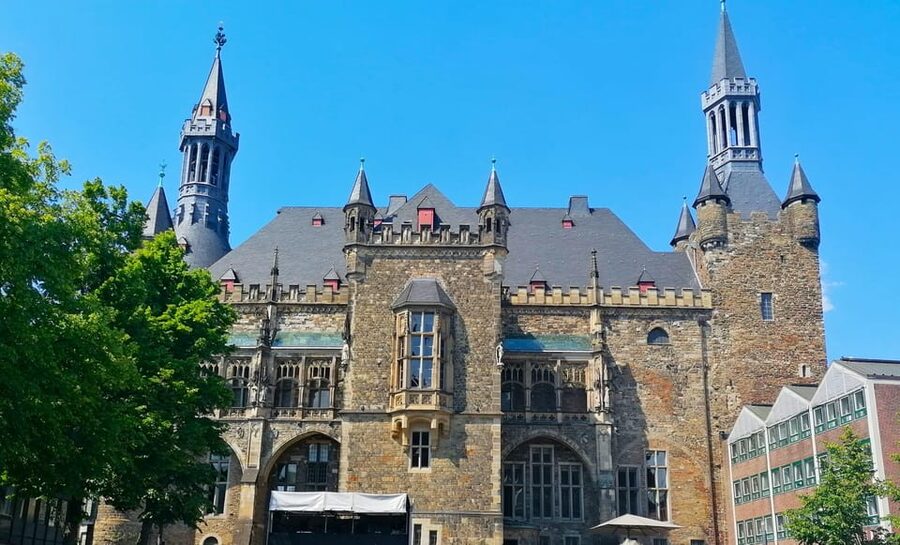
The live guide language is Italian, and the guide is described as a certified native Italian speaker. That is the right choice for Italian-speaking visitors who want more than a translated list of dates.
A native guide can explain names, jokes, and local references in a natural way. The comments about Sara repeatedly point to her preparation, humor, availability, and ability to keep the tour interesting. Her personality seems to be a major part of the experience.
The rating is 4.8 from seven reviews, a small sample but a strong result. Most of the detailed comments give her five out of five and call the tour interesting, never boring, and highly recommendable. One four-star review still praises Sara, with the only complaint being the lack of interior explanations.
That is a useful pattern. The guide receives the strongest praise, while the main reservation concerns the tour format itself. If you want an engaging Italian introduction to Aachen, this is encouraging. If you want a formal building-by-building interior tour, choose something else or add your own visits.
Is $29 a fair price for 90 minutes?
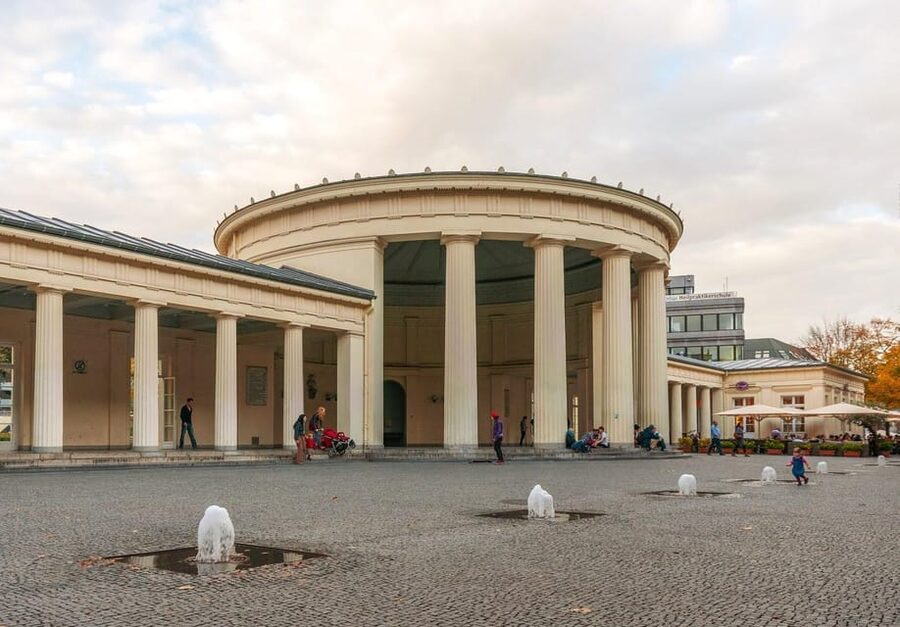
At $29 per person, the tour is priced as a compact city orientation rather than a full-day historical program. I think the value is good if you are interested in Aachen’s major story and prefer an Italian guide.
You are paying for a live explanation across a wide section of the old town. The route includes thermal history, Roman archaeology, Charlemagne, the cathedral, the Rathaus, fountains, the Couven Museum, the market area, the palace courtyard, and the treasury and chapel as subjects.
The price feels less attractive if you expect admission tickets, a cathedral interior visit, or a long stop at each monument. None of those are included. You are buying access to Sara’s interpretation and the structure of the walk.
The reserve-now-and-pay-later option also gives you some flexibility. You can reserve a place without paying immediately, and cancellation is free up to 24 hours before the tour for a full refund. Starting times depend on availability, so check the schedule before planning the rest of your day.
Who should book this Aachen walking tour?
I would recommend it to:
- Italian-speaking visitors who want a live guide in their first language
- First-time visitors with 90 minutes for a strong overview
- History fans interested in Roman baths, Charlemagne, and the Holy Roman Empire
- People who prefer stories and anecdotes to a dry list of architectural facts
- Visitors who want to understand the cathedral before returning for an interior visit
- Anyone looking for a central walking route rather than transport between sights
I would be more cautious if you have mobility concerns, since the experience is a walking tour and no accessibility details are provided. I would also hesitate if your top priority is going inside the cathedral, treasury, or museum. The tour does not include those interiors.
Should you book the Aachen classic walking tour?
Book it if you want a lively Italian-language introduction to Aachen, especially if Sara is leading the walk. Her strongest qualities are preparation, warmth, humor, and a clear passion for the city. The route gives you a useful story arc, from Roman springs to Charlemagne’s palace and the later civic center.
Skip it if you want admission to the cathedral or a detailed interior architecture tour. For everyone else, $29 buys a focused 90-minute walk through the places that define Aachen. Use it to get your bearings, learn the city’s big story, and choose which interiors deserve a second look.
FAQ
Where does the Aachen classic walking tour meet?
The meeting point is in front of the tourist board. The guide will be carrying an Italian flag.
How long does the tour last?
The tour lasts 1.5 hours.
What language is the tour conducted in?
The live tour is conducted in Italian.
Who guides the tour?
The tour is led by Sara, a certified native Italian-speaking guide with the provider Guida di Colonia Sara.
How much does the tour cost?
The listed price is $29 per person.
What is included in the tour?
A guided walking tour of the listed monuments from the outside is included.
Does the tour include entry to Aachen Cathedral?
No. The tour covers the Palatine Chapel and Aachen Cathedral from the outside. Interior explanations and entry are not included.
Does the tour include the Treasury Chamber?
The Treasury Chamber is part of the listed route, but the tour format covers monuments from the outside. The supplied details do not include Treasury Chamber admission.
Can I reserve now and pay later?
Yes. You can reserve your place and pay later, keeping your plans flexible.
What is the cancellation policy?
You can cancel up to 24 hours in advance for a full refund.
Just added around Germany
- Aachen old town tour – GERMAN (public)★ 5.0 · 24 reviews
- Aachen Private Walking Tour With A Professional Guide★ 5.0 · 11 reviews
- Cologne Highlights: Exclusive Private Tour★ 5.0 · 5 reviews
- Bremen Private Walking Tour With A Professional Guide★ 5.0 · 7 reviews
- Private Walking Tour through the Fascinating Bremen’s City Center★ 5.0 · 5 reviews
- Explore Cologne’s best Street Art Quarter★ 4.5 · 4 reviews
- Bremen Exploration Private Game and City Tour on your Phone★ 4.5 · 7 reviews
- e-Scavenger hunt Bremen: Explore the city at your own pace★ 4.0 · 24 reviews
Walking Tours, compared.

Berlin’s Best: 2 Hour Walking Tour Third Reich and the Cold War
Read our review →