
Reviewed · HISTORICAL TOURS
Munich: Private Walking Tour of the Historical City Center
Munich’s past is packed into a small area, and this three-hour private walk connects the city’s medieval beginnings with its Nazi-era history. You move through Marienplatz, the old and new town halls, St. Peter’s Church, Frauenkirche, Odeonsplatz, Hofbräuhaus, and Viktualienmarkt while a guide explains what happened in each place.
I like the choice of adding the Residenz Museum, and I like the focus on stories that go beyond royal rooms and postcard views, including Georg Elser’s attempt to kill Hitler and stop the war. The main caution is that guide quality can shape the whole experience: one booking had trouble hearing a quiet guide, while Tom earned high praise for his storytelling.
In This Review
- Key points to know before booking
- Starting at Marienplatz and the fish fountain
- Reading the Rathaus-Glockenspiel
- St. Peter’s and Munich’s earliest beginnings
- The Residenz option and Munich’s royal side
- Munich’s Nazi-era story at Odeonsplatz
- Hofbräuhaus and Munich’s beer tradition
- Viktualienmarkt and the final food stop
- How the private format changes the experience
- Timing, walking comfort, and accessibility
- Who will get the most from this walk
- Should you book the Munich private walking tour?
- FAQ
- Where does the Munich walking tour begin?
- How long does the tour last?
- Is this a private tour?
- Which languages are available?
- Is the Residenz Museum included?
- What sights are covered on the walking route?
- Are food and drinks included?
- Is the tour suitable for wheelchair users?
- How much does the private tour cost?
- Can I cancel the booking?
Key points to know before booking
- Munich’s central story in three hours: The route covers the city’s main historic squares, churches, royal sites, beer landmarks, and food market.
- A private group up to 15: You get a guide for your own party, but a large group may need to stay close so everyone can hear.
- Serious history alongside local legends: Expect discussion of Georg Elser, the Beer-Hall Putsch, Eva Braun, the devil’s footprint, and Munich’s monastic origins.
- Residenz Museum is an option: Choose the version that includes a guided visit, but note that entrance fees are not included.
- A strong central meeting point: The tour begins at the fish fountain in front of Munich’s Town Hall on Marienplatz.
- Good value for a full group: At $288 for up to 15 people, the per-person cost is low for a private tour, especially for a larger party.
Starting at Marienplatz and the fish fountain
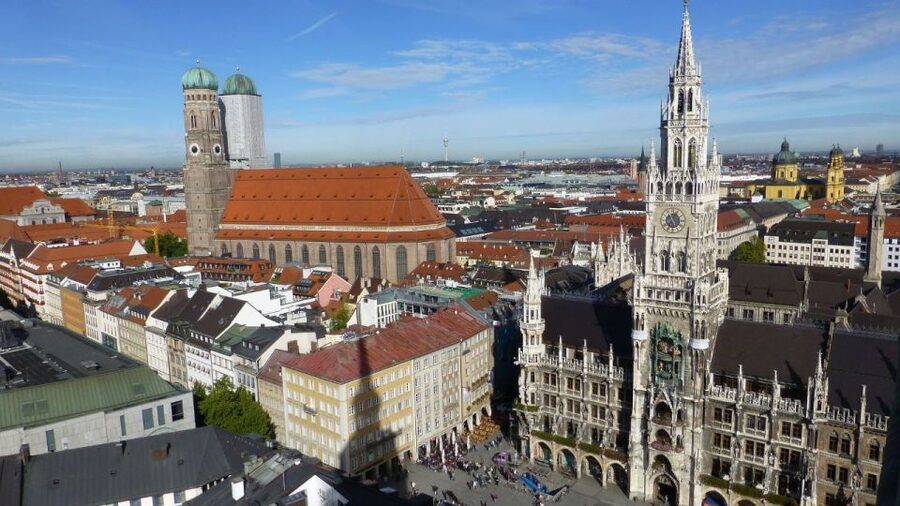
Your meeting point is the fish fountain in front of the Town Hall at Marienplatz. This is a useful place to begin because the square puts several of Munich’s main sights within a short walk of one another.
Marienplatz is the city center in the most literal sense. The square takes its name from Mary’s Column, and your guide explains why that column was placed here and how it gave the square its name. This is the sort of detail that can pass unnoticed if you are walking alone with a map.
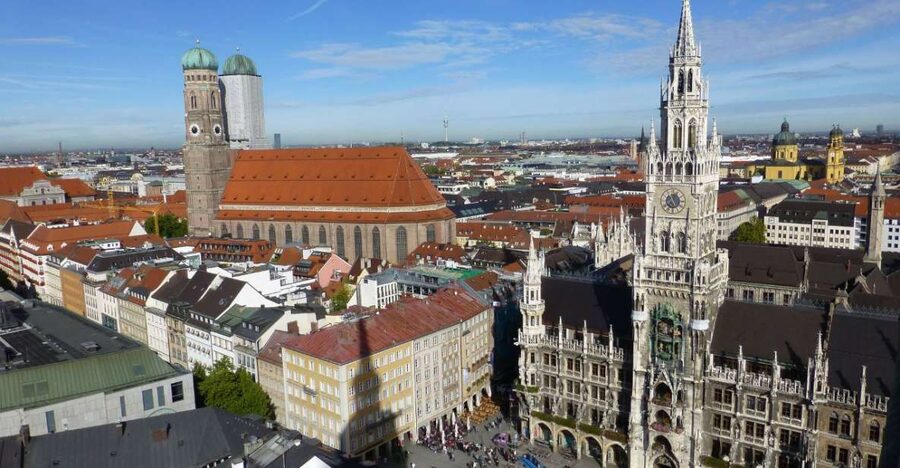
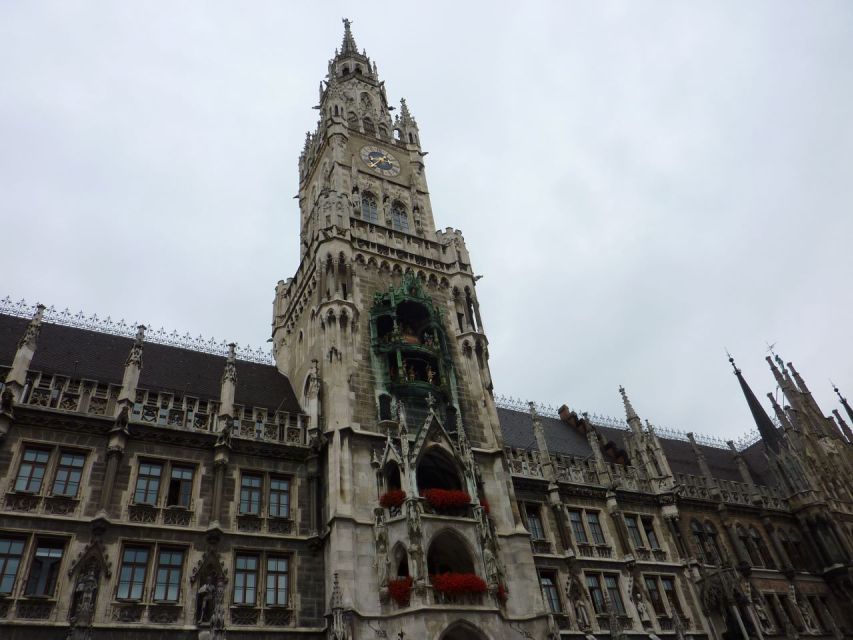
You also see both the Old Town Hall and the New Town Hall. The contrast helps you read Munich’s growth over time. The New Town Hall is the more famous building, with its tall clock tower and animated Rathaus-Glockenspiel.
A few more Munich trips to weigh up
- Munich: Guided Tour of the historic Town Hall on Marienplatz
★ 4.8 · 63 reviews - Munich and Nazi History Combination Day Tour Small Group
★ 5.0 · 31 reviews - Munich: Nazi History 2-Hour Small Group Walking Tour
★ 5.0 · 30 reviews
Reading the Rathaus-Glockenspiel
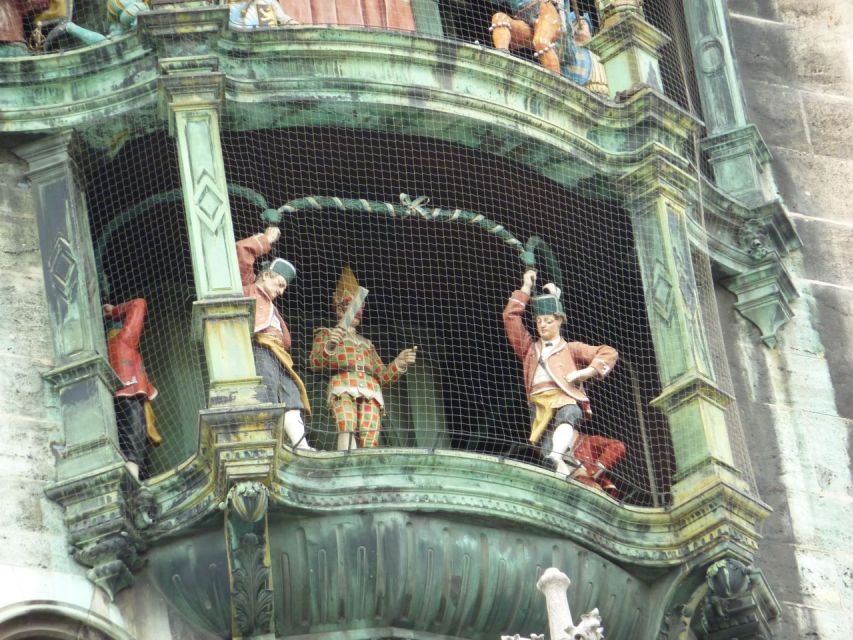
The Glockenspiel is more than a pretty clock that draws a crowd at the right hour. Its figures and movements tell stories connected with Munich’s past, and the guide explains the meaning behind the display.
That context is useful because the clock tower can otherwise become a quick photo stop. You may still want a photograph, but you will also understand what the figures represent and why this particular clock has become one of Munich’s best-known symbols.
The square can be busy, especially around the New Town Hall. Since this is a walking tour rather than a private vehicle tour, expect to share the public streets with other people. A private guide can answer questions as you go, but the experience depends on staying close enough to hear.
St. Peter’s and Munich’s earliest beginnings
The route continues to St. Peter’s Church, described as the oldest Catholic church in Munich. Here, the story reaches back to the monks who helped give rise to the city.
This stop supplies an important correction to the idea that Munich began as a grand royal capital. Its early identity was tied to religious foundations, trade, and the settlement that grew around them. Your guide uses the church to explain that beginning in a way that connects the building to the city around it.
The tour also takes you to Frauenkirche, Munich’s largest church. Its twin towers are among the city’s most familiar sights, and they are easy to recognize from many central viewpoints.
Inside or around the cathedral, your guide describes the famous devil’s footprint and the legend attached to it. This is a lighter story than the wartime material later in the walk, but it adds the kind of local folklore that makes an old city feel less like a museum display.
Do not expect a full church tour with extended time for quiet reflection. Three hours is enough for an overview, not a detailed architectural study. If religious art or church interiors are your main interest, you will want to ask the guide how much time the schedule allows.
The Residenz option and Munich’s royal side
If you select the option that includes it, your guide leads you to the Residenz Museum. This gives the tour a different angle, shifting from public squares and street history to the world of Bavaria’s ruling family.
The Residenz helps explain how Munich functioned as a seat of power. You can see the contrast between the city’s older religious roots and the wealth, ceremony, and political influence of its rulers.
Entrance fees are not included, so check the cost before you book. The museum option may also make the schedule feel more structured, since indoor visits require time beyond a quick look at a building from the street.
For someone visiting Munich for the first time, adding the Residenz makes sense if you want both the public city and its royal story. If you prefer street life, political history, and food stops, the basic walking route may suit you better.
Same city, a completely different kind of day:
- From Munich: Neuschwanstein & Linderhof Castle Full-Day Trip
★ 4.5 · 12,494 reviews - Neuschwanstein & Linderhof Castle-Fairytale Day Tour from Munich
★ 4.5 · 7,275 reviews - Munich: Third Reich & WWII Walking Tour
★ 4.6 · 6,181 reviews - Dachau Concentration Camp Memorial Site Tour from Munich by Train
★ 4.5 · 5,637 reviews
Munich’s Nazi-era story at Odeonsplatz
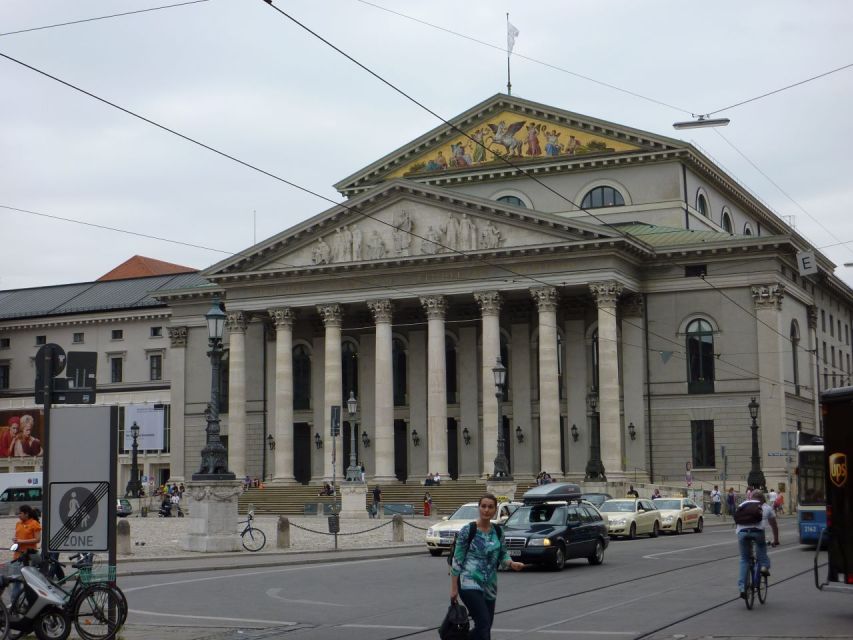
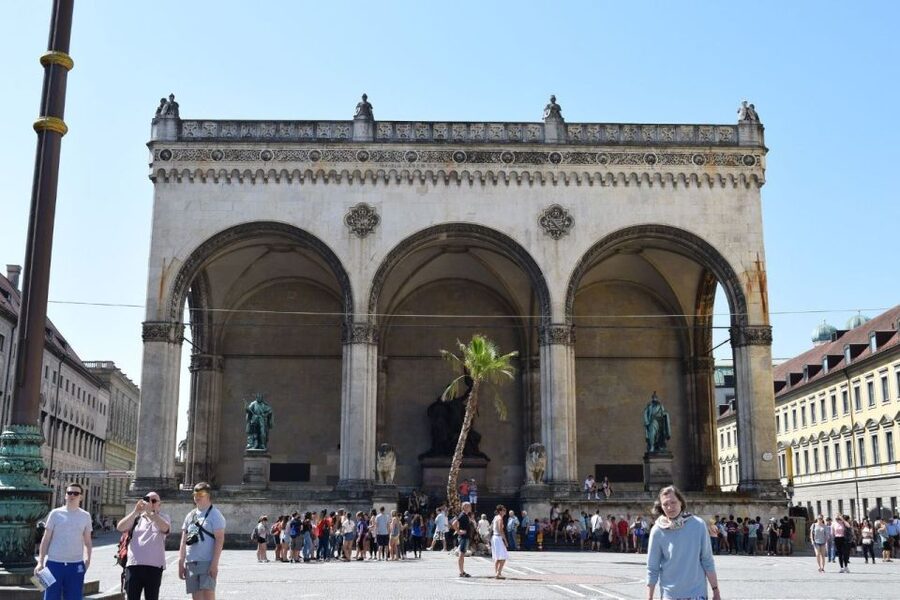
The most serious part of the walk comes as you reach Odeonsplatz. Here, the guide explains the Beer-Hall Putsch, the failed 1923 attempt by Adolf Hitler and about 2,000 men to march into central Munich and seize power.
This stop matters because Munich was not only a backdrop to later Nazi rule. The city played a direct role in the movement’s early rise. Seeing the place where that attempted takeover unfolded makes the political history more concrete.
The tour also covers Georg Elser, a Munich carpenter who planned an assassination attempt on Hitler in an effort to prevent the outbreak of the Second World War. It is a lesser-known story, and one of the most valuable parts of the itinerary because it shows that opposition existed before the war began.
You also hear about Eva Braun, who grew up in Munich and later became Hitler’s wife. This is not presented as a separate museum visit, but as part of the city’s personal and political history.
I appreciate that the tour places these stories on actual streets rather than treating the Nazi period as a detached chapter in a textbook. At the same time, you should know that this is an overview. The guide introduces the events and their locations, but three hours cannot provide a full study of Nazi Germany, wartime Munich, or resistance movements.
Hofbräuhaus and Munich’s beer tradition
Munich’s beer culture gets its own place on the route at Hofbräuhaus, the royal brewery established in 1589. That date gives you a sense of how long beer has been tied to the city’s public life.
The stop is useful even if you are not planning to drink. Hofbräuhaus is part of Munich’s civic identity, and the guide explains how the royal brewery fits into the city’s history. You learn that beer gardens in Munich have roots stretching back nearly 450 years.
This is also where the tone of the tour lightens after the discussion of war and political violence. You move from historical events to everyday customs, eating, drinking, and public gathering.
Food and drinks are not included, so you should not treat the tour price as covering a beer or meal. The route may show you good places to return to later, but any stop for refreshments is at your own expense.
Viktualienmarkt and the final food stop
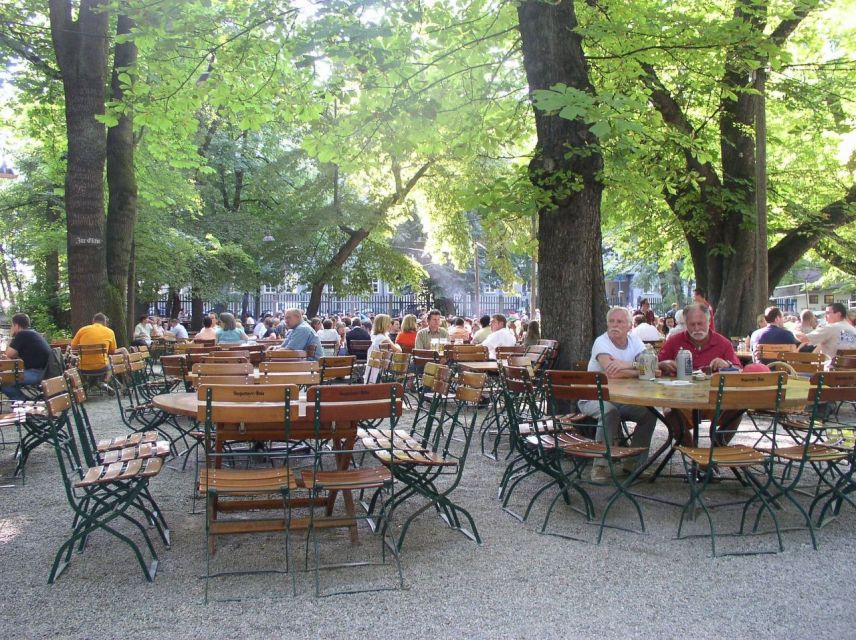
The tour finishes by passing Viktualienmarkt, Munich’s central public food market. The market offers fresh produce, local delicatessen, and one of the city’s most central beer gardens.
This is a good ending because it brings you back to present-day Munich. After churches, royal buildings, political rallies, and legends, you finish among the foods and public spaces that locals use in ordinary life.
You may want to return here after the tour, especially if you prefer to browse at your own pace. The market is more useful as a final orientation point than as a full tasting visit, since food and drinks are not part of the booking.
If you are hoping for a dedicated food tour, this is not that. Viktualienmarkt is one stop near the end of a history walk, not a series of tastings or a market lunch.
How the private format changes the experience
The price is $288 per group of up to 15 people. For a full group, that works out to $19.20 per person, which is a strong price for a private three-hour tour. For two people, the same booking works out to $144 each, so the value depends heavily on your group size.
A private format gives you room to ask questions and adjust the emphasis. You can ask for more detail about the medieval city, the Residenz, Munich’s Nazi-era story, church legends, or beer culture, although the guide still needs to cover a long route in three hours.
The group limit also creates a practical issue. Fifteen people is a sizable walking group, even when it is private. Stay near the guide, especially in Marienplatz or other busy public areas, and tell the guide if you are having trouble hearing.
One booking involved only two people, but the guide reportedly spoke very quietly and was difficult to understand. The route itself was considered acceptable but not especially engaging. That is a fair warning: the private format does not automatically guarantee a compelling presentation.
Another booking praised Tom’s knowledge of Munich and his natural storytelling. If you are able to request or confirm a guide by name, Tom is worth asking about. However, guide assignment is not guaranteed in the information provided, so book for the itinerary and format rather than assuming a particular person.
Timing, walking comfort, and accessibility
The tour lasts three hours and runs on foot through Munich’s historical center. The route links several major sights, so comfortable shoes are sensible even though the distance is not specified.
Wheelchair users should not book this activity, as it is listed as unsuitable for wheelchair users. The tour includes public squares, churches, market areas, and city streets, so anyone with mobility concerns should confirm conditions before booking.
English and German are the available tour languages. You choose the language when arranging the experience, and the guide is live rather than recorded.
Starting times vary. You need to check availability for the date you want, since no single start time is provided. The meeting point is specific, though: the fish fountain at Marienplatz 8, in front of the Town Hall.
The booking terms are flexible. You can cancel up to 24 hours before the tour for a full refund, and you can reserve now while paying later. Those terms are helpful if your Munich schedule may change.
Who will get the most from this walk
I would choose this tour if you want a first look at Munich with a guide who can connect buildings to events. It suits couples, families, and small private groups that prefer questions and conversation over a large public tour.
It is especially useful for you if Munich’s twentieth-century history matters as much as its churches and royal buildings. The Georg Elser story and the Beer-Hall Putsch give the tour more weight than a simple stroll through attractive squares.
The tour also works well for a group with mixed interests. One person can focus on architecture, another on beer culture, and another on political history. The route touches each subject without requiring separate bookings.
I would be more cautious if you want long museum visits, extensive interior detail, or a food-focused experience. The Residenz is an optional addition, food and drinks cost extra, and the entire route is limited to three hours.
Should you book the Munich private walking tour?
Book it if you are traveling with several people and want a reasonably priced private introduction to Munich’s center. The route covers the city’s essential sights, while the stories of Georg Elser, the Beer-Hall Putsch, Eva Braun, and the devil’s footprint give you more to think about than a standard photo walk.
For two people, the price is harder to justify unless you value the private format and the ability to ask questions. For a larger group, the cost becomes much more attractive.
The biggest variable is the guide. Tom received strong praise for his storytelling, while another guide was difficult to hear and not very engaging. Confirm the language and, if possible, ask whether Tom is available. If you want a solid city orientation with serious history, local legends, beer traditions, and an optional Residenz visit, this is a sensible choice. If you want a polished museum tour or a tasting tour, choose something more specialized.
FAQ
Where does the Munich walking tour begin?
It begins at the fish fountain in front of the Town Hall, Marienplatz 8, 80331 München.
How long does the tour last?
The tour lasts three hours.
Is this a private tour?
Yes. It is a private group experience for up to 15 people.
Which languages are available?
The live guide can conduct the tour in English or German.
Is the Residenz Museum included?
The Residenz Museum is included only if you choose the option that adds the museum visit. Entrance fees are not included.
What sights are covered on the walking route?
The route includes Marienplatz, the Old and New Town Halls, St. Peter’s Church, Frauenkirche, Odeonsplatz, Hofbräuhaus, and Viktualienmarkt.
Are food and drinks included?
No. Food and drinks are not included in the tour price.
Is the tour suitable for wheelchair users?
No. The activity is listed as unsuitable for wheelchair users.
How much does the private tour cost?
The price is $288 per group of up to 15 people.
Can I cancel the booking?
Yes. You can cancel up to 24 hours in advance for a full refund. You can also reserve now and pay later.
Just added around Munich
- Pub crawl incl. Oktoberfest museum guided tour with beer tasting (private)★ 5.0 · 5 reviews
- South Tyrolean specialties and wine tasting★ 5.0 · 5 reviews
- Size Matters Beer Tour Munich★ 4.6 · 105 reviews
- Short & sweet: Tasting the Viktualienmarkt★ 4.8 · 37 reviews
- Secret Food Tours Munich★ 4.8 · 5 reviews
- Munich: Romantic Wine Experience for Two at Viktualienmarkt★ 4.2 · 14 reviews
- Residence of Munich private tour with skip the line ticket★ 5.0 · 4 reviews
- Munich: Resistance against Hitler – Historical Walking Tour★ 5.0 · 5 reviews
Historical Tours, compared.

City History Canal Sightseeing Tour on a Motorboat
Read our review →






Browse the lists this tour appears in