
Reviewed · HISTORICAL TOURS
Munich: National Socialism Historical Tour in GERMAN
Munich’s grand squares and stately streets carry a dark political past, and this walking tour puts that past in plain view. You follow the path from Königsplatz to Feldherrnhalle while a German-speaking guide explains how Munich became the City of the Movement and how National Socialism grew from a local political force into a dictatorship.
I like the route’s clear focus and the guide’s use of black and white photographs, which lets you compare past events with the places around you. I also like that you can choose a private or group tour, a useful option if you want either a more personal discussion or a lower-cost shared walk.
The main consideration is language: the tour is conducted in German. The activity is also described as wheelchair accessible in one section, yet it is listed as unsuitable for people with mobility impairments, so you should confirm the route’s practical conditions before booking.
In This Review
- Key points about Munich’s National Socialism tour
- Why Munich is the right place to study this period
- Starting at Königsplatz and the former Führerbau
- Walking Briennerstrasse with photographs from the 1920s
- Passing the former Gestapo headquarters
- Feldherrnhalle and the Beer Hall Putsch
- How the archival images improve the walk
- German-language format and guide style
- Two hours, $34, and the question of value
- Who should book this walking tour?
- Practical details before you go
- Should you book it?
- FAQ
- How long does the Munich National Socialism Historical Tour last?
- What language is the tour conducted in?
- Where does the tour meet?
- How can I identify the guide?
- Which locations are included on the walking route?
- What event is discussed at Feldherrnhalle?
- Does the tour include museum entrance fees?
- Is food or drink included?
- Does the tour operate in bad weather?
- Can I cancel the booking for a refund?
Key points about Munich’s National Socialism tour
- Königsplatz sets the scene: Begin among the monumental buildings tied to Munich’s political past.
- November 9, 1923 comes into focus: Learn about Hitler’s failed Beer Hall Putsch and its importance to the Nazi movement.
- Historic photographs add context: The guide carries black and white images from Munich in the 1920s and 1930s.
- The route connects several locations: Walk along Briennerstrasse, pass the former Gestapo headquarters, and finish at Feldherrnhalle.
- The tour stays outdoors: Entrance fees are not included, so expect a walking tour rather than a museum visit.
- German is the only listed language: Choose between a private tour and a group departure.
Why Munich is the right place to study this period
Munich was not just another stop in the story of National Socialism. It was the city where Hitler built his early political base, where the NSDAP developed its public identity, and where the failed Beer Hall Putsch took place in 1923.
That local focus gives this tour value. Instead of hearing a general account of Germany during the Nazi period, you connect national events to specific streets, buildings, and squares. I find that approach easier to follow because the history has a physical setting.
The tour also deals with a difficult subject without presenting Munich as a simple museum of the past. You will hear about the rise of the NSDAP, Germany under National Socialism, and the events that helped shape Hitler’s movement. The point is not to admire the grand architecture. It is to understand how public spaces, political gatherings, and organized propaganda helped give a dangerous ideology room to grow.
Because the tour lasts two hours, it can give you a firm foundation without taking an entire morning or afternoon. If you want a detailed study of every building and document connected with the period, you will need more time elsewhere. If you want a focused introduction while walking through central Munich, the length works well.
A few more Munich trips to weigh up
- Munich: Guided Tour of the historic Town Hall on Marienplatz
★ 4.8 · 63 reviews - Munich and Nazi History Combination Day Tour Small Group
★ 5.0 · 31 reviews - Munich: Nazi History 2-Hour Small Group Walking Tour
★ 5.0 · 30 reviews
Starting at Königsplatz and the former Führerbau
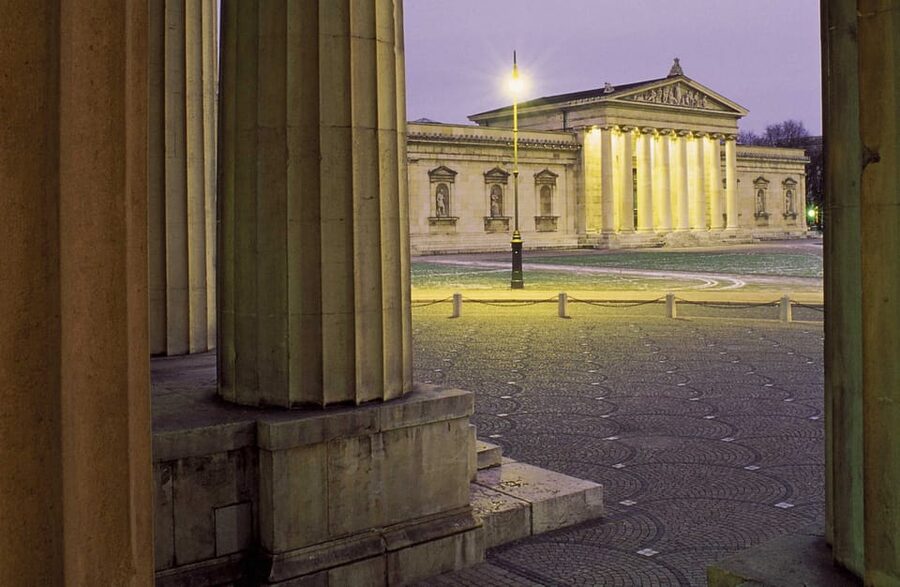
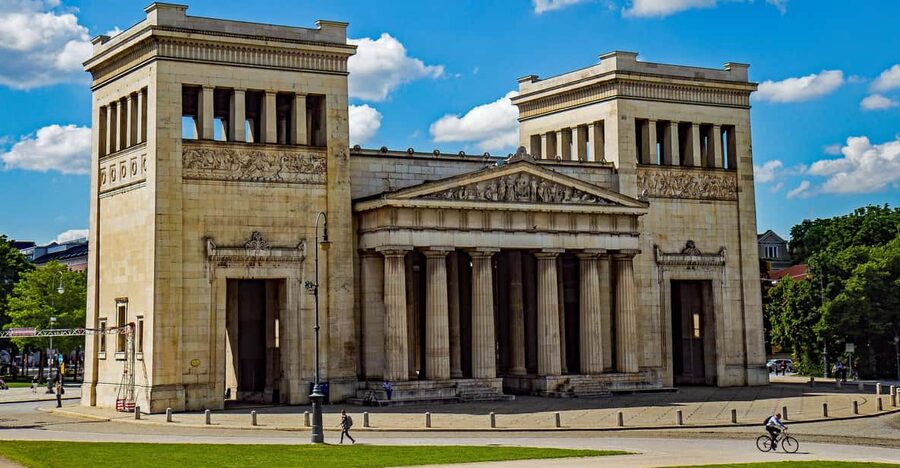
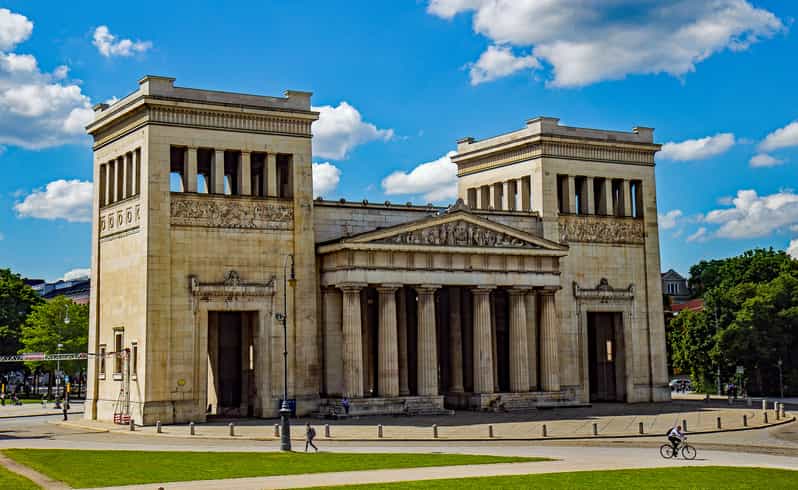
You meet in front of the main entrance of the Staatliche Antikensammlungen at Königsplatz. Look for the guide carrying a large blue bag marked with the white words Weis(s)er Stadtvogel. That detail matters in a busy city square, especially if several groups are gathering nearby.
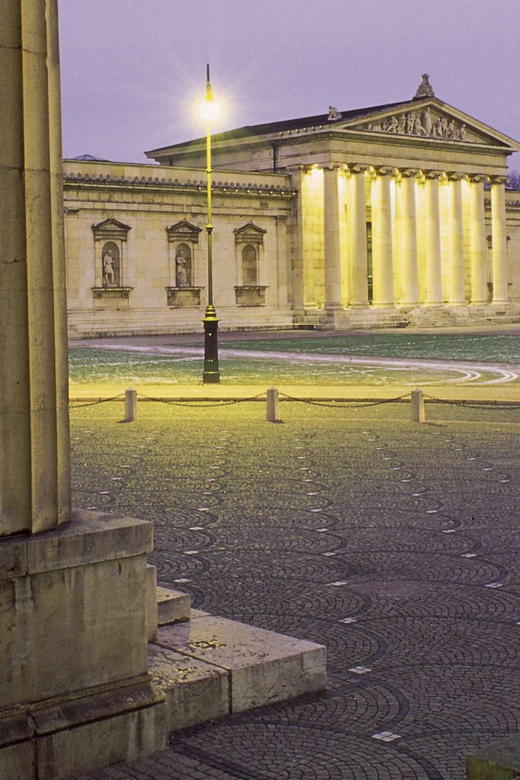
Königsplatz is a fitting place to begin. The square’s monumental design gives the guide a visual setting for explaining Munich’s role in the movement. You start by looking at the city not only as a place of art and royal architecture, but also as a place where political power was staged and displayed.
The route then leads to the former Führerbau, or Führer’s building. The Munich Agreement was signed there in 1938, making the building an important stop when discussing the final years before the Second World War. You should expect the guide to explain the building’s political significance rather than treat it as a normal sightseeing attraction.
The site is also connected with what is now the Munich Documentation Centre for the History of National Socialism. This is useful context, but keep the tour’s format in mind. Entrance fees are not included, so the walking experience does not promise an interior museum visit. If you want time with exhibitions and documents inside a museum, plan a separate visit and allow extra time.
Walking Briennerstrasse with photographs from the 1920s
From Königsplatz, you walk along Briennerstrasse. This part of the route helps link individual sites rather than presenting them as isolated points on a map.
The guide carries historic black and white photographs from Munich in the 1920s and 1930s. I like this feature because it gives the discussion something concrete. A photograph can show how a street looked during a rally, how a building was used, or how public life was presented during the period.
These images also help you keep the chronology straight. The tour covers the early political rise of the NSDAP, the development of National Socialism in Germany, and the way Munich became central to that story. You are not simply walking past old buildings. You are using the modern city as a reference point for events that took place decades ago.
The route is outdoors, so you should dress for changing weather. The activity runs rain or shine, and comfortable shoes are essential. Munich’s streets are generally easy to reach, but a two-hour walk can still feel demanding if you are not prepared for standing and walking throughout.
Passing the former Gestapo headquarters
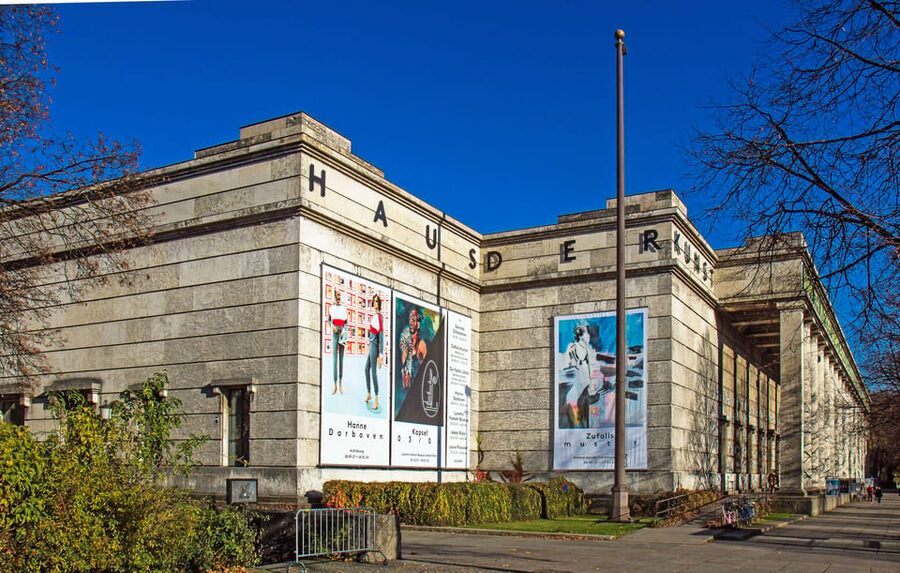
The next major point is the former Gestapo headquarters. This stop adds a more direct connection to the machinery of political repression.
The tour’s value here comes from the way it connects the early rise of the movement with the later operation of the Nazi state. The story is not limited to speeches, marches, and party politics. It also includes the institutions that enforced Nazi rule and helped silence opposition.
You should expect the guide to place the building within the wider story of Germany under National Socialism. The tour is conducted in German, so you need enough German to follow a serious historical explanation. This is not an audio walk with multiple language choices. It is a live guided discussion, and the quality of your experience will depend heavily on your ability to understand spoken German.
A private tour may be the better choice if you want to ask questions at each stop or need the guide to adjust the pace. A group tour may suit you if you prefer a shared outing and do not need much individual attention. No group size is specified, so you should not book expecting a particular number of participants.
Same city, a completely different kind of day:
- From Munich: Neuschwanstein & Linderhof Castle Full-Day Trip
★ 4.5 · 12,494 reviews - Neuschwanstein & Linderhof Castle-Fairytale Day Tour from Munich
★ 4.5 · 7,275 reviews - Munich: Third Reich & WWII Walking Tour
★ 4.6 · 6,181 reviews - Dachau Concentration Camp Memorial Site Tour from Munich by Train
★ 4.5 · 5,637 reviews
Feldherrnhalle and the Beer Hall Putsch
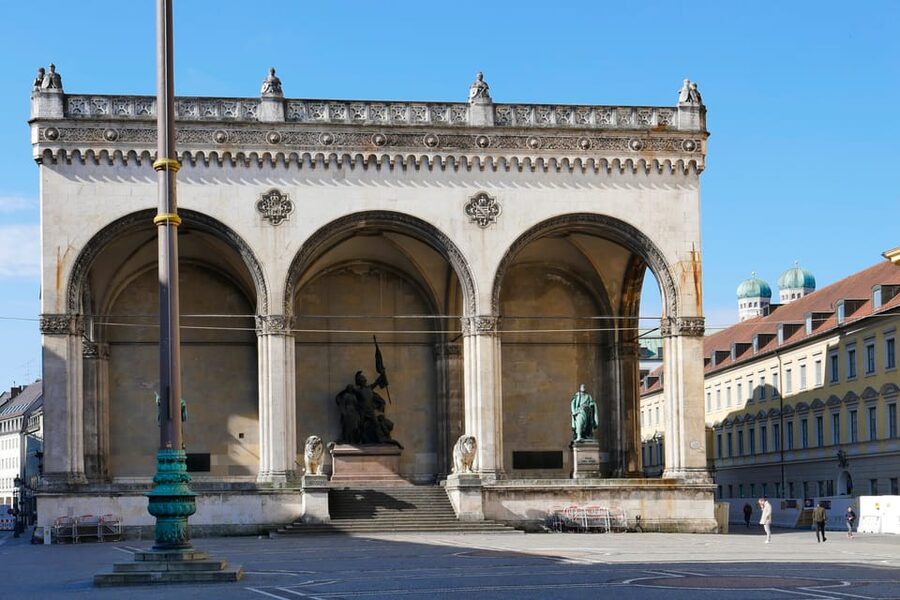
The walk finishes at Feldherrnhalle on Odeonsplatz, the site associated with Hitler’s Beer Hall Putsch on November 9, 1923. This failed attempt to seize power was a key event in the early history of the Nazi movement.
The date matters. The uprising did not bring Hitler immediate control of Germany, but it gave him a major political episode to use later. A guide can explain how failure, publicity, and political strategy affected the NSDAP’s later path to power.
Feldherrnhalle is a useful final stop because it brings the tour back to a clearly identifiable public place. You can connect the events discussed at the beginning of the walk with one of the best-known episodes in Munich’s political history.
This is also where the tour’s short format becomes apparent. You will receive an organized explanation of the site and its place in the story, but two hours cannot cover every political, social, and military development from the 1920s through 1945. I would treat this tour as a focused orientation, not a complete study of the period.
How the archival images improve the walk
The photographs are more than a visual extra. They help you see how political movements use public space.
A modern street can look ordinary until you learn what happened there. The images give you a way to picture Munich during the 1920s and 1930s and to understand how buildings and squares appeared during that era. They can also make the discussion easier to follow if you are less familiar with Munich’s central districts.
I especially value this kind of material on an outdoor history walk. Without it, you might hear a sequence of dates and names while trying to keep track of the route. With photographs in hand, the guide can point to specific changes and explain how the locations were used.
The photos do not replace a museum collection or a long lecture. Their strength is speed and relevance. The guide can bring out an image at the right place, then connect it to the street in front of you.
German-language format and guide style
The tour is offered in German, with a live guide from Weis(s)er Stadtvogel GmbH. No guide name is provided, so you cannot request a named guide based on the available information.
A live German tour suits you if you are comfortable listening to historical explanations in German. It may also work well for German-speaking residents or visitors who want to discuss the subject in the language used by the guide. If you need English, this is not the right departure.
The guide is the key to the experience. You are not just being led from one address to another. The route depends on clear explanations of the NSDAP’s rise, the Beer Hall Putsch, Munich’s role in National Socialism, and Germany under Nazi rule.
For that reason, I would avoid booking this as a casual walk if you understand only basic German. The subject includes political terms, dates, and connected events. You will get much more from it if you can follow a sustained historical discussion.
Two hours, $34, and the question of value
At $34 per person, the tour is priced like a focused guided city walk rather than a full-day historical program. I think the value is strongest if you want an organized route and a professional guide to connect the sites for you.
You are paying for two hours of live interpretation, the guide’s route planning, and the use of historic photographs. Food, drinks, hotel pickup, and entrance fees are not included. Since the tour is primarily an outdoor walk, you should budget separately if you plan to visit the Documentation Centre or another museum afterward.
The price also makes more sense if you have limited time in Munich. You can cover several important locations in one compact outing instead of researching the route yourself. On the other hand, you may prefer to spend your money on museum admission if you want documents, exhibitions, and more time indoors.
Private and group options give you some flexibility, but the available details do not state the private-tour supplement or group size. Check the exact price for your chosen format before paying.
You can reserve now and pay later, which helps if your Munich schedule is still changing. Free cancellation is available up to 24 hours before the start time for a full refund. Those terms reduce the risk of booking ahead, though the rain-or-shine policy means you should still bring suitable clothing.
Who should book this walking tour?
I would recommend it most to German-speaking adults and older teenagers with a serious interest in 20th-century history. It is also useful early in a Munich visit, since the route can help you understand the city before you explore the Documentation Centre or other related sites on your own.
The tour suits you if you prefer place-based history. You walk between real locations, see the streets involved, and hear how Munich connected to the national story. It is less suitable if you want a relaxed sightseeing walk with light commentary.
The subject matter is difficult, so I would not choose it for young children or anyone looking for entertainment. The available information does not give a minimum age, but the focus is clearly historical and political.
Mobility deserves careful attention. The activity information calls the tour wheelchair accessible, but it also says it is not suitable for people with mobility impairments. That conflict should not be ignored. Contact the provider before booking if you use a wheelchair, walker, or need frequent rest stops.
Practical details before you go
Meet at the main entrance of the Staatliche Antikensammlungen at Königsplatz. The guide will carry the distinctive blue Weis(s)er Stadtvogel bag, which is the easiest way to identify the meeting point contact.
Wear comfortable shoes and prepare for weather. The tour takes place rain or shine, and there is no indication that hotel pickup or drop-off is provided, so you should make your own way to and from the central meeting point.
No food or drinks are included. The tour lasts two hours, and starting times vary, so check availability for the date you want.
The activity is available as either a private or group tour. The language is German, and the guide is live rather than recorded. Entrance fees are not included, so plan a separate museum visit if you want to go inside related institutions after the walk.
Should you book it?
Book this tour if you want a concise, serious German-language introduction to Munich’s role in National Socialism, with a route that links Königsplatz, the former Führerbau, Briennerstrasse, the former Gestapo headquarters, and Feldherrnhalle.
The strongest reasons to choose it are the specific Munich locations, the archival photographs, and the chance to hear the history explained as you walk. At $34, it offers fair value for a two-hour guided route, especially if you would otherwise spend time piecing the sites together yourself.
Skip it if you need English, want extensive museum time, or have mobility concerns that make a rain-or-shine walking tour difficult. If you do book, arrive ready for a focused history lesson, wear good shoes, and confirm the accessibility details directly with the provider.
FAQ
How long does the Munich National Socialism Historical Tour last?
The tour lasts two hours.
What language is the tour conducted in?
The live tour guide speaks German. German is the only listed language.
Where does the tour meet?
Meet in front of the main entrance of the Staatliche Antikensammlungen at Königsplatz.
How can I identify the guide?
The guide will be carrying a large blue bag with the white words Weis(s)er Stadtvogel on it.
Which locations are included on the walking route?
The route begins at Königsplatz, continues to the former Führerbau, follows Briennerstrasse, passes the former Gestapo headquarters, and ends at Feldherrnhalle at Odeonsplatz.
What event is discussed at Feldherrnhalle?
The tour discusses Hitler’s Beer Hall Putsch, which took place on November 9, 1923.
Does the tour include museum entrance fees?
No. Entrance fees are not included.
Is food or drink included?
No. Food and drinks are not included.
Does the tour operate in bad weather?
Yes. The activity takes place rain or shine.
Can I cancel the booking for a refund?
You can cancel up to 24 hours in advance for a full refund. You can also reserve now and pay later.
Just added around Munich
- Pub crawl incl. Oktoberfest museum guided tour with beer tasting (private)★ 5.0 · 5 reviews
- South Tyrolean specialties and wine tasting★ 5.0 · 5 reviews
- Size Matters Beer Tour Munich★ 4.6 · 105 reviews
- Short & sweet: Tasting the Viktualienmarkt★ 4.8 · 37 reviews
- Secret Food Tours Munich★ 4.8 · 5 reviews
- Munich: Romantic Wine Experience for Two at Viktualienmarkt★ 4.2 · 14 reviews
- Munich: Resistance against Hitler – Historical Walking Tour★ 5.0 · 5 reviews
- Residence of Munich private tour with skip the line ticket★ 5.0 · 4 reviews
Historical Tours, compared.

City History Canal Sightseeing Tour on a Motorboat
Read our review →






Browse the lists this tour appears in