
Reviewed · CITY TOURS
Day trip through multicultural city landscapes & photo highlights
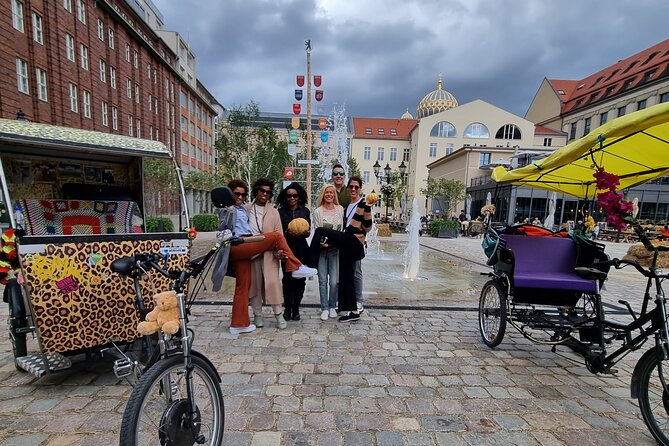
Berlin is a big, spread-out city, and this private rickshaw tour gives you a clever way to cover a lot of it without wearing out your feet. Guide Leo takes you from the Brandenburg Gate and Reichstag to the Berlin Wall, Museum Island, and Kreuzberg, using parks and smaller passages where cars cannot go. The photo stops and door-to-door pickup are real strengths.
I especially like the flexible private format. Your group rides alone, and the route can include major monuments as well as local streets, parks, shopping areas, and nightlife districts. I also like that the tour reaches places such as Bergmannstraße and Admiralbrücke, which give you a better feel for everyday Berlin than a parade of famous buildings alone.
The main consideration is time. With 3 to 6 hours and more than two dozen possible stops, this is a fast overview rather than a full visit to every site. Most stops are for photos and explanation, so plan separate museum visits if you want to go inside.
In This Review
- Key points at a glance
- Why a rickshaw works so well in Berlin
- Brandenburg Gate to Potsdamer Platz
- Nazi history and the former Wall
- Gendarmenmarkt, Bebelplatz, and Museum Island
- Alexanderplatz and old Berlin near the Spree
- Kreuzberg by Bergmannstraße and Oranienstraße
- Tempelhofer Feld and Park am Gleisdreieck
- What $140.77 means in practical value
- Who should book this experience
- Should you book Leo’s Berlin rickshaw tour?
- FAQ
- How long does the Berlin rickshaw tour last?
- What language is the tour offered in?
- Is the tour private?
- Where can pickup take place?
- Is transportation included?
- Are drinks included?
- Are admission tickets included?
- Can I cancel for a full refund?
Key points at a glance
- Private rickshaw sightseeing: Your group rides alone with guide Leo, making the outing more personal than a large bus tour.
- Major sights without long walks: The route links central Berlin, the former Wall zone, Kreuzberg, and Tempelhofer Feld in one outing.
- Small streets and pedestrian paths: The rickshaw can reach places that cars cannot, including quieter passages and park routes.
- Strong photo focus: Expect short stops at the Brandenburg Gate, Berlin Wall sites, Checkpoint Charlie, Museum Island, and more.
- Local Berlin flavor: Bergmannstraße, Oranienstraße, Görlitzer Bahnhof, and Admiralbrücke add cafés, nightlife, neighborhood life, and green space.
- Flexible extras: Private transportation, guiding, coffee or tea, alcoholic drinks, and music on request are included.
Why a rickshaw works so well in Berlin
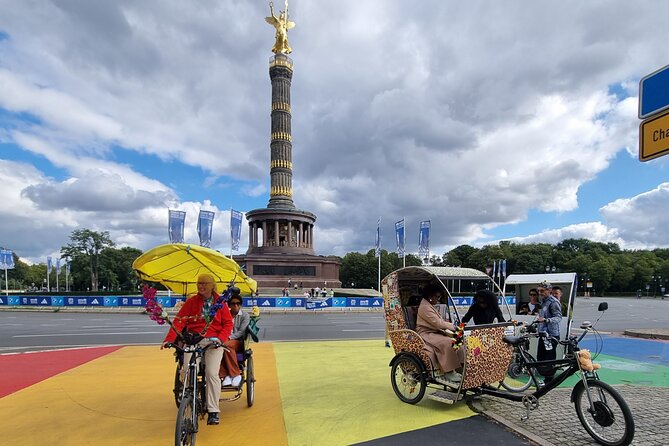
Berlin rewards a broad view. Its famous sights are scattered across several districts, and the distances between them can make a walking day surprisingly tiring. A private rickshaw gives you a moving seat while still keeping you close to the street.
That matters here. You are not sealed inside a sightseeing coach, and you are not committed to the pace of a large group. You can look up at the Reichstag, watch the city pass through Tiergarten, and shift quickly from grand government buildings to Kreuzberg streets.
Leo is the named guide for this experience. The tour is offered in English, and music can be arranged on request. Coffee, tea, and alcoholic beverages are also included, although the practical value of those extras depends on the length of your outing and the conditions on the day.
Pickup is offered from hotels, the central station, and cafés. The activity ends back at the meeting point, which makes it easier to fit into a day of sightseeing without arranging a separate return across town.
A few more Berlin trips to weigh up
- Berlin Complete in one day
★ 5.0 · 222 reviews - From Berlin: Sachsenhausen Concentration Camp Day Trip
★ 4.7 · 52 reviews - Private Tour: Potsdam Day Trip from Berlin
★ 4.5 · 43 reviews
Brandenburg Gate to Potsdamer Platz
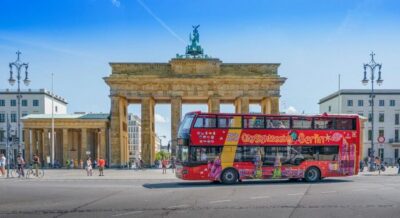
The Brandenburg Gate is a sensible starting point because it introduces Berlin’s grandest civic scale. Built between 1788 and 1791 from sandstone, it was designed by Carl Gotthard Langhans and inspired by the gateway buildings of the Acropolis in Athens.
You can photograph the gate from its broad open space and hear how it was meant to finish Unter den Linden, the historic boulevard leading east toward the center. Admission is free, and this is one of the stops where a short visit still feels worthwhile.
Nearby, the Reichstag recalls several turning points in German history. Philipp Scheidemann proclaimed the republic from the building’s west portal in 1918. The Reichstag fire followed in 1933, and the building was badly damaged again during the final battle for Berlin in 1945.
The stop at the Reichstag is listed as only about five minutes, with admission not included. That means you should think of it as an exterior introduction and photo pause, not a dome visit or parliamentary tour.
The German Chancellery offers a sharp contrast. Its 36-meter central building uses tall concrete pillars, broad glass surfaces, and large arches to create a modern sense of openness. The side wings are more compact, with offices grouped around glazed courtyards.
You may appreciate this stop if you enjoy modern architecture. It is less about an old monument and more about how reunified Germany presents its government in glass, concrete, and carefully framed open space.
The Soviet War Memorial in Tiergarten adds a more solemn note. Two T-34 tanks flank a bronze Red Army soldier, while the rear section contains the graves of about 2,500 Soviet soldiers. Admission is free, but the listed stop is brief, so expect a respectful look rather than a long memorial visit.
Tiergarten itself gives the route breathing room. Once a royal hunting ground, it was reshaped in the 19th century by Peter Joseph Lenné as an English-style public park. The roughly 200-hectare park includes monuments, bridges, the Victory Column, the Federal President’s Office, the House of World Cultures, and an English Garden around a pond.
Potsdamer Platz then brings you back into the modern city. The district was planned as a whole, with high-rise buildings, cafés, cinemas, shops, and a large shopping arcade. The short stop is mainly useful for seeing how Berlin filled a former divided and damaged zone with a new commercial center.
Nazi history and the former Wall
Berlin’s 20th-century history is impossible to avoid, and the Topography of Terror is one of the clearest places to begin. The site once held the main offices of the SS and police terror system, including the Gestapo headquarters, the SS leadership, and the Reich Security Main Office.
The outdoor and indoor material here is serious and documentary in tone. This tour allows only a short stop, with no admission fee listed, so use it to get oriented. If the subject matters to you, return later with more time.
The nearby Gropius Bau is devoted to cultural history, contemporary art, and photography. The building itself adds another architectural layer to this part of Berlin, but entry is not included. You can photograph the exterior during the tour and save the galleries for another visit.
The Berlin Wall Memorial and Checkpoint Charlie represent different sides of the divided city. The Wall memorial gives you a brief look at the physical remains and memory of the barrier. Checkpoint Charlie was the most famous of the American-controlled crossing points, used mainly by foreigners, West German officials, and East German officials.
Checkpoint Charlie is a quick stop, and the surrounding area is now full of shops and displays aimed at sightseers. I would use the rickshaw stop for orientation and a photograph, then avoid expecting a preserved border crossing in its original form.
Friedrichstraße continues the story of change. The north-south street became a popular shopping route after the Wall fell, especially between Checkpoint Charlie and Friedrichstraße station. It gives you a useful sense of how a former division line became a central commercial corridor.
Gendarmenmarkt, Bebelplatz, and Museum Island
Gendarmenmarkt is one of central Berlin’s most elegant squares. Its history reaches back to the late 17th century, when French Protestant immigrants settled in the area. The square changed names several times before taking its current name from the military regiment whose guardhouse and stables were located here from 1736 to 1782.
The German Cathedral, Concert Hall, and surrounding buildings make this a strong photo stop. The German Cathedral houses a five-floor exhibition about the development of liberal parliamentary democracy in Germany, but admission is not included.
The Konzerthaus is a major work of architect Karl Friedrich Schinkel. A theater opened here in 1776 under Frederick the Great, and the building later became the Royal National Theater. Again, the tour focuses on the outside, so you will need another ticket and another visit for a performance or interior tour.
Bebelplatz is beautiful at first glance, but its memorial asks you to look closer. On May 10, 1933, the Nazis burned more than 20,000 books here, targeting works they labeled hostile to German nationalism. The memorial below the square recalls the empty shelves left by that act of censorship.
This is a good example of why a guide adds value even at a two-minute stop. Without context, Bebelplatz can look like another handsome square. With context, it becomes a reminder of how public spaces can carry painful memory beneath their polished surfaces.
Museum Island and the Berliner Dom sit close together on the Spree. Museum Island developed over a century and now contains five major museum buildings. UNESCO added the complex to its World Heritage list in 1999, and restoration has continued since the late 1990s.
The tour does not provide a full museum visit. It gives you a quick look at one of Europe’s major museum centers, followed by the imposing Berlin Cathedral. The cathedral was rebuilt between 1894 and 1905 as the court and cathedral church of the Hohenzollern family.
If you have only one day in Berlin, this sequence gives you a strong visual introduction to the city’s imperial, parliamentary, cultural, and modern sides. If you want to enter the museums or cathedral, allow extra time outside the rickshaw tour.
Same city, a completely different kind of day:
- Berlin: Reichstag, Dome and Government District Guided Tour
★ 4.7 · 18,288 reviews - Berlin: 1-Hour City Tour by Boat with Guaranteed Seating
★ 4.3 · 16,993 reviews - Berlin: Boat Tour Along the River Spree
★ 4.4 · 11,252 reviews - Discover Berlin Half-Day Walking Tour
★ 5.0 · 9,624 reviews
Alexanderplatz and old Berlin near the Spree
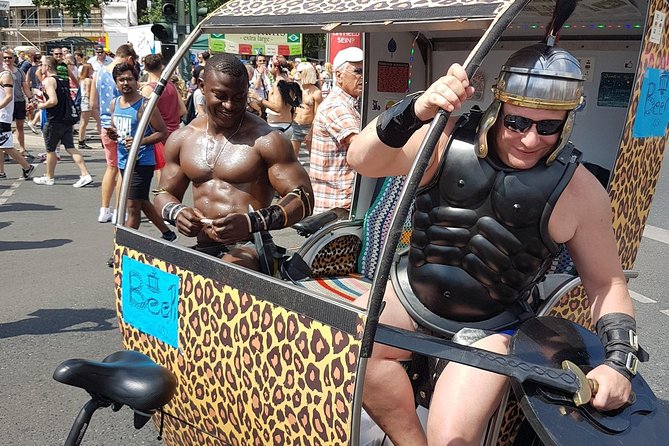
Alexanderplatz, or Alex, is both a major square and a transport hub. It is one of Berlin’s best-known public spaces, though its scale and mix of buildings can feel less graceful than Gendarmenmarkt or Museum Island.
The short visit works as a city orientation stop. From here, the route can move toward Nikolaiviertel, a recreated version of old Berlin built for the city’s 750th anniversary in 1987. The neighborhood functions almost like an open-air museum, centered on the Nikolaikirche.
The nearby Neptune Fountain sits in front of the Red City Hall. Neptune holds his trident in a basin, while four female figures represent the Elbe, Rhine, Oder, and Vistula rivers. It is a tiny stop, but it makes a good photo and adds a bit of Berlin civic folklore.
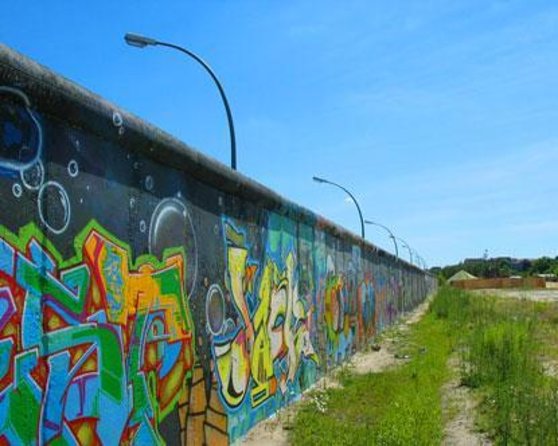
The East Side Gallery is one of the more important Wall-related stops. This 1.3-kilometer section of former Wall is covered with more than one hundred paintings and is described as the longest open-air gallery in the world.
The tour information does not assign a time to this stop, so the actual length may depend on your chosen route and schedule. If you want to study the paintings, walk along the Wall, or photograph several sections, ask for enough time before setting off.
Kreuzberg by Bergmannstraße and Oranienstraße
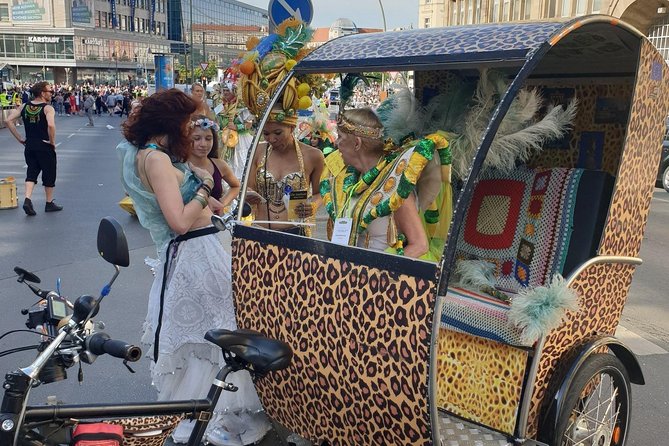
The move into Kreuzberg is where this experience becomes more than a list of monuments. Bergmannstraße and the surrounding streets show a calmer side of the district, with old buildings, small shops, cafés, and a mix of residents from many backgrounds.
Bergmannstraße sits between Gneisenaustraße, Mehringdamm, Südstern, and Fidicinstraße. The route describes it as more sedate than the SO 36 area, but still multicultural and lively. That makes it a useful counterpoint to the formal center of Berlin.
The Landwehrkanal is another pleasant change of pace. Built between 1845 and 1850, the 10.74-kilometer waterway was designed to help move building materials during Berlin’s industrial growth. It now runs through several districts, including Kreuzberg, Neukölln, Tiergarten, and Charlottenburg.
Admiralbrücke is especially appealing in warm weather. Its cobblestones and old gas lamps create a small urban meeting place beside the canal, where people gather to talk, drink, play music, and watch the sunset. Because nearby residents have complained about noise, the bridge is cleared at 10 p.m., so a late-night stop is not guaranteed.
Oranienstraße shifts the mood again. Small shops, bars, restaurants, and international food give the street a strong evening character, and the SO 36 area is closely tied to Kreuzberg’s nightlife.
Görlitzer Bahnhof offers a different kind of local history. The former station opened in 1866 on a 14-hectare site and once handled passengers, goods, and troop transports. The station is gone, but the area became Görlitzer Park, with lawns, sports fields, playgrounds, and a children’s farm.
These Kreuzberg stops are valuable because they show Berlin as a lived-in city rather than only a historical stage. They also explain why the private format matters. You can ask Leo to linger in an area that interests you, although the large number of possible stops means the exact balance depends on your time.
Tempelhofer Feld and Park am Gleisdreieck
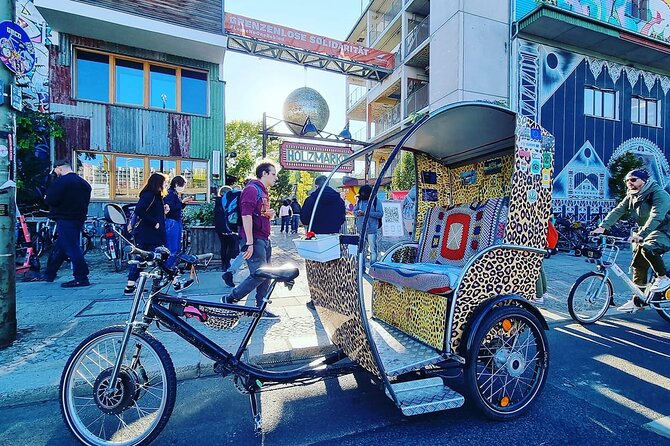
Tempelhofer Feld is one of Berlin’s most unusual open spaces. The former airport, including its large check-in hall and more than 300 hectares of airfield, opened to the public in 2010 after flights ended.
The scale is the attraction. Instead of a traditional park made of paths and planted beds, you get a huge former airport field with room for many kinds of public use. A 2014 referendum led to a law calling for public participation in the site’s future care and development.
The stop at Park am Gleisdreieck shows another way Berlin turned unused transport land into public space. The railway area near the Gleisdreieck junction sat unused after the Second World War, allowing plants and wildlife to develop. Local residents later organized to protect the area and helped secure its future as a park.
Together, these stops make a strong case for Berlin’s ability to reuse difficult urban spaces. They are less polished than a formal square, but they tell you more about how the city changes and how residents shape it.
What $140.77 means in practical value
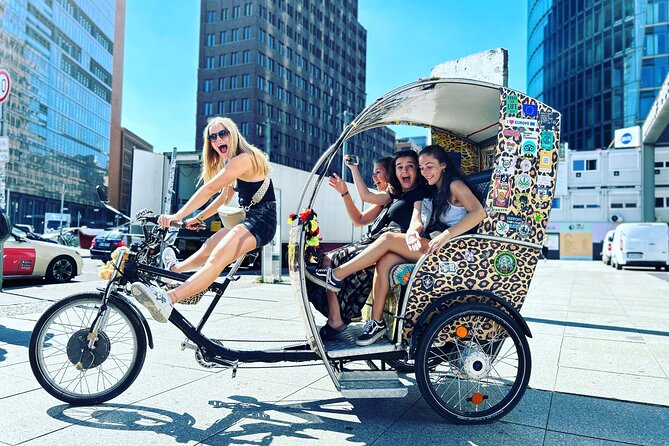
At $140.77 per person, this is not the cheapest way to see Berlin’s monuments. You are paying for a private vehicle, a personal guide, pickup, and the ability to cover a wide area without planning several transit connections.
The value is strongest for a small group that wants a quick orientation. It can also suit anyone who finds long walks tiring, since you can see much of central Berlin and Kreuzberg from a seat rather than on foot. One three-hour outing can connect places that would otherwise require careful routing.
The price is harder to justify if you want long museum visits, detailed memorial study, or slow neighborhood exploration. Most listed stops last from one to five minutes, and several have admission not included. Think of this as an efficient introduction with photo pauses, not a replacement for a full day at Museum Island or the Topography of Terror.
Music on request, drinks, coffee, and tea add a relaxed touch, but the core value remains the route and the guide. The private format also means you are not sharing the schedule with unrelated passengers.
Who should book this experience
I would choose this tour if you want to see Berlin’s main sights quickly and then decide where to return. It is especially useful early in a stay, when you need a map in your head and a feel for how the districts connect.
It suits couples, families, and private groups who prefer a personal pace. The activity allows service animals, is near public transportation, and most people can participate. Pickup from a hotel, central station, or café is convenient when you are still finding your way around.
I would be more cautious if your main goal is museum interiors or long historical discussions. The route covers a great deal, but its short stops favor breadth over depth. Good weather is also important, since the experience is outdoors and can be canceled for poor conditions.
Free cancellation is available up to 24 hours before the start time for a full refund. Changes or cancellations made within 24 hours are not accepted for a refund, and the local weather rule may result in a new date or full refund.
Should you book Leo’s Berlin rickshaw tour?
Book it if you want a lively, efficient first look at Berlin and like the idea of reaching parks, pedestrian areas, neighborhood streets, and major sights in one private outing. Leo’s route can show you both the Brandenburg Gate and the quieter corners of Kreuzberg, which is a useful balance.
Skip it if you already know Berlin well or want to spend serious time inside museums and memorials. For most first-time visitors with limited time, though, the rickshaw format makes practical sense. You get a broad city introduction, plenty of photo opportunities, and a guide who can help you decide where to spend the rest of your visit.
FAQ
How long does the Berlin rickshaw tour last?
The experience lasts approximately 3 to 6 hours. The exact length can affect how many of the listed sights receive more than a short photo stop.
What language is the tour offered in?
The tour is offered in English.
Is the tour private?
Yes. Only your group participates in the private activity.
Where can pickup take place?
Pickup is offered from hotels, the central station, and cafés. The tour ends back at the meeting point.
Is transportation included?
Yes. Private transportation is included, with the experience presented as a rickshaw tour through Berlin.
Are drinks included?
Alcoholic beverages, coffee, and tea are included. Music is available on request.
Are admission tickets included?
Some stops are free, while admission is not included for certain sites such as the Reichstag, Gropius Bau, the Berlin Wall Memorial, the German Cathedral, the Konzerthaus, the Berliner Dom, and Alexanderplatz-related attractions. The tour mainly provides exterior visits and short stops.
Can I cancel for a full refund?
You can cancel at least 24 hours before the start time for a full refund. If poor weather causes the tour to be canceled, you will be offered another date or a full refund.
Just added around Berlin
- Love and War in Berlin: Self-Guided Story Puzzle Walk★ 5.0 · 7 reviews
- Rickshaw Tours Berlin – Groups of up to 16 people with several rickshaws★ 4.0 · 97 reviews
- Walking on the Wall: 3-Hour Tour in Berlin★ 4.5 · 34 reviews
- eSIM for Germany and 34 European Countries★ 4.5 · 16 reviews
- Warnemuende Shore Excursion: Berlin Private Sightseeing Tour from Rostock★ 5.0 · 4 reviews
- Your ticket to The Wall Museum Berlin★ 3.0 · 60 reviews
- Warnemuende Shore Excursion: Private Berlin Tour★ 4.5 · 27 reviews
- Berlin’s Gay, Lesbian, and Queer Scene Small-Group Walking Tour★ 4.5 · 66 reviews
City Tours, compared.

1-Hour City Tour by Boat with Guaranteed Seating
Read our review →
City History Canal Sightseeing Tour on a Motorboat
Read our review →

Browse the lists this tour appears in