

Reviewed · SELF-GUIDED TOURS
Berlin Walking Tour with Audioguide on Your Smartphone
Berlin’s story unfolds block by block on this self-guided smartphone walk, from the Brandenburg Gate and Reichstag to Checkpoint Charlie and Alexanderplatz. You get a useful sweep of central Berlin without being tied to a group or a guide’s timetable.
I like two things right away: the freedom to pause and replay sections, and the route’s mix of famous sights and easy-to-miss details, such as the book-burning memorial window beneath Bebelplatz. The main caution is that the advertised two hours may be optimistic. One careful outing took about four hours, including lunch, and the app has occasionally frozen or placed the GPS marker inaccurately.
In This Review
- Key points to know
- A low-cost way to meet Berlin at street level
- Starting at Pariser Platz and the Brandenburg Gate
- The Reichstag and the politics of modern Berlin
- A quiet pause at the Holocaust Memorial
- The Führerbunker site and the need for historical care
- Ampelmännchen and the Trabi: Berlin’s lighter side
- Checkpoint Charlie and the Cold War city
- Gendarmenmarkt and Bebelplatz
- Unter den Linden, Frederick the Great, and the State Opera
- Museum Island and Berlin Cathedral
- Marx and Engels Forum, Red Town Hall, and Alexanderplatz
- How the app works in real use
- Is the two-hour estimate realistic?
- Who will get the most from this walk?
- Should you book it?
- FAQ
- Is this a guided walking tour with a person?
- What language is available?
- How long does the tour take?
- Where does the tour begin?
- Where does the tour end?
- Do I need my own smartphone?
- Are headphones included?
- Is transportation included?
- Are entrance tickets included?
- Can I pause the tour for coffee or lunch?
- Is the map available offline?
- What happens if the app freezes?
- Can I cancel for a refund?
Key points to know
- 24 English recordings cover major landmarks, historical events, and smaller details along the route.
- GPS navigation and an offline map make it possible to follow the walk without a human guide.
- The route begins and ends at Pariser Platz, taking in the Brandenburg Gate, Holocaust Memorial, Checkpoint Charlie, Gendarmenmarkt, Museum Island, and Alexanderplatz.
- You control the pace, so you can stop for coffee, lunch, photographs, or extra time at a memorial.
- The app costs about $6.61 per person, making it a low-cost introduction to central Berlin.
- Bring your own smartphone and headphones, and allow extra time for app setup and a route that may take longer than two hours.
A low-cost way to meet Berlin at street level
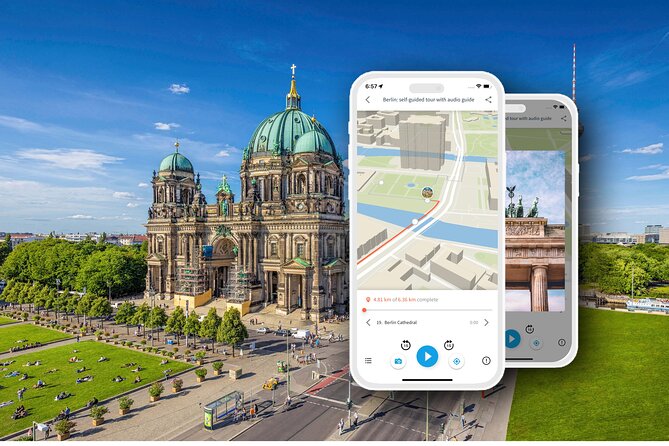
At about $6.61 per person, this tour is priced more like a city orientation than a full guided excursion. You are paying for a route, audio commentary, map, and landmark illustrations, not for entrance tickets or personal attention from a guide.
That distinction matters. If you want to ask questions about Prussian architecture, Nazi Germany, or the Cold War as you walk, a live guide will serve you better. If you prefer to stop whenever a café catches your eye, replay a story, or spend ten extra minutes taking pictures, the app gives you room to do that.
The route covers a large section of central Berlin. It links grand ceremonial spaces, memorials, government buildings, former Cold War sites, and East German symbols. You will get a strong first look at the city’s major sights, though you should not treat the two-hour estimate as a strict schedule.
The experience is self-guided from start to finish. You download the app for iPhone or Android, activate the purchase, put in your headphones, and follow the map. The audio guide is available at any date and time during its one-year access period, so you can use it when the weather and your energy cooperate.
A few more Berlin trips to weigh up
- Discover Berlin Half-Day Walking Tour
★ 5.0 · 9,624 reviews - Berlin: Third Reich and Cold War 2 Hour Walking Tour
★ 4.9 · 6,830 reviews - Berlin: Discover Berlin Walking Tour
★ 4.9 · 5,998 reviews
Starting at Pariser Platz and the Brandenburg Gate

The walk begins at Pariser Platz, one of Berlin’s most recognizable urban rooms. The square frames the Brandenburg Gate and the formal buildings around it, giving you a quick lesson in how Berlin presents its past through architecture and public space.
The audio commentary helps you look beyond the gate’s familiar columns. You hear about its role as a symbol of power, division, and later reunification. It is worth pausing here before moving on, since Pariser Platz can feel very different depending on crowds, traffic, and the time of day.
The Brandenburg Gate itself receives a separate stop, which makes sense. You can study the neoclassical design, the Quadriga sculpture above it, and the gate’s change from a marker of separation to a symbol of a reunited city.
Because both Pariser Platz and the gate receive about ten minutes in the planned route, you are not expected to spend a long time at either one. Still, I would allow extra time if this is your first visit to Berlin. The opening section establishes the main theme of the whole walk: the city’s monuments often carry several meanings at once.
The Reichstag and the politics of modern Berlin
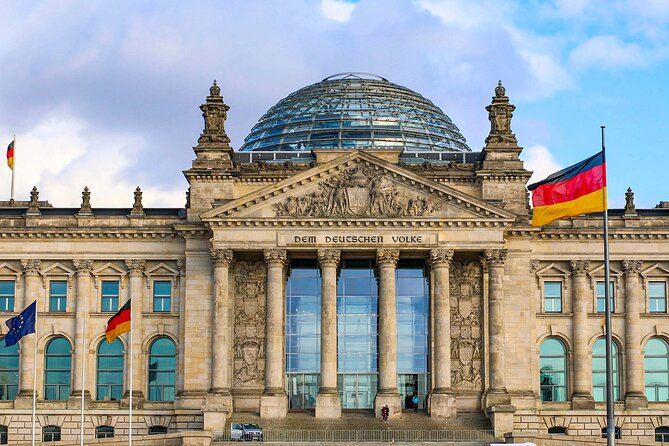
The Reichstag is the next major sight. Its historic shell and modern glass dome make it one of Berlin’s clearest examples of old and new architecture sharing the same address.
The commentary points toward the dome’s connection with transparency and democracy, as well as the building’s place in Germany’s political story. You can admire the exterior as part of the walk, but the tour does not include entry. Any visit inside or to the dome would require separate planning and tickets.
This is an important practical point throughout the route. The tour guides you to sights, but admission fees are not included. Many of the places are public squares, streets, or exterior monuments, so the low price remains useful. Museums, observation decks, and other ticketed attractions cost extra.
A quiet pause at the Holocaust Memorial
The Memorial to the Murdered Jews of Europe shifts the tone. Its field of concrete slabs creates a physical experience that is difficult to reduce to a short audio explanation. Walking between the blocks, you may feel the space change as the ground rises and falls around you.
The route allows roughly ten minutes here, but I would not rush. The underground Information Centre adds context, although it is not included as an admission feature in the tour. The audio stop gives you a starting point for reflection, while the memorial itself asks you to slow down and pay attention.
A self-guided format can work well at a place like this. You can listen quietly, pause the recording, and continue only when you are ready. There is no group waiting at the corner, and no need to compete with a guide’s speaking pace.
Same city, a completely different kind of day:
- Berlin: Reichstag, Dome and Government District Guided Tour
★ 4.7 · 18,288 reviews - Berlin: 1-Hour City Tour by Boat with Guaranteed Seating
★ 4.3 · 16,993 reviews - Berlin: Boat Tour Along the River Spree
★ 4.4 · 11,252 reviews - Berlin: Hop-on Hop-off Bus Tour with Live Commentary
★ 4.3 · 8,579 reviews
The Führerbunker site and the need for historical care
The former Führerbunker site is now an ordinary-looking area with a parking lot and an information display. That contrast is the point. The physical setting does not offer a preserved underground complex to explore, but the site marks where Hitler spent his final days.
The audio stop presents the location as a reminder of the end of the Nazi era. You should arrive with realistic expectations: this is a historical marker, not a dramatic ruin or an underground attraction.
This section also shows why a little preparation can help. The subject matter is grim, and the site is intentionally plain. The value comes from understanding what happened there and why the modern city has chosen not to turn it into a shrine.
Ampelmännchen and the Trabi: Berlin’s lighter side
After the darker chapters, the route introduces two reminders of everyday East German life. Ampelmännchen, the cheerful little pedestrian figures on traffic lights, began in East Germany and later became a popular symbol across the reunited city.
You will spot them at crossings rather than at one formal monument. The audio commentary gives this small design detail a place in Berlin’s cultural story. It is a good example of how the tour can make ordinary street scenes more interesting.
The Trabant, usually called the Trabi, adds another East German reference. These small cars became symbols of life behind the former Iron Curtain and now appear in novelty city tours. The walk points you toward that piece of Berlin’s past, but it does not include a Trabi ride.
That distinction is easy to miss when scanning the stops. You are learning about the car and its meaning, not booking transportation in one. For some people, these lighter stops break up the sequence of monuments. For others, they may feel less important than the major historical sites.
Checkpoint Charlie and the Cold War city
Checkpoint Charlie is one of the route’s most direct encounters with Berlin’s divided past. The present-day border post is a replica, but the location still carries the memory of a city split by ideology, walls, guards, and escape attempts.
The audio guide explains the crossing’s place in Cold War Berlin and points you toward the nearby museum, which covers escape stories and border history. Museum entry is not included, and the area around the checkpoint can feel commercial and crowded.
I would use the app’s commentary as an introduction rather than the final word on the Cold War. The stop helps you understand what you are looking at, but the museum or a longer historical visit will give you more detail if this period interests you.
Still, Checkpoint Charlie works well on a broad orientation walk. It connects the earlier material about division and reunification with the physical reality of a former border crossing.
Gendarmenmarkt and Bebelplatz

Gendarmenmarkt offers a welcome change of setting. The square is framed by the German Cathedral, French Cathedral, and Konzerthaus, with the Schiller Monument at its center. Even if you are mainly interested in Berlin’s political past, this stop reminds you that the city is also a place of music, design, and grand public spaces.
The audio commentary gives you enough context to appreciate the square’s balance and formal layout. Cafés around the area make it a natural place for a pause, though the tour’s price does not cover food or drinks.
Bebelplatz brings the mood back to intellectual freedom and state persecution. The square is surrounded by major cultural and religious buildings, including the State Opera, St. Hedwig’s Cathedral, and Humboldt University.
Look down for the underground memorial to the Nazi book burning. A glass panel lets you see the empty library below the square. This is one of the route’s most useful details because it is easy to walk past without noticing. The audio guide directs your attention to a small feature that carries a large historical meaning.
The stop may be brief in the suggested schedule, but I would give yourself time to locate the glass window and consider what it represents. This is exactly where a pause-and-replay format has an advantage over a hurried group.
Unter den Linden, Frederick the Great, and the State Opera

The route continues along Unter den Linden, Berlin’s grand central boulevard. The equestrian statue of Frederick the Great gives the audio guide a chance to explain the Prussian era and the king’s role in shaping the city’s image.
The monument is large and formal, with Frederick shown on horseback. You do not need to be a specialist in Prussian history to appreciate the way the statue dominates the boulevard. The commentary helps place it within Berlin’s older political tradition.
Nearby, the German State Opera adds a cultural note. The building’s neoclassical setting and long performance tradition make it an important part of Unter den Linden. The experience guides you past it, but it does not include an opera, ballet, or interior visit.
This is a recurring pattern: the walk gives you a useful framework, then leaves you free to return to the places that catch your interest. I like that approach for a first day in Berlin, but you should not expect full architectural lectures at every façade.
Museum Island and Berlin Cathedral
Museum Island brings together several of Berlin’s most important cultural institutions on the Spree. The island is a UNESCO World Heritage site and includes five museums, among them the Neues Museum and Pergamon Museum.
The tour introduces the area rather than providing museum admission. If you plan to visit the collections, set aside a separate block of time. Trying to combine a museum visit with the entire walk would make the two-hour estimate even less realistic.
Berlin Cathedral is another major sight in this section. Its large dome, ornate interior, and terrace views make it one of the city’s most impressive landmarks. Again, the audio guide takes you to the building and explains its place in Berlin, but entrance is extra.
This is one of the route’s strongest stretches for architecture. You move from the formal boulevard to the river setting of Museum Island, then to the cathedral’s imperial scale. The app’s illustrations can help you identify buildings as you go, especially if you are walking through a crowded area.
Marx and Engels Forum, Red Town Hall, and Alexanderplatz
The Marx and Engels Forum offers a glimpse into the city’s communist-era symbolism. Statues, reliefs, and remnants of the Berlin Wall recall the political system that shaped East Berlin after the Second World War.
The park setting gives you a calmer place to listen. The stop may be most useful if you want your Berlin walk to include more than Nazi and Cold War landmarks. It puts the former East German period into the route without requiring a separate museum visit.
The Red Town Hall follows, with its red-brick Neo-Renaissance façade and nearby Neptune Fountain. It remains the city government’s seat, making it both an architectural sight and a working civic building.
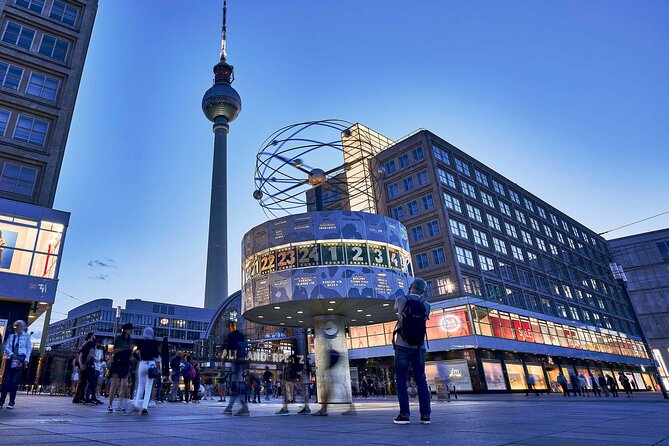
The final numbered stop is Alexanderplatz, a major transport and shopping center. The Television Tower dominates the view, while the Weltzeituhr, or world-time clock, offers a recognizable meeting point and a reminder of the square’s East German design.
You can visit the Television Tower’s observation deck separately for wide views over Berlin. That ticket is not included, so treat the audio stop as an introduction to the tower and Alexanderplatz rather than a reservation.
Ending where you began at Pariser Platz would be convenient, but the route details also describe the walk through Alexanderplatz and say the activity ends back at the meeting point. Use the app’s route screen as your final guide on the day, and allow time for the return portion if it is included in your active route.
How the app works in real use
You receive an app for iPhone or Android, an offline map, GPS navigation, landmark illustrations, and 24 audio recordings. The map is designed to help you follow the route without needing a human guide or printed directions.
The GPS worked well for some users, but it was not perfect for everyone. At times, the position marker was inaccurate, and one useful improvement would be written walking directions alongside the map. You should keep your bearings by checking the next landmark rather than trusting the blue dot alone.
The app has also frozen occasionally. Closing and reopening it solved the problem during one outing, with the tour resuming from the previous point. Download and activate the tour before you reach Pariser Platz, and bring headphones with enough battery for the full walk.
The audio delivery may sound theatrical to some listeners. The content itself covers interesting questions and lesser-known details, but a few sections can feel long. Since you can pause or replay a recording, you have more control than you would in a live group.
One booking detail deserves attention: the date and time selected at checkout are approximate because you can use the tour at any time during its one-year access period. Free cancellation is available up to 24 hours before the experience start time. Cancellations inside that window are not refunded.
Is the two-hour estimate realistic?
The planned time at many stops is about ten minutes, which explains the two-hour estimate. That schedule works if you move steadily, listen while walking, and keep your stops short.
In real use, you may want four hours or more. Lunch, photographs, the Holocaust Memorial, Museum Island, and the many sights between the numbered stops can easily stretch the route. The ability to pause is one of the tour’s best features, so there is little reason to force yourself into the shortest possible schedule.
The route also covers a lot of ground. Wear comfortable shoes, keep your phone charged, and treat the two-hour figure as a minimum orientation time rather than a promise of door-to-door completion.
Who will get the most from this walk?
I would choose this tour if you want a broad introduction to central Berlin and prefer independence over a scheduled group. It suits couples, solo visitors, and families who want to take breaks without holding up other people.
It is also a good fit if you have already walked through the city and noticed monuments without knowing their meaning. The audio commentary can turn a familiar crossing, statue, or glass memorial panel into part of a larger story.
I would choose a live guide instead if you want detailed questions answered, strong architectural analysis, or a carefully paced account of Berlin’s complicated past. The commentary is informative, but one criticism was that some monuments received less historical and architectural explanation than expected.
Should you book it?
Book this Berlin audio walk if you want the lowest-cost, flexible way to cover major central sights. The route links the Brandenburg Gate, Holocaust Memorial, Führerbunker site, Checkpoint Charlie, Gendarmenmarkt, Bebelplatz, Museum Island, and Alexanderplatz, while leaving you free to stop for lunch or replay a section.
Skip it if app glitches would frustrate you, if you need a human guide, or if you want to enter several museums and landmarks during the same outing. For the best experience, activate the app early, bring headphones, allow four hours rather than two, and use the GPS as a helpful aid rather than your only source of direction.
FAQ
Is this a guided walking tour with a person?
No. This is a self-guided audio tour delivered through a mobile app. There is no human guide accompanying you.
What language is available?
The tour is offered in English.
How long does the tour take?
The estimated duration is about two hours, but you should allow more time if you take photographs, stop for food, visit sights, or listen at a relaxed pace.
Where does the tour begin?
It begins at Pariser Platz, 10117 Berlin, Germany.
Where does the tour end?
The activity information says it ends back at the meeting point. The route also includes Alexanderplatz, so follow the active app map for the exact return instructions.
Do I need my own smartphone?
Yes. The audio guide works through an iPhone or Android mobile app, and a smartphone is not provided.
Are headphones included?
No. You need to bring your own headphones.
Is transportation included?
No. Transportation is not included in the tour.
Are entrance tickets included?
No. Entrance fees and tickets for places such as museums, the Television Tower, or other attractions are not included.
Can I pause the tour for coffee or lunch?
Yes. The tour is designed for flexible use, so you can pause and restart it when you wish. You receive access for one year after purchase.
Is the map available offline?
Yes. An offline map with the route is included for GPS navigation.
What happens if the app freezes?
The app has occasionally frozen for some users. Closing and reopening it allowed the tour to resume in one reported case. If you need help activating the guide, support is available through [email protected].
Can I cancel for a refund?
Yes, if you cancel at least 24 hours before the experience start time. Cancellations made less than 24 hours in advance are not refunded.
Just added around Berlin
- Love and War in Berlin: Self-Guided Story Puzzle Walk★ 5.0 · 7 reviews
- Rickshaw Tours Berlin – Groups of up to 16 people with several rickshaws★ 4.0 · 97 reviews
- Walking on the Wall: 3-Hour Tour in Berlin★ 4.5 · 34 reviews
- eSIM for Germany and 34 European Countries★ 4.5 · 16 reviews
- Warnemuende Shore Excursion: Berlin Private Sightseeing Tour from Rostock★ 5.0 · 4 reviews
- Your ticket to The Wall Museum Berlin★ 3.0 · 60 reviews
- Warnemuende Shore Excursion: Private Berlin Tour★ 4.5 · 27 reviews
- Berlin’s Gay, Lesbian, and Queer Scene Small-Group Walking Tour★ 4.5 · 66 reviews
Self-Guided Tours, compared.

BVB Signal Iduna Park: Stadium Access and Self-Guided Tour
Read our review →
Solar Powered Sunset Catamaran Cruise & Audio Guide
Read our review →
Neuschwanstein Castle Entry Ticket and Audio Guide
Read our review →
Neuschwanstein Castle Ticket With Audio Guided Tour
Read our review →


Browse the lists this tour appears in