
Reviewed · MUSEUM & GALLERY TICKETS
Berlin: Neues Museum Entry Ticket
The bust of Nefertiti is the star, but it is only the beginning. Inside the Neues Museum, you move from Egyptian galleries to prehistoric Europe and the classical world, all within a beautifully rebuilt 19th-century museum. I like the way the building itself tells a story, with wartime damage left visible beside David Chipperfield’s modern restoration. I also like the included audio guide, which gives the objects much more meaning than labels alone. The main drawback is that the museum is far larger than the advertised 15-minute entry window suggests, and limited cloakroom space makes arriving with bags a nuisance.
I love that a $16 ticket can fill two or three hours without adding transport or a separate guided-tour fee. I also like the flexible feel of the visit: once admitted, you can stay as long as you like. Photography restrictions around Nefertiti, occasional missing audio stops, and some dimly lit cases may frustrate you, but the collection and the building make this one of Museum Island’s strongest stops.
In This Review
- Key points to know before you go
- Why the Neues Museum deserves your time
- Entering from the James Simon Gallery
- The building is part of the exhibit
- The Egyptian Museum and Nefertiti
- Prehistory from the Middle East to Scandinavia
- The Antique Collection and the Roman world
- Priam’s Treasure and the problems behind great collections
- Using the audio guide without losing your own pace
- How much time should you allow?
- Is $16 good value?
- Who will enjoy this museum most?
- Should you book the Neues Museum ticket?
- FAQ
- Where is the entrance to the Neues Museum?
- What collections are included?
- Is the bust of Nefertiti included?
- Is an audio guide included?
- How long can I stay inside?
- Is the ticket valid for other Museum Island museums?
- Can I bring a backpack?
- Is the Neues Museum wheelchair accessible?
- Does the ticket include transportation?
Key points to know before you go
- Nefertiti is the headline attraction, but the Green Head and Berlin Gold Hat deserve serious attention too.
- Three major collections share one building: Egyptian artifacts, the Antique Collection, and Prehistory and Early History.
- The audio guide is included in English, Spanish, French, German, and Italian.
- The $16 price is strong value if you spend two or three hours exploring rather than making a quick photo stop.
- Enter through the James Simon Gallery on Bodestrasse, and avoid bringing a backpack because storage is limited.
- The whole building is wheelchair accessible, with seating along parts of the route.
Why the Neues Museum deserves your time
Museum Island has several big-name institutions, so it is fair to ask why the Neues Museum should claim a place in your Berlin schedule. My answer is that it offers more than a famous object in a glass case. You get a broad look at how people lived, worshipped, created, and traded across thousands of years, while the building itself adds another layer.
The museum presents three collections: the Egyptian Museum, the Museum of Prehistory and Early History, and the Antique Collection. That mix gives the visit a useful rhythm. One room may focus on pharaohs and burial customs, while the next shifts toward prehistoric cultures stretching from the Middle East to the Atlantic, North Africa to Scandinavia.
I would not treat this as a quick 15-minute attraction. The 15-minute period refers to the validity of entry from first activation, not the amount of time you get inside. Once admitted, you can remain in the museum for as long as you like. Most people should allow at least two hours, while anyone who reads labels carefully or uses the audio guide could easily spend three hours.
More museum & gallery tickets in Germany:
- Berlin: Jewish Museum Berlin Entrance Ticket
★ 4.5 · 8,393 reviews - Berlin: DDR Museum Tickets
★ 4.3 · 3,443 reviews - Berlin: Natural History Museum Entrance Ticket
★ 4.6 · 3,382 reviews
Entering from the James Simon Gallery
The visitor entrance is at the James Simon Gallery on Bodestrasse, 10178 Berlin. This matters because the Neues Museum itself is part of the larger Museum Island complex, and the entry point is not simply a door marked Neues Museum beside the famous exhibits.
Have your ticket ready on your phone. The advance ticket is especially useful on rainy days, holidays, or warm afternoons when the ticket line can stretch outside. The practical benefit is not that the museum becomes a private experience, but that you avoid spending your limited Berlin time waiting to buy admission.
The entry arrangement can have some flexibility, but I would not build your entire day around arriving far outside the stated time. Some ticket holders have been admitted early or later than expected, yet that depends on staff and crowd levels. Treat any flexibility as a bonus, not a promise.
Bring as little as possible. Backpacks are not allowed in the exhibition areas, and locker and cloakroom capacity is limited. A smaller bag is a much safer choice. This is one of those small planning details that can save you an awkward return to the entrance.
The building is part of the exhibit
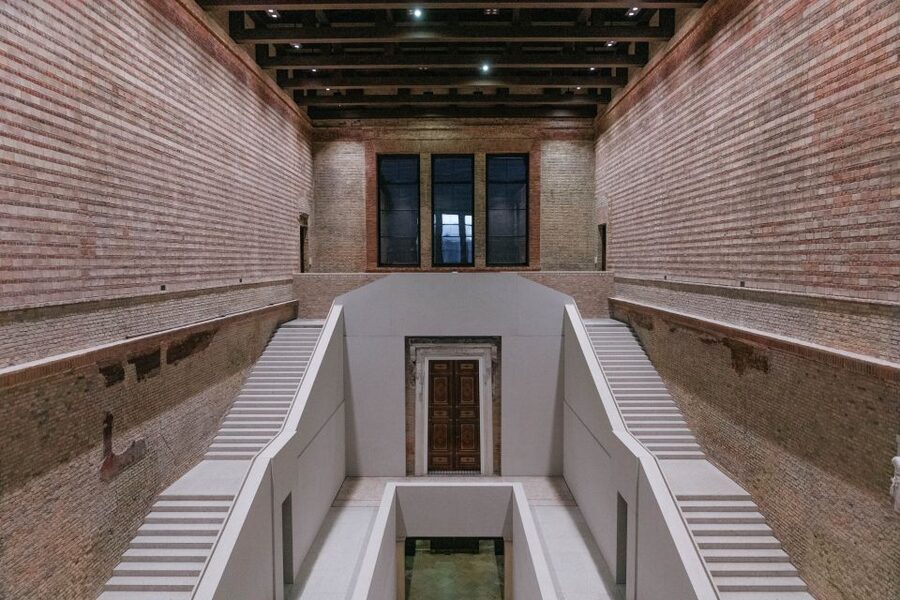
The Neues Museum suffered major damage during the Second World War and later underwent a major reconstruction led by David Chipperfield. The result is not a shiny replica of the original. Surviving sections, scars, worn surfaces, restored rooms, and new architectural elements share the same route.
I like this approach because it lets you read the museum as both a historic structure and a modern public space. The grand staircase is a highlight in its own right, with high ceilings and broad rooms that give large artifacts room to breathe. Some visitors come for Egypt and end up spending almost as much time looking at the building.
The restoration also helps explain the 19th-century story behind the museum. This was an age when European institutions were classifying the world, building public collections, and using new technologies to study the past. The Neues Museum reflects that ambition, including both the excitement and the difficult questions that come with collecting objects from other cultures.
The Egyptian Museum and Nefertiti
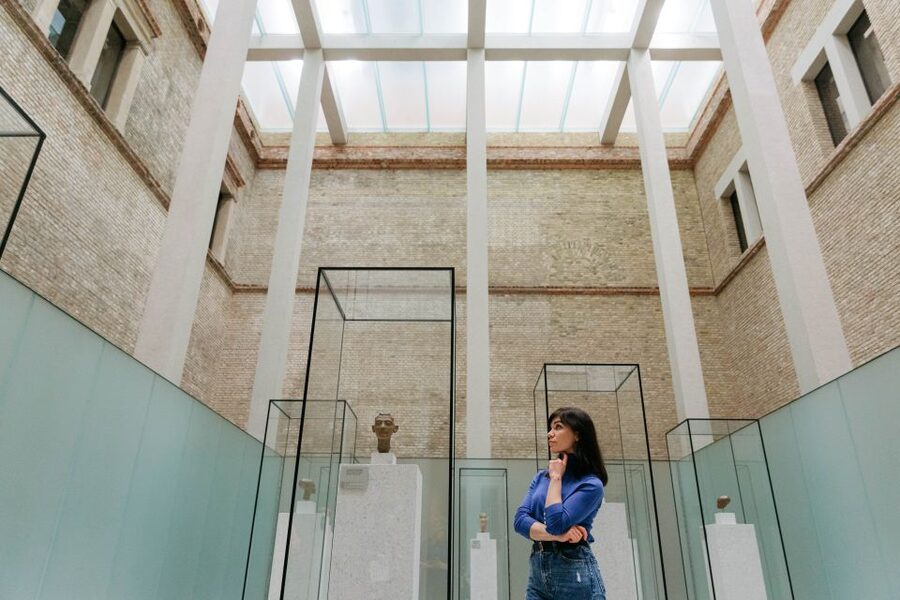
The Egyptian galleries are the emotional center of the visit. You will find statues, funerary objects, sarcophagi, architectural pieces, and objects that show how Egyptian life was shaped by religion, death, status, and craftsmanship.
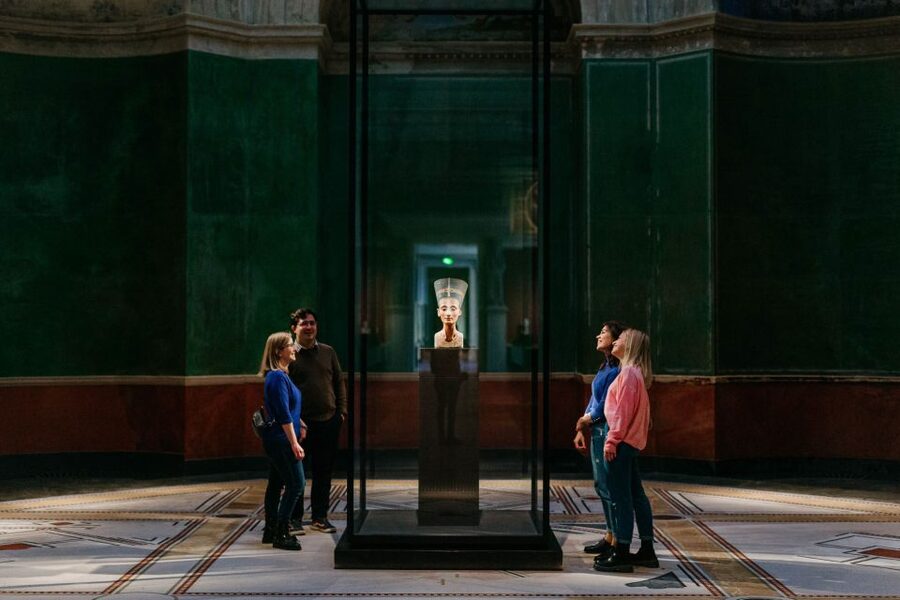
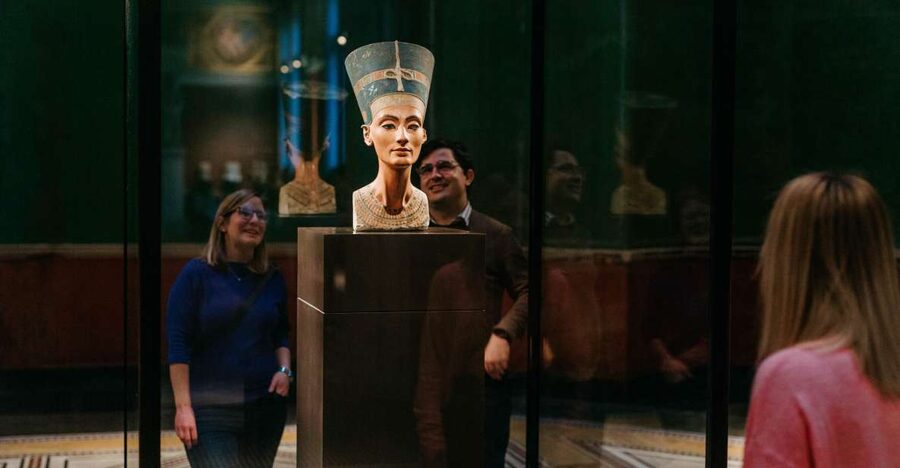
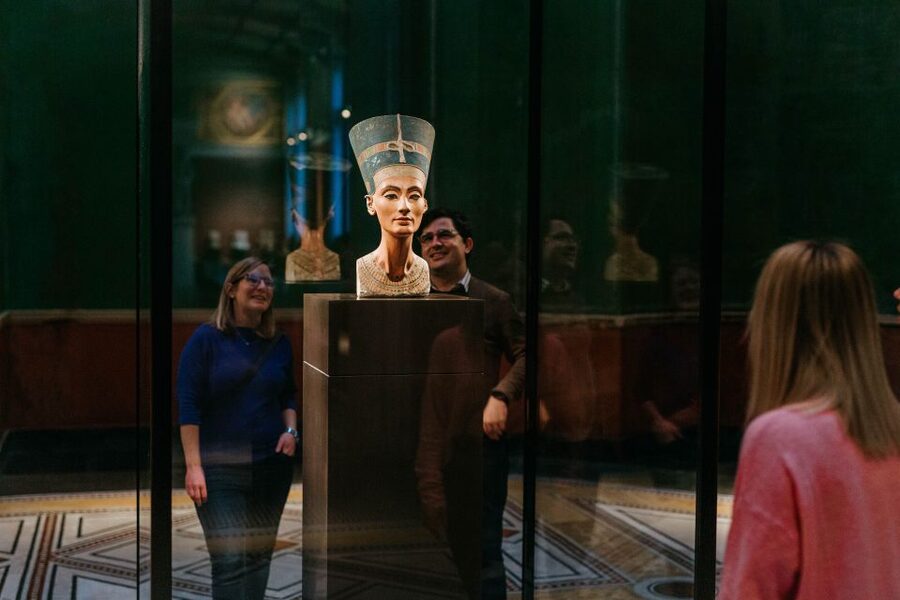
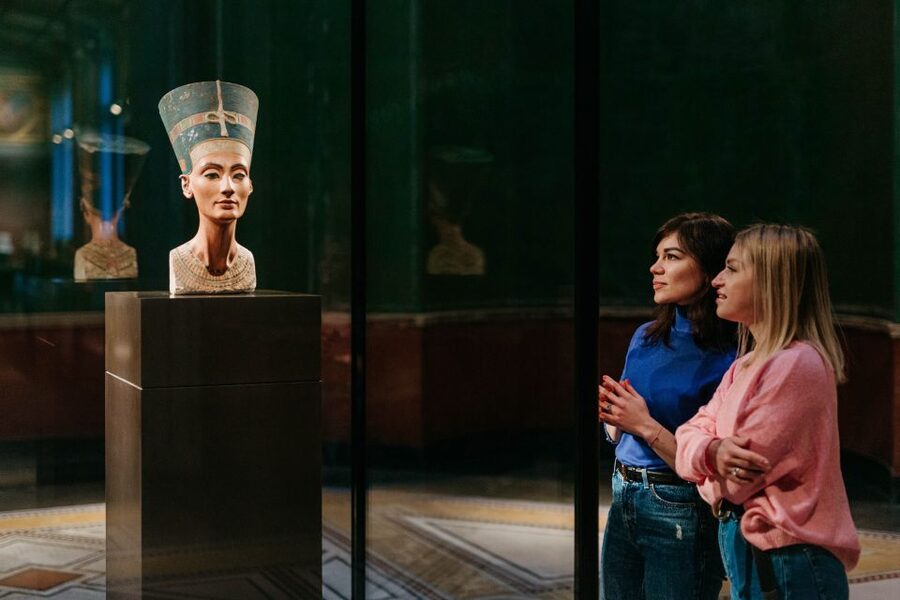
The famous bust of Nefertiti is displayed in a dedicated setting, and it earns its reputation. The sculpture’s calm expression and carefully balanced features are easy to appreciate even if you are not an Egypt specialist. The audio commentary is particularly useful here because it gives you context instead of leaving you to stare at the object for thirty seconds and move on.
Photography around Nefertiti is restricted. Do not assume that your phone camera is welcome right beside the bust. Some visitors have been able to take a picture from behind a marked line, but follow the current instructions from the museum staff rather than arguing with the guard. In practical terms, the moment is better if you give yourself time to look instead of trying to manage a perfect photograph.
The Green Head is another essential stop. Its distinctive expression makes it feel very different from the polished royal image of Nefertiti. I would use the audio guide for both objects, then pause and compare what each face seems to communicate.
You will also see a replica of an Egyptian sarcophagus, along with a large number of objects that help fill out the wider picture. The Egyptian section is not just a greatest-hits display. It gives you enough material to understand how individual pieces fit into a culture of ritual, power, and remembrance.
A few more Germany trips to weigh up
- Cologne: Chocolate Museum Entrance Ticket
★ 4.4 · 2,790 reviews - Dresden: Church of Our Lady Guided Tour of Gallery
★ 4.7 · 2,421 reviews - Skip-the-Line: Berlin Wall Museum at Checkpoint Charlie
★ 4.1 · 2,041 reviews - Berlin: Museum Island Multiple Museum Entry Ticket
★ 4.4 · 2,007 reviews
Prehistory from the Middle East to Scandinavia
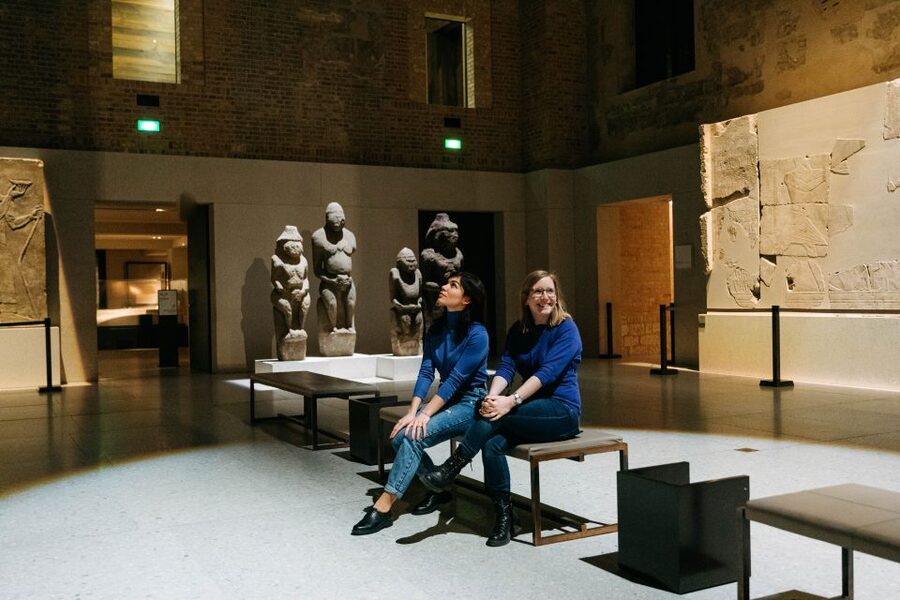
The Museum of Prehistory and Early History expands the visit beyond Egypt. Its scope reaches from the Middle East to the Atlantic and from North Africa to Scandinavia, so the galleries offer a long, wide view rather than a single civilization story.
This section is valuable when you want to understand how archaeologists build a picture of the past from objects that often seem ordinary. Tools, ornaments, weapons, vessels, and ritual pieces can reveal movement, trade, technology, and changing social habits.
The Berlin Gold Hat is one of the objects I would seek out. It is visually striking, but its importance also lies in what it suggests about prehistoric craftsmanship and belief. The museum’s presentation encourages you to consider not only how the object was made, but who could have commissioned or used something so elaborate.
You will also encounter the statue known as the Xanten Boy. Its presence adds a human scale to a collection that can otherwise feel dominated by grand artifacts. The displays make the most sense when you give yourself time to read the labels and listen to selected audio stops.
The route is organized well enough to help you avoid missing major rooms, though it is still easy to lose your sense of how much remains. One practical strategy is to follow the main path once, then return only to the objects that held your attention. Trying to study every case in one pass can turn an enjoyable museum visit into an endurance test.
The Antique Collection and the Roman world
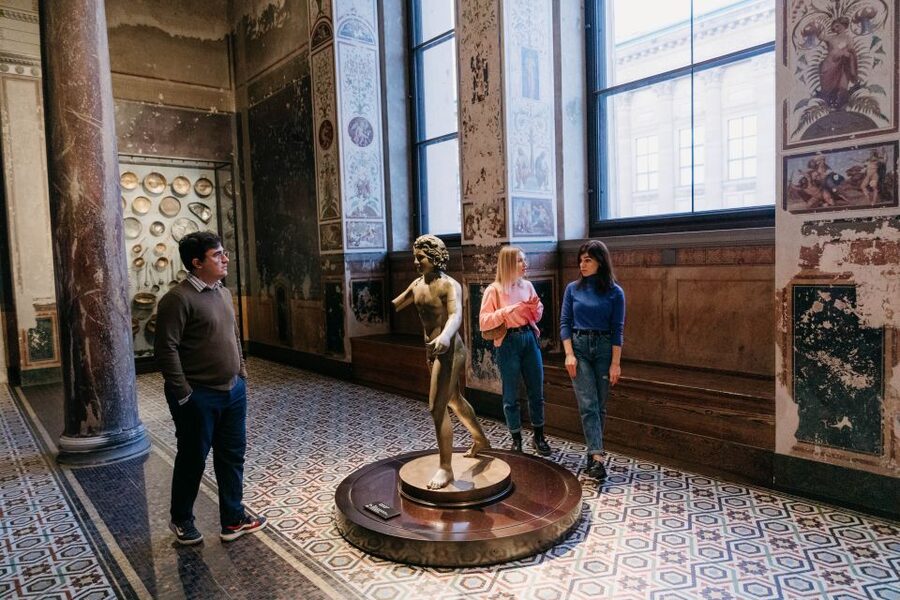
The Antique Collection brings Greek and Roman material into the picture. You may find yourself moving from Egyptian religious imagery to the visual language of the classical Mediterranean, then onward to objects connected with wider European cultures.
Among the notable pieces is one of the surviving statues of the Roman sun god Helios. The statue gives you a useful reminder that ancient religion was not abstract. Gods were represented through recognizable forms, poses, clothing, and attributes, and those visual choices helped make belief public and understandable.
The Antique Collection is also where the museum’s broad historical approach pays off. Instead of treating Egypt, Greece, Rome, and prehistoric Europe as sealed-off subjects, the visit allows you to think about connections and contrasts. I find that more rewarding than a museum that presents each culture as an isolated chapter.
Some displays may seem less immediately spectacular than Nefertiti or the Gold Hat. Give them a chance. The quieter objects often explain daily life, production, or technical skill better than the famous centerpiece pieces do.
Priam’s Treasure and the problems behind great collections
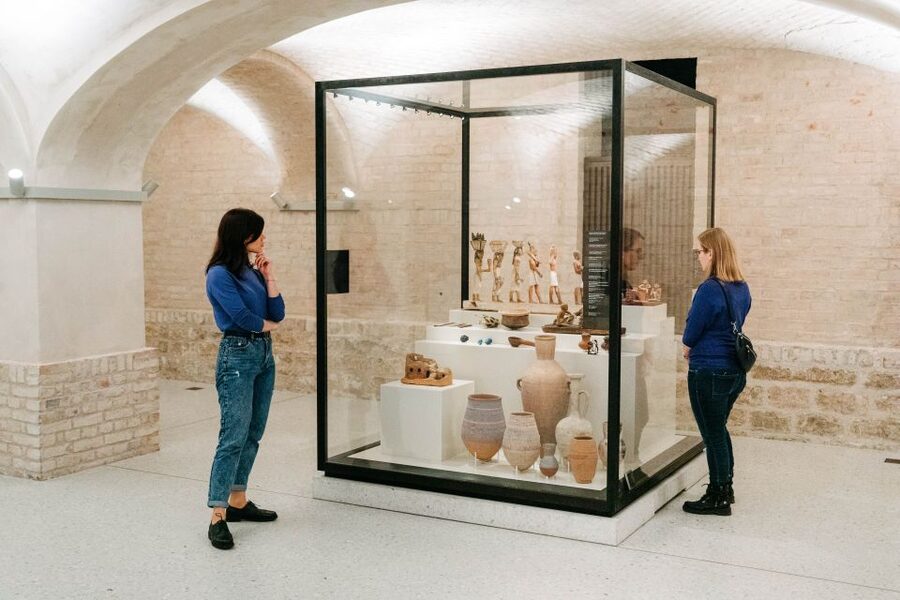
Priam’s Treasure, associated with Heinrich Schliemann, is another major draw. The collection is visually impressive, but it also raises questions about how archaeological objects were excavated, acquired, removed, and displayed.
That question is especially clear with Egyptian material. You may admire the skill and beauty of the objects while still wondering if they should be displayed in Berlin or returned to the places where they originated. The museum visit does not erase that issue, and it is worth keeping in mind as you move through the galleries.
I appreciate the chance to enjoy the objects without pretending that collecting has always been simple or fair. If you are interested in museums as institutions, rather than only as containers for old things, the Neues Museum offers plenty to think about.
Using the audio guide without losing your own pace
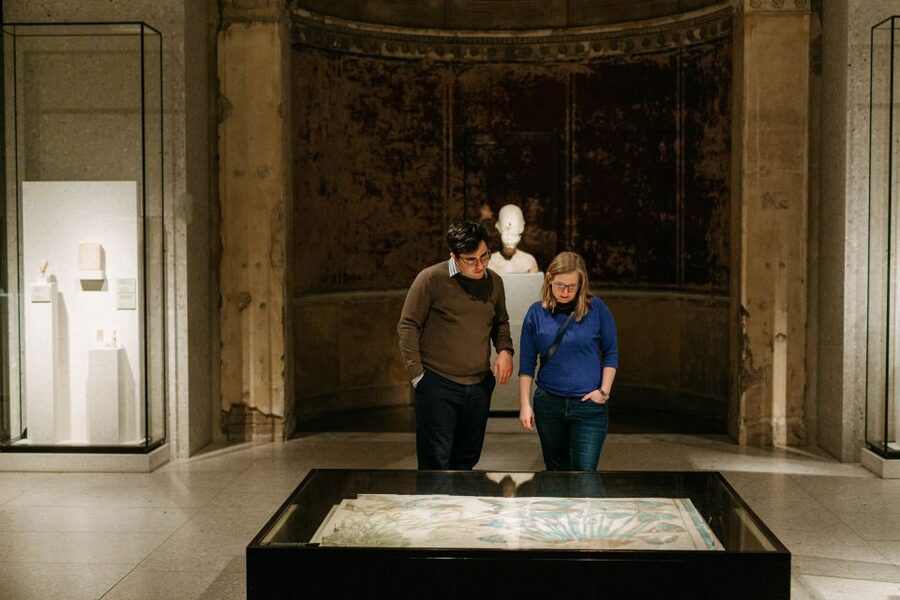
The audio guide is included with admission and is available in English, Spanish, French, German, and Italian. Staff can direct you to the audio-guide area, and it is worth picking one up even if you normally skip museum commentary.
The guide helps most with Nefertiti, the Green Head, the major prehistoric objects, and the architectural story of the building. It can turn a beautiful object into a clear piece of history. At the same time, some audio stops have been removed, updated, or were unavailable in English at times, so do not expect commentary for every case.
I would not listen to every stop. Choose the objects that catch your eye, then use the guide to add context. This keeps the museum from becoming a long sequence of numbered instructions and leaves room for your own reactions.
The route includes seating in several places, which is welcome in a museum this size. You can stop, rest, and decide whether you want to read more or keep moving. The entire building is wheelchair accessible, so the physical route is suitable for wheelchair users, though the limited storage space remains relevant for anyone arriving with equipment or large bags.
How much time should you allow?
For a fast visit focused on Nefertiti, the Egyptian galleries, and a few major objects, two hours may be enough. If you want to see the building, use the audio guide, and take in all three collections, plan on two and a half to three hours.
Some people have spent more, especially when reading the labels or revisiting favorite rooms. I would schedule the museum in the morning or early afternoon rather than squeezing it between tightly timed plans. The flexible stay makes it easier to pause, but it does not make the building small.
There is also a café for a break. It can be useful if you want to stay on Museum Island without immediately moving to another sight, though the most important point is that you do not need to rush out after seeing Nefertiti.
Is $16 good value?
At $16 per person, this is a strong-value museum ticket if you plan to spend several hours inside. You are paying for access to three substantial collections, the restored museum building, and an audio guide, rather than for a short guided presentation.
The price is less compelling if you only have fifteen or twenty minutes and want to see one famous bust. In that case, the visit will feel hurried, and you will miss much of what makes the museum worthwhile.
The ticket covers the Neues Museum only. Entry to the other museums on Museum Island is not included, and transfers are not included either. If you want to visit several institutions, check the separate ticket choices before assuming this admission covers the whole island.
Discounted tickets require the relevant identification. Children may be admitted free under the applicable arrangement, but they still need their own ticket. This is easy to overlook, so sort out every ticket before reaching the desk.
Who will enjoy this museum most?
I would recommend the Neues Museum to anyone interested in ancient Egypt, archaeology, classical art, museum design, or Berlin’s wartime history. Families can also find plenty to look at, especially in the large galleries and the objects connected with everyday life, though younger children may not want to spend three hours reading labels.
It suits independent visitors who like to choose their own pace. The audio guide gives structure without requiring you to join a group or follow a guide’s schedule.
It is also a good choice on a rainy Berlin day. The advance ticket can save time outside, and the museum has enough material to occupy a substantial part of the day. If your main aim is photography, however, manage your expectations. Nefertiti is the object most people want to photograph, and restrictions apply around the display.
Should you book the Neues Museum ticket?
I would book it if you want Nefertiti but also care about the larger story. The ticket is easy to use, the audio guide adds real value, and two or three hours inside makes $16 feel reasonable.
Book ahead if you are visiting during a busy period, traveling on a tight schedule, or hoping to avoid an outdoor queue. Bring a small bag, allow more than the 15-minute entry validity, and do not plan to cover the other Museum Island museums with this ticket.
Skip it only if you have no interest in archaeology, ancient art, or museum architecture, or if your Berlin schedule allows time for only a very brief stop. For most first-time visitors, the Neues Museum is one of the best uses of a few hours on Museum Island.
FAQ
Where is the entrance to the Neues Museum?
The visitors’ entrance is at the James Simon Gallery on Bodestrasse, 10178 Berlin.
What collections are included?
Your ticket includes the Egyptian Museum, the Museum of Prehistory and Early History, and the Antique Collection, all presented within the Neues Museum.
Is the bust of Nefertiti included?
Yes. The famous bust of Nefertiti is one of the museum’s main highlights and is included with entry.
Is an audio guide included?
Yes. An audio guide is included in English, Spanish, French, German, and Italian.
How long can I stay inside?
You can stay in the museum for as long as you like once you have entered. The 15-minute validity refers to the period from first activation of the entry ticket.
Is the ticket valid for other Museum Island museums?
No. Entry to the other museums on Museum Island is not included.
Can I bring a backpack?
No. Backpacks are not allowed in the exhibition areas, and locker and cloakroom space is limited.
Is the Neues Museum wheelchair accessible?
Yes. The whole building is wheelchair accessible.
Does the ticket include transportation?
No. Transfers are not included.
Just added around Germany
- Aachen old town tour – GERMAN (public)★ 5.0 · 24 reviews
- Aachen Private Walking Tour With A Professional Guide★ 5.0 · 11 reviews
- Cologne Highlights: Exclusive Private Tour★ 5.0 · 5 reviews
- Bremen Private Walking Tour With A Professional Guide★ 5.0 · 7 reviews
- Private Walking Tour through the Fascinating Bremen’s City Center★ 5.0 · 5 reviews
- Explore Cologne’s best Street Art Quarter★ 4.5 · 4 reviews
- Bremen Exploration Private Game and City Tour on your Phone★ 4.5 · 7 reviews
- e-Scavenger hunt Bremen: Explore the city at your own pace★ 4.0 · 24 reviews
Museum & Gallery Tickets, compared.



Skip-the-Line: Berlin Wall Museum at Checkpoint Charlie
Read our review →
Browse the lists this tour appears in