
Reviewed · CITY TOURS
Night magic city tour in Berlin
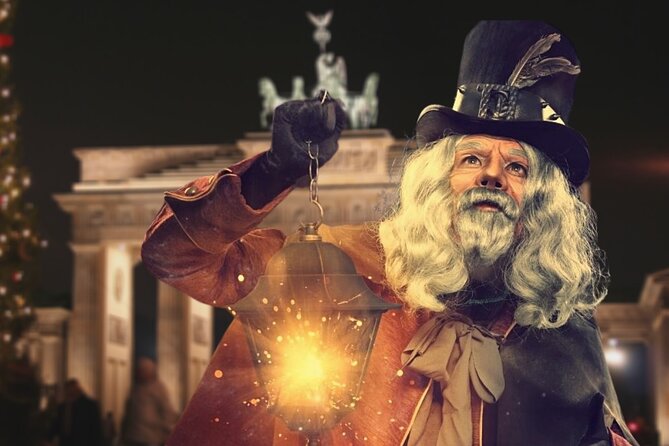
Berlin gets a different personality after sunset. This 90-minute night walk uses actors, costumes, an audioguide, and visual effects to turn the old center into a small stage. You move through Nikolaiviertel, past medieval landmarks and the Spree, while Berlin’s past is brought to life around you.
I like the mix of history and theater, especially the way the tour goes beyond pointing at buildings. I also like the small touches: a coffee, chocolate, and schnapps may be included along the way or at the finish. The main caution is practical: it is an outdoor experience, so cold, icy pavement, poor weather, or a no-show guide can spoil the evening.
In This Review
- Key points to know
- Berlin after dark, with a little theater
- Starting at St. Marienkirche
- Neptune Fountain and the rivers of Prussia
- Red City Hall and Berlin’s public face
- Ampelmännchen and the memory of two Germanys
- Nikolaiviertel, Berlin’s reconstructed old heart
- St. Nikolai-Kirche and the oldest church in Berlin
- Humboldt Forum and the rebuilt palace façades
- Mühlendamm and the road over the Spree
- What the theatrical format adds
- Is $46.99 a fair price?
- Who should book this night walk?
- Booking, weather, and cancellation advice
- Should you book the Night Magic City Tour?
- FAQ
- Where does the Night Magic City Tour begin?
- Where does the tour end?
- How long does the experience last?
- What language is offered?
- How much does the tour cost?
- How many people can join the tour?
- Is the tour available by mobile ticket?
- Can I cancel for a full refund?
- What happens if the weather is poor?
Key points to know
- A theatrical night walk: Actors, costumes, an audioguide, and visual effects add drama to Berlin’s oldest quarter.
- A compact central route: The walk links St. Marienkirche, Alexanderplatz, Nikolaiviertel, the Spree, and Ephraim’s in about 90 minutes.
- A small group limit: No more than 20 people can join, which should make the performance easier to follow.
- A good history lesson: You’ll hear about Prussia, medieval Berlin, German reunification, and the rebuilt city center.
- Small refreshments: Coffee, chocolate, and a schnapps are included according to the experience details.
- Plan for the weather: The tour requires good weather and takes place outdoors at night.
Berlin after dark, with a little theater
Farolero’s Night Magic City Tour is not a standard walk where you trail behind a guide listening to dates and building names. It is closer to a short street performance built around Berlin’s old center.
You begin near St. Marienkirche, beside Alexanderplatz. From there, the route heads toward the Neptune Fountain and the Red City Hall before entering Nikolaiviertel. The atmosphere changes quickly. Alexanderplatz is broad and modern, while Nikolaiviertel offers narrow streets, restored façades, and a more intimate setting.
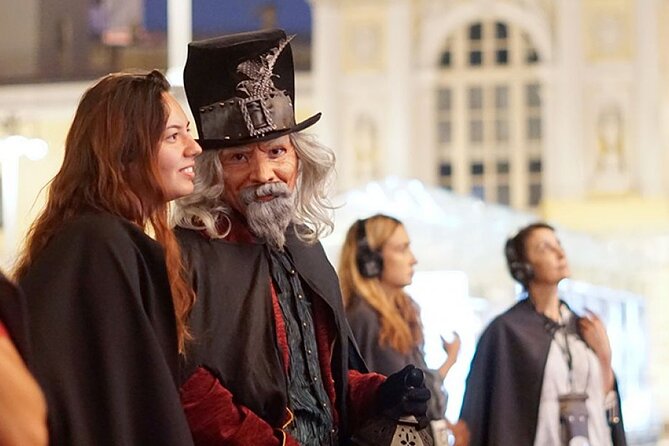
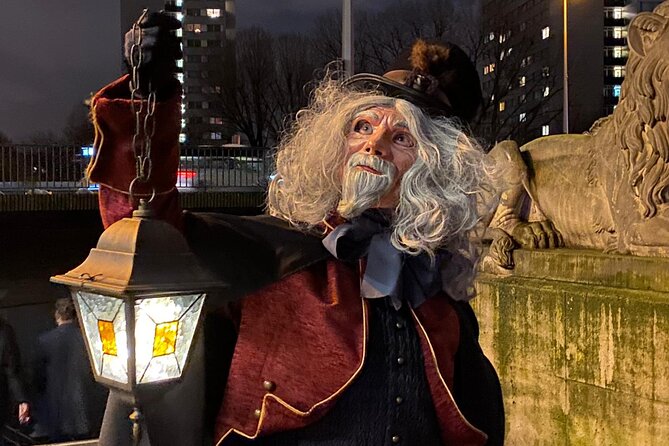
The format is the key feature. The tour combines spoken history with an audioguide, actors, visual effects, and audience participation. Costumes are part of the experience, and you may be invited to take part in small scenes rather than simply watch from the side.
That makes the walk lively and easy to remember. It also means the experience will suit you best if you enjoy performance and storytelling. If you want a quiet, detailed architectural lecture, this may feel too staged.
The group is capped at 20 people. That is a useful limit for an interactive outing. You are less likely to disappear at the back of a large crowd, and the actors can involve people without turning the whole thing into a packed street show.
A few more Berlin trips to weigh up
- Berlin: Solar Powered Sunset Catamaran Cruise & Audio Guide
★ 4.6 · 1,043 reviews - Berlin: Live-Guided Evening Sightseeing Tour by Open-top Bus
★ 4.1 · 783 reviews - Berlin: Bus Tour by Night with Live Commentary
★ 4.2 · 687 reviews
Starting at St. Marienkirche
The meeting point is St. Marienkirche on Karl-Liebknecht-Strasse 8. This location puts you right in Berlin’s historic center, close to Alexanderplatz and several major sights.
The church itself is important context. It is one of Berlin’s oldest churches, though it is not listed as one of the main stops in the route details. Its position helps frame the evening: you are starting in the area where Berlin’s old and modern centers meet.
You should arrive with enough time to find the church and locate the group. The experience is offered in English and uses a mobile ticket, so keep your booking accessible on your phone. Because the activity takes place outdoors, dress for the actual forecast, not the temperature you hope for.
The first moments matter on this kind of tour. If you arrive late, you may miss the introduction, the costume setup, or the first performance cue. No special transport is described, so plan on walking from the meeting point through the central district.
Neptune Fountain and the rivers of Prussia
The Neptune Fountain is an excellent first major stop because it gives the tour a striking object to explain. Built in 1891 and designed by Reinhold Begas, it places the Roman god Neptune at the center, surrounded by four women.
Those figures represent the four main rivers of Prussia at the time: the Elbe, Rhine, Vistula, and Oder. Their objects help identify them. The Elbe carries fruits and ears of corn, the Rhine has a fishnet and grapes, the Vistula is linked with wooden blocks and forestry, and the Oder is shown with goats and animal skins.
This is the sort of detail that can disappear if you only snap a picture and move on. The fountain becomes a small lesson in how monuments express politics and geography. Borders have changed since 1891. The Vistula now lies entirely in Poland, while the Oder forms part of the border between Germany and Poland.
At night, the theatrical treatment should make the fountain feel less like a static monument. Still, keep your expectations sensible. The stop is outdoors, and the exact lighting or performance may depend on the evening’s conditions.
Red City Hall and Berlin’s public face
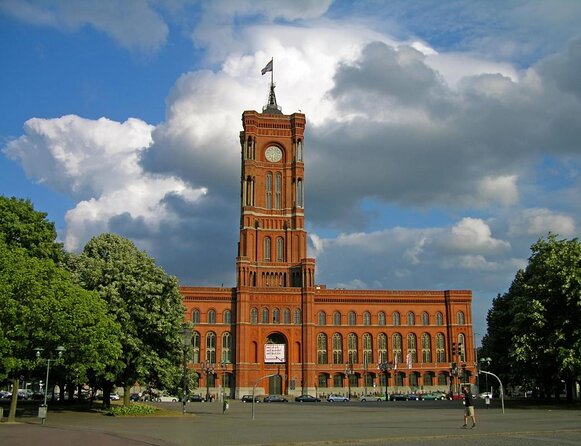
The next important landmark is Rotes Rathaus, or Red City Hall. Its name comes from the red clinker bricks used on the façade, not from any political slogan.
The building is Berlin’s town hall and the seat of the governing mayor and the Senate of Berlin. That makes it more than a handsome stop on a walking route. It remains tied to the city’s current government, while the surrounding tour explores much older Berlin.
This contrast is one of the route’s strengths. You move between monuments, civic buildings, reconstructed historic streets, and symbols of divided Germany. The tour does not stay locked in one century.
The Red City Hall is near Alexanderplatz and Nikolaiviertel, so it fits naturally into a compact walk. You will not spend the evening crossing distant parts of the city. For a first night in Berlin, that concentration is useful. You get a sense of the central district without committing to a long, tiring walk.
Same city, a completely different kind of day:
- Berlin: Reichstag, Dome and Government District Guided Tour
★ 4.7 · 18,288 reviews - Berlin: 1-Hour City Tour by Boat with Guaranteed Seating
★ 4.3 · 16,993 reviews - Berlin: Boat Tour Along the River Spree
★ 4.4 · 11,252 reviews - Discover Berlin Half-Day Walking Tour
★ 5.0 · 9,624 reviews
Ampelmännchen and the memory of two Germanys
Ampelmännchen is one of Berlin’s most recognizable everyday symbols. The name means little traffic light man, and the figure appears on pedestrian signals.
Before German reunification in 1990, East and West Germany used different pedestrian figures. West Germany had a more generic human shape. East Germany used a figure that usually appeared male and wore a hat.
This is a small subject, but it carries a lot of meaning. You see how political division can survive in something as ordinary as a crossing signal. The East German figure became popular after reunification and is now part of Berlin’s visual identity.
I like this stop because it keeps the tour from becoming a parade of grand monuments. Berlin’s past also lives in signs, street details, and objects you might otherwise walk past. The theatrical format can make this kind of story more memorable, especially for families and first-time visitors.
Do not expect a full lesson on the Cold War from this one symbol. It is a brief, accessible way into a much larger story.
Nikolaiviertel, Berlin’s reconstructed old heart
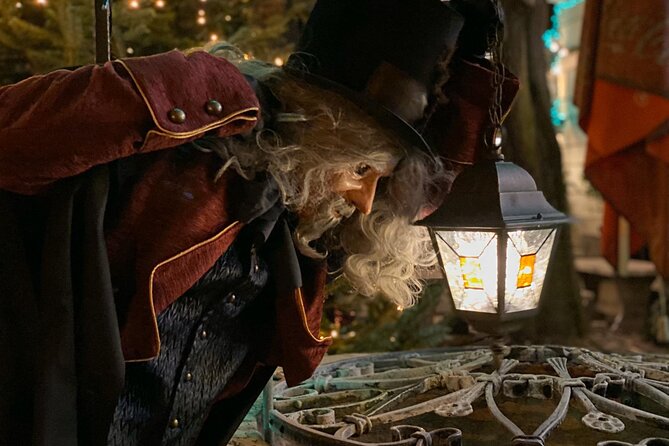
Nikolaiviertel is the emotional center of the route. Founded around 1200, it forms part of the reconstructed historic heart of Berlin, together with nearby Cölln.
The quarter sits only about five minutes from Alexanderplatz, but it feels more enclosed and old-fashioned than the broad streets around the square. The buildings are restored medieval forms, and in some cases modern imitations. That distinction matters. This is not an untouched medieval neighborhood. It is a rebuilt version of old Berlin.
That does not make it worthless. In fact, the reconstruction gives you a readable picture of how the city’s early center was organized. The quarter is bounded by streets, the Spree, and Mühlendamm, and the route uses its lanes and open spaces as a natural theater.
This is where costumes and actors make the most sense. The setting provides a strong backdrop, while the story turns a short walk into a sequence of scenes. One of the most appealing details from the experience is that participants may be dressed up and included in the action.
You should be prepared for some playful involvement. That will delight you if you like being part of a performance. If you prefer to remain unnoticed, stand toward the back and let the actors carry the scene.
St. Nikolai-Kirche and the oldest church in Berlin
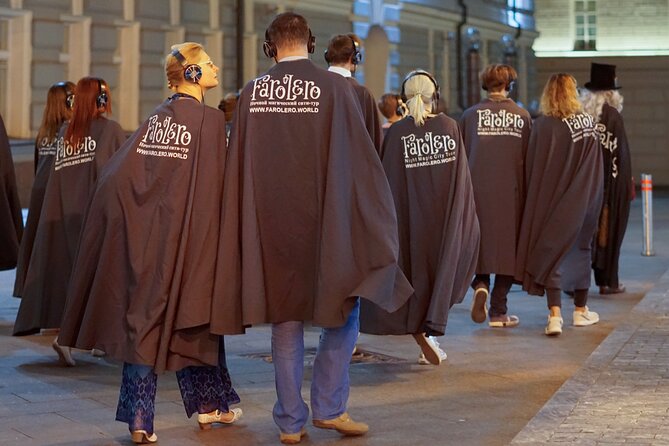
St. Nikolai-Kirche, also called Nikolaikirche, is one of the main historical anchors of the walk. Built between 1220 and 1230, it is identified as the oldest church in Berlin. The Church of Our Lady near Alexanderplatz dates from the same broad early period.
The church sits inside Nikolaiviertel, surrounded by restored historic buildings and modern recreations. Its location helps explain why this quarter matters. The city’s early religious, commercial, and civic life grew around places like this.
At night, you will mainly experience the church from the outside as part of the walking route. The value comes from its age and its position in the quarter, not from an interior visit. If you want to study the church’s interior or architecture in detail, allow separate time during the day and check opening arrangements independently.
The performance style also changes how you read the church. Instead of treating it as a single old building, the tour places it inside a larger story about Berlin’s origins and reconstruction.
Humboldt Forum and the rebuilt palace façades
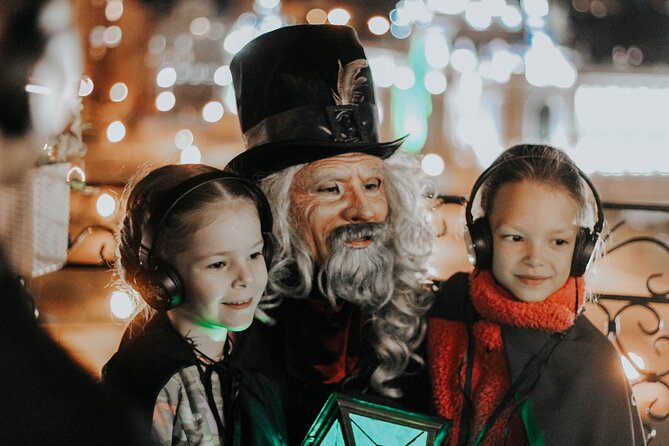
The Humboldt Forum brings a different chapter to the route. Located on Museum Island, it combines three reconstructed Baroque façades from the former Royal Palace with a contemporary side facing the Spree and a modern interior by Franco Stella.
The building houses non-European art collections belonging to the Berlin State Museums, along with temporary exhibitions, public events, and other programs. It is named after the Prussian scholars Wilhelm and Alexander von Humboldt.
Even if you do not enter, the exterior raises useful questions about old and new Berlin. Parts of a palace façade have been rebuilt, while the rest of the building is modern. The result is a deliberate blend of reconstruction and present-day design.
The tour’s short visit cannot replace a museum visit. Think of this stop as a visual and historical marker along the walk. You get a sense of how Berlin has chosen to rebuild parts of its center, and you can return later if the building interests you.
The location beside the Spree also gives the route a change of pace. Water, bridges, and open views break up the tighter streets of Nikolaiviertel.
Mühlendamm and the road over the Spree
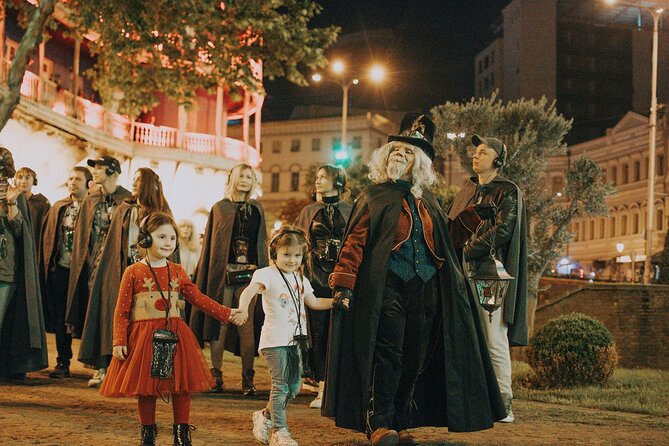
Mühlendamm means Mill Dam. It is a major route through central Mitte, crossing the Spree by the Mühlendamm Bridge.
The name comes from watermills that once operated at the site. A causeway was first laid out there around 1200, and it helped form the nucleus of the late medieval city.
This stop rewards attention because it connects physical geography with urban growth. A bridge is not just a bridge here. The crossing helped link the early settlements of Cölln and Alt-Berlin and supported the development of the city.
The route ends near Ephraim’s at Spreeufer 1. That gives the final stretch a clear sense of place, close to the river and the old center. You finish within walking distance of the route’s main landmarks rather than being dropped far outside the area.
Keep in mind that some parts of central Berlin can be noisy. One especially useful aspect of the audioguide and visual effects is that they help keep the performance focused despite traffic and other city sounds.
What the theatrical format adds
The best part of this experience is the cooperation between several simple tools. The audioguide provides structure. The actors add human energy. Costumes help you recognize the historical mood, and visual effects create a stronger sense of occasion.
A German-language description of the experience also highlights the way this combination can block out traffic noise and other distractions. That is important in central Berlin, where a historic scene can share space with cars, cyclists, and modern city life.
The small refreshments add a friendly touch. Coffee and chocolate suit a cold evening, while a schnapps at the end gives the finish a local social flavor. These extras do not transform the tour’s value, but they make the 90-minute outing feel more generous.
The experience has been recommended by 92 percent of bookers and carries a 4.7 rating from 25 reviews. That is a strong result, though the sample is not large. One serious problem is recorded: on one occasion, the guide did not appear at the meeting point, leaving the customer in the cold on icy pavement. It appears to be an exception, but you should keep the provider’s contact details available and confirm promptly if anything seems wrong.
Is $46.99 a fair price?
At $46.99 per person, this is not the cheapest way to see central Berlin. You are paying for a staged experience, not simply a guide pointing out buildings.
The price makes more sense if you value the combination of actors, costumes, visual effects, audience participation, and refreshments. It is also a reasonable format for an evening when you want something organized but do not want a long show in a theater.
The tour lasts about an hour and 30 minutes. That keeps the commitment manageable and leaves the rest of your evening open. You could pair it with dinner nearby, though no restaurant arrangement is included in the details.
The group limit of 20 helps protect the quality of the performance. A cheaper, larger walk might offer more facts but less contact with the action. Here, the value depends on how much you enjoy the style.
The experience is booked an average of 53 days ahead, so advance planning is sensible. That does not guarantee every date sells out, but it signals that you should not wait until the last evening of a short Berlin visit.
Who should book this night walk?
I would choose this tour for a first visit to Berlin, especially if you want a lively introduction to the old center. It suits couples, families, and small groups who enjoy stories with a playful edge.
It is also a good fit if you have already seen Berlin’s main museums and want a short evening activity outside. The route gathers several important sites without requiring a full night of walking.
You may prefer another option if you want detailed art history, a serious Cold War lecture, or extensive time inside monuments. This experience gives you memorable context, but it moves at a performance pace. The stops are designed to support the story, not to provide long independent visits.
The outdoor setting also matters. A cold or wet night can reduce the fun, and poor weather may lead to cancellation. Wear shoes suitable for city pavement and dress warmly. The route is described as open to most people, but the provided details do not give a specific accessibility assessment.
Booking, weather, and cancellation advice
You receive confirmation when booking, unless you book within two days of departure. In that case, confirmation can take up to 48 hours and remains subject to availability.
Free cancellation is available up to 24 hours before the start time for a full refund. Changes or cancellations made inside that period are not accepted for a refund.
The tour requires good weather. If the provider cancels because conditions are poor, you can choose another date or receive a full refund. The same choice applies if the minimum number of participants is not reached.
Because one recorded booking problem involved a missing guide, I would arrive at the correct meeting point and keep your booking information handy. The start is St. Marienkirche, while the end is Ephraim’s near the Spree, so do not confuse the two locations when planning your evening.
Should you book the Night Magic City Tour?
Book it if you want Berlin’s historic center presented as a short outdoor performance rather than a formal lecture. The strongest elements are the actors, costumes, audioguide, visual effects, audience participation, and the atmospheric walk through Nikolaiviertel.
At $46.99, it is best treated as an evening show with historical content. You are paying for mood and presentation as much as facts. If that sounds fun, the compact route and small group make the price easier to justify.
Skip it if you dislike audience participation, need a fully indoor activity, or want long visits inside churches and museums. For everyone else, it offers a friendly way to meet old Berlin after dark, with enough history to give the scenery meaning and enough theatrical flair to keep the walk from feeling like homework.
FAQ
Where does the Night Magic City Tour begin?
The tour begins at St. Marienkirche, Karl-Liebknecht-Strasse 8, 10178 Berlin, Germany.
Where does the tour end?
The tour ends at Ephraim’s, Spreeufer 1, 10178 Berlin, Germany.
How long does the experience last?
The tour lasts approximately 1 hour and 30 minutes.
What language is offered?
The experience is offered in English.
How much does the tour cost?
The listed price is $46.99 per person.
How many people can join the tour?
The maximum group size is 20 people.
Is the tour available by mobile ticket?
Yes. A mobile ticket is available.
Can I cancel for a full refund?
Yes. You can cancel at least 24 hours before the experience start time for a full refund.
What happens if the weather is poor?
If poor weather causes the tour to be canceled, you will be offered a different date or a full refund.
Just added around Berlin
- Love and War in Berlin: Self-Guided Story Puzzle Walk★ 5.0 · 7 reviews
- Rickshaw Tours Berlin – Groups of up to 16 people with several rickshaws★ 4.0 · 97 reviews
- eSIM for Germany and 34 European Countries★ 4.5 · 16 reviews
- Walking on the Wall: 3-Hour Tour in Berlin★ 4.5 · 34 reviews
- Warnemuende Shore Excursion: Berlin Private Sightseeing Tour from Rostock★ 5.0 · 4 reviews
- Your ticket to The Wall Museum Berlin★ 3.0 · 60 reviews
- Warnemuende Shore Excursion: Private Berlin Tour★ 4.5 · 27 reviews
- Berlin’s Gay, Lesbian, and Queer Scene Small-Group Walking Tour★ 4.5 · 66 reviews
City Tours, compared.

1-Hour City Tour by Boat with Guaranteed Seating
Read our review →
City History Canal Sightseeing Tour on a Motorboat
Read our review →

Browse the lists this tour appears in