
Reviewed · CITY TOURS
All of Berlin (city panorama)
Berlin reveals itself quickly on this four-hour city walk, which links the capital’s grandest squares, royal avenues, Cold War landmarks, and memorials. You begin at Alexanderplatz and work west through Museum Island, Unter den Linden, Gendarmenmarkt, Checkpoint Charlie, Potsdamer Platz, and Brandenburg Gate.
I like the efficient route and the fact that you walk around places a vehicle cannot reach. I also like the steady historical thread, from medieval Berlin and Prussian power to Nazi Germany, the Berlin Wall, and reunification. The main catch is simple: this is a long walking outing, and the guide speaks Spanish only.
In This Review
- Key points to know
- Why this four-hour route works for a first look at Berlin
- Alexanderplatz and the symbols of East Berlin
- Nikolaiviertel and Berlin’s oldest center
- Berlin Cathedral, Lustgarten, and Museum Island
- Unter den Linden and Bebelplatz’s difficult past
- Neue Wache and the human cost of war
- Gendarmenmarkt, Berlin’s grandest square
- Checkpoint Charlie and the Berlin Wall story
- Potsdamer Platz and Berlin rebuilt
- The Holocaust Memorial beside Brandenburg Gate
- Finishing at Brandenburg Gate
- What the Spanish-only format means for you
- Walking, timing, and practical value
- Should you book this Berlin city panorama?
- FAQ
- How long does the Berlin city panorama tour last?
- What time does the tour start?
- Where does the tour meet?
- What language is the tour conducted in?
- What sights are included?
- Is transportation included?
- Are attraction admission tickets included?
- How large is the group?
- Can I cancel for a full refund?
Key points to know
- Alexanderplatz to Brandenburg Gate: A broad introduction to central Berlin’s main sights in one morning.
- Spanish-speaking guide: Commentary is provided only in Spanish, with guide Juan specifically named in the tour feedback.
- Short stops, lots of context: Most visits last 5 to 25 minutes, so expect explanation and orientation rather than long museum visits.
- Mostly outdoor sightseeing: Admission is free at nearly every stop, but this is not a ticketed interior tour.
- Maximum group of 25: Large enough for social energy, but limited enough to keep the group manageable.
- Good value at $25.58: You pay for route planning, local guidance, and historical context rather than transportation or admissions.
Why this four-hour route works for a first look at Berlin
Berlin is spread out, and its story is split among many neighborhoods and monuments. If you have only a short stay, planning a sensible route can take almost as much time as seeing it. This tour solves that problem by moving in a clear line from Alexanderplatz toward the city’s best-known central sights.
You get a useful first map of Berlin. The morning begins in the former East Berlin city center, passes through the old royal quarter, then reaches Cold War and modern Berlin landmarks farther west. That sequence matters because Berlin’s past is not tucked into one historic district. It is layered across streets, squares, empty spaces, rebuilt facades, and modern towers.
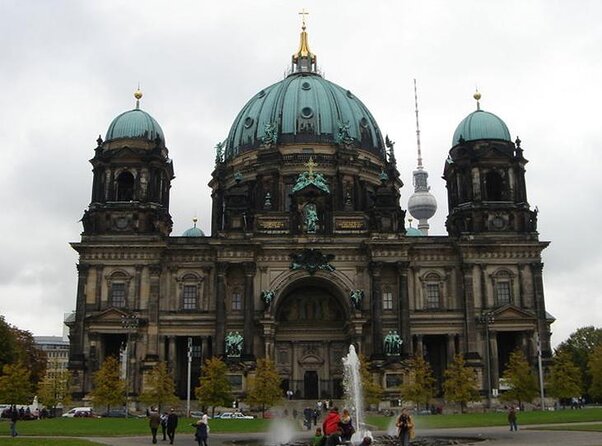
The tour is best understood as an orientation walk, not a museum tour. You will hear why a place matters, look closely at its monuments, and leave with a list of sites to revisit on your own. The short stop at the Berlin Cathedral, for example, gives you the building’s story and appearance, but not an interior visit.
At $25.58 per person, the price is sensible if you value a prepared route and a guide who can connect the pieces. You are not paying for private transportation, attraction tickets, or an intimate private guide. You are paying a modest amount to see a large portion of central Berlin without spending hours working out the order yourself.
A few more Berlin trips to weigh up
- Berlin: 1-Hour City Tour by Boat with Guaranteed Seating
★ 4.3 · 16,993 reviews - Berlin: City Sightseeing Hop-On Hop-Off Bus Tour
★ 4.1 · 4,233 reviews - Berlin: 1-Hour City Sightseeing Cruise
★ 4.4 · 2,210 reviews
Alexanderplatz and the symbols of East Berlin
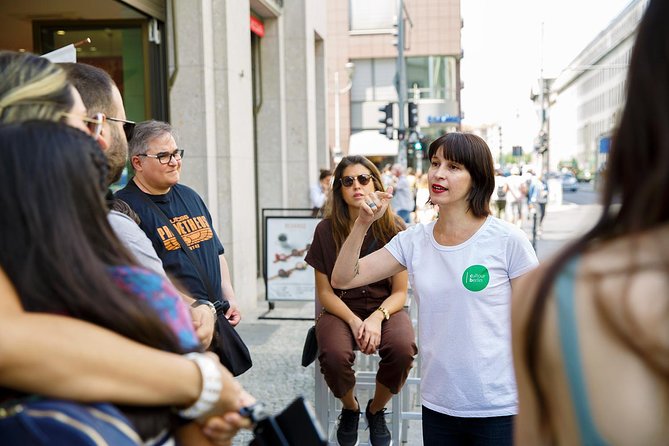
Meet beside the entrance to the Berlin TV Tower at 10:00 a.m. in Alexanderplatz. This is a practical starting point, since the square is easy to find and well connected to public transportation.
The opening 20 minutes focus on Alexanderplatz itself. The square has changed greatly over time, and your guide sets out its appearance, role, and historical context. The TV Tower provides an unmistakable landmark, while the wide open space helps you see the scale of central Berlin.
You then spend about five minutes at Neptunbrunnen, the Neptune Fountain. This is a quick stop, but it gives the guide a chance to explain the fountain’s symbolism and its place in the square.
The red facade of Rotes Rathaus comes next. The building is Berlin’s town hall, and the stop explains the role of the city council. You will not have admission included here, though the tour is centered on the exterior and its civic meaning.
This opening section is useful because it avoids treating Alexanderplatz as just a busy square with a tall tower. You begin to see how architecture and public spaces reflect different periods of Berlin’s political life.
Nikolaiviertel and Berlin’s oldest center
From Alexanderplatz, the route moves toward Nikolaiviertel. The stop lasts about 15 minutes and focuses on what is described as the most original part of Berlin, along with the city’s foundation more than 800 years ago.
Nikolaiviertel offers a change of mood from Alexanderplatz. Instead of a broad modern square, you encounter a smaller historic quarter with a stronger sense of old Berlin. The guide also explains the meaning of St. Georg in the middle of the square, giving you a detail to look for rather than simply passing through.
The route then reaches the complex of buildings and museums associated with UNESCO World Heritage status. The available schedule does not assign a separate stop number or visit time here, so treat this as a viewing and explanation point, not a museum admission.
That distinction is important. If you want to enter museums on Museum Island, plan a separate visit. This tour lets you understand the setting and see the entrances, while keeping the morning moving.
Berlin Cathedral, Lustgarten, and Museum Island
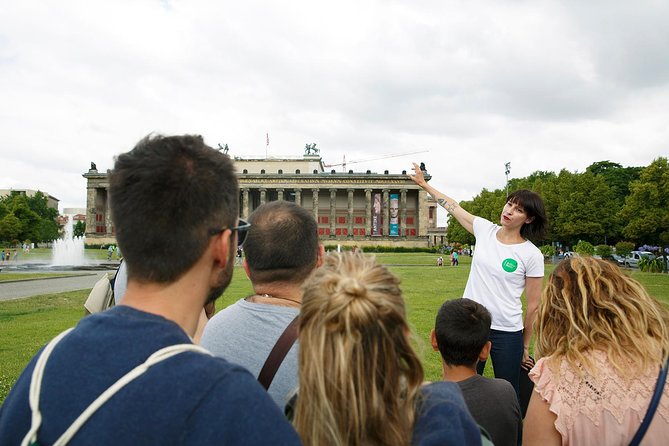
The Berlin Cathedral receives a 10-minute stop. You will look at its dome and decoration while learning which history lies behind the church and who made its construction possible.
The next five minutes are spent in Lustgarten, the open space beside the cathedral. The guide explains the name and why this particular place became important. The tour describes it as one of the most notable spots in central Berlin, and it is easy to see why the setting is useful: several major buildings and layers of Berlin’s past come together here.
This is one of the better places for a short orientation talk. You can look from the cathedral toward the surrounding museums and public spaces, then understand how the area functioned as part of the city center. The stop is brief, so keep your expectations realistic. You get a close look and an explanation, not time to explore every corner.
Same city, a completely different kind of day:
- Berlin: Reichstag, Dome and Government District Guided Tour
★ 4.7 · 18,288 reviews - Berlin: Boat Tour Along the River Spree
★ 4.4 · 11,252 reviews - Discover Berlin Half-Day Walking Tour
★ 5.0 · 9,624 reviews - Berlin: Hop-on Hop-off Bus Tour with Live Commentary
★ 4.3 · 8,579 reviews
Unter den Linden and Bebelplatz’s difficult past
The route continues along Unter den Linden, one of Berlin’s principal avenues. Once a royal road connecting the palace area with the Tiergarten, it remains one of the city’s most visited streets.
This section helps you read Berlin’s ceremonial center. The avenue connects important buildings and squares, so walking it gives you a sense of how power and culture were arranged in the old capital.
At Staatsoper Unter den Linden, the guide spends about five minutes discussing the opera house and its cultural role. It is a quick exterior stop, but the building adds a different note to the morning after the cathedral and civic buildings.
Bebelplatz receives about 10 minutes and carries far more weight than its elegant appearance suggests. You will learn why the square mattered during the 20th century, see its memorial, and hear about the role of Hitler’s propaganda minister in the events connected with the site.
This is a place where guide commentary has real value. Without context, Bebelplatz can look like a handsome open square surrounded by impressive buildings. With an explanation, the space becomes a reminder of how propaganda and state power can turn a cultural center into a site of persecution.
Neue Wache and the human cost of war
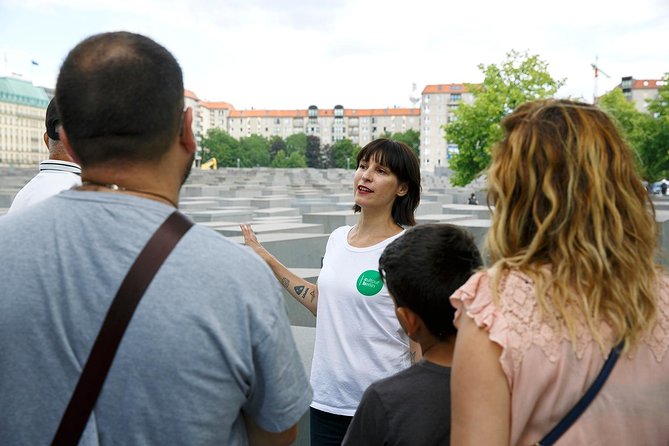
The stop at Neue Wache lasts around 10 minutes and includes admission. The memorial has been adapted to different periods of German history, and the focus includes Käthe Kollwitz’s work inside.
The short visit gives you a chance to consider how Germany has changed the meaning of memorial spaces over time. The subject is serious, and the tour does not treat Berlin’s monuments as a parade of attractive buildings. That balance is valuable. The morning includes royal architecture and grand squares, but also the consequences of dictatorship, war, and political violence.
Because the stop is brief, you may want to return later if you want more time with the artwork. Still, it adds emotional depth to the route and prepares you for the Holocaust Memorial later in the day.
Gendarmenmarkt, Berlin’s grandest square
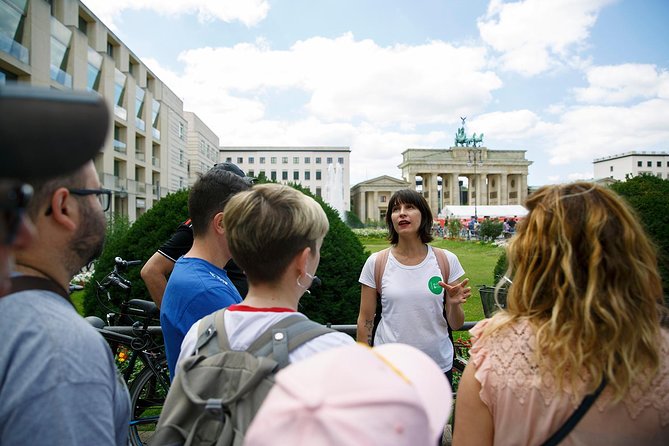
Gendarmenmarkt gets about 15 minutes. The guide introduces the concert hall and the two church buildings, whose towers create the square’s famous symmetry.
This is one of Berlin’s most satisfying architectural stops. The open space allows you to take in the full arrangement, rather than seeing each building from a cramped sidewalk. Your guide explains why the ensemble is considered one of the city’s finest public squares.
The stop also gives the morning a pause from heavier historical subjects. You can appreciate the proportions, facades, and relationship among the buildings before the route turns toward the divided city and the Cold War.
Checkpoint Charlie and the Berlin Wall story
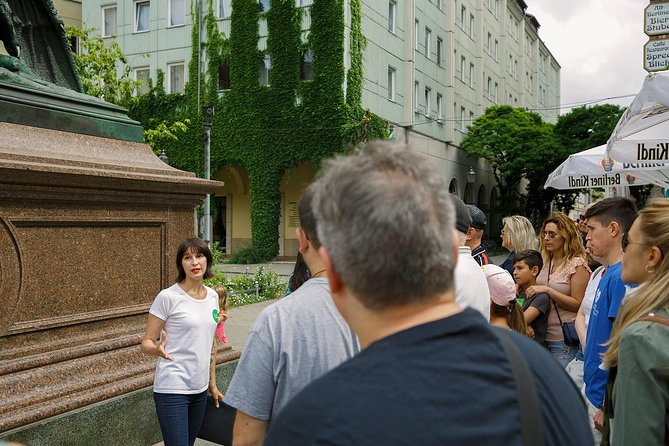
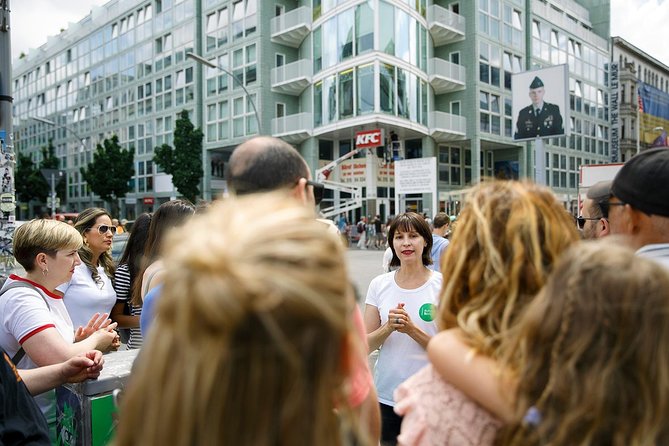
Checkpoint Charlie is the longest stop so far, at about 25 minutes. The focus is the former border crossing, the Cold War, and Berlin’s division.
This is where the tour’s east-to-west route becomes especially clear. Earlier stops explored royal Berlin, civic Berlin, and cultural Berlin. Here, the guide shifts to the city split between competing political systems and the people affected by that division.
Checkpoint Charlie can be visually confusing because the area has changed and the crossing itself is remembered through a mix of surviving history and later presentation. That makes explanation especially useful. You will spend time looking at the area and placing it in its historical setting instead of treating it as a quick photo stop.
The tour does not include private transportation, so this section is reached as part of the walking route. Wear comfortable shoes and expect a steady pace.
Potsdamer Platz and Berlin rebuilt
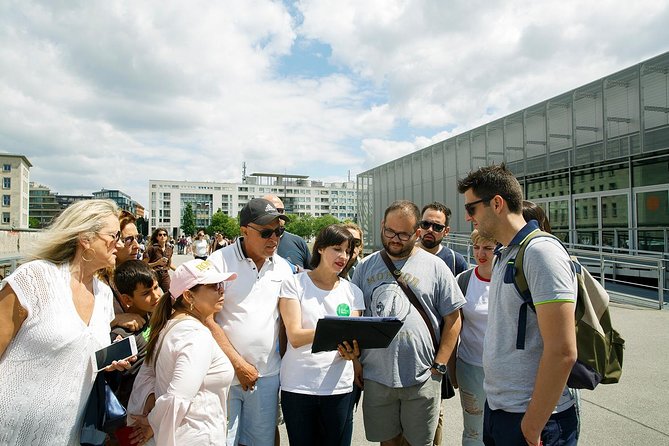
Potsdamer Platz receives a short, five-minute stop. The guide traces what it was from its early development through the present day, with attention to its role as one of Berlin’s most modern areas.
The contrast with Checkpoint Charlie is the point. Berlin’s central districts contain both reminders of division and rebuilt spaces that signal the city’s later transformation. Potsdamer Platz helps you see that Berlin is not only a city of preserved monuments. It is also a city that has been cleared, divided, reconstructed, and redesigned.
Five minutes is enough for a quick explanation and a look around, but not for a detailed architectural walk. If modern urban design interests you, note the area and return independently.
The Holocaust Memorial beside Brandenburg Gate
The Memorial to the Murdered Jews of Europe receives about 15 minutes. The guide explains why the memorial matters and helps you consider the meaning intended by its creator.
The location beside Brandenburg Gate makes this a powerful part of the route. You move from a place of Cold War division and modern rebuilding to a memorial addressing the murder of Europe’s Jews under the Nazi regime.
This stop calls for quiet attention. The schedule gives you time to walk among the memorial’s concrete blocks, but the tour does not promise a visit to the underground information center. If you want to explore that part, check the time available after the tour.
The memorial works best when you allow yourself a moment without rushing for photographs. The guide’s role here is to give you the basic context and point toward the questions raised by the design.
Finishing at Brandenburg Gate
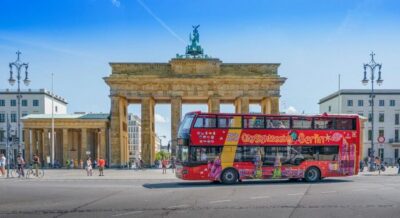
The final listed stop is Brandenburg Gate, with about 20 minutes. You will see the gate, the Tiergarten, Pariser Platz, and the Adlon Hotel while learning how this landmark fits into Berlin’s wider story.
Brandenburg Gate is more than a grand neoclassical entrance. It has been used as a symbol by different governments and became one of the most recognizable images of divided and reunited Berlin. Ending here gives the route a strong visual finish.
The stated meeting point is beside the TV Tower, and the activity information says the tour ends back at the meeting point. At the same time, the route itself finishes at Brandenburg Gate, so confirm the exact end arrangement with the guide on the day. Either way, the route gives you a clear run through central Berlin’s main sights.
What the Spanish-only format means for you
The guide operates in Spanish only. This is the most important booking condition, and it should determine your choice more than the price or sightseeing list.
If you understand Spanish comfortably, the format can work very well. The tour depends on spoken explanation at nearly every stop, and the historical links are a major part of its value. A strong Spanish speaker will get much more from the morning than someone relying on a few familiar words.
A guide named Juan is specifically associated with the experience, and the available feedback praises his amount of historical information. Guide assignments can change, so do not assume Juan will lead every departure. Still, the praise points to the kind of tour this is meant to be: information-heavy, direct, and focused on the story behind each location.
The maximum group size is 25 people. That is not a private experience, but it is more controlled than an unlimited public crowd. You should still stay close to the guide, especially in busy central areas.
Walking, timing, and practical value
The four-hour schedule covers a lot of ground. Many stops last only five or 10 minutes, while Alexanderplatz, Checkpoint Charlie, the Holocaust Memorial, and Brandenburg Gate receive more time. This keeps the route moving but limits time for sitting, shopping, or independent exploration.
The tour is not recommended for people who cannot walk long distances comfortably. Public transportation is nearby, but private transportation is not included. Good walking shoes are the sensible choice, and you should expect an outdoor morning with repeated stops.
Nearly all listed admission points are free. Neue Wache is marked as including admission, while Rotes Rathaus is not included. The main value is therefore the guide’s route and explanation, not entry to paid attractions.
At $25.58, I see this as a strong introduction for a first day in Berlin. You can spend the rest of your visit returning to the Berlin Cathedral, Museum Island, Bebelplatz, or the Holocaust Memorial with a better sense of where each place fits. If you already know central Berlin well, the short stops may feel too basic.
Free cancellation is available until 24 hours before the 10:00 a.m. start time. Changes or cancellations made inside that window are not accepted for a refund, so keep the local cut-off in mind.
Should you book this Berlin city panorama?
Book it if you want a fast, history-led introduction to Berlin, speak Spanish, and can walk for four hours. The route covers an unusually useful mix of landmarks, from Alexanderplatz and the cathedral to Checkpoint Charlie, the Holocaust Memorial, and Brandenburg Gate.
Skip it if you need an English-language guide, want extended interior visits, or prefer a relaxed pace with plenty of free time. For the right person, the price is fair and the route is well judged. It gives you the city’s main outline, then leaves you better prepared to explore Berlin on your own.
FAQ
How long does the Berlin city panorama tour last?
The tour lasts approximately four hours.
What time does the tour start?
It starts at 10:00 a.m.
Where does the tour meet?
The meeting point is Berlin TV Tower, Panoramastraße 1A, 10178 Berlin, beside the TV Tower entrance in Alexanderplatz.
What language is the tour conducted in?
The tour is conducted only in Spanish by a Spanish-speaking local guide.
What sights are included?
The route includes Alexanderplatz, Neptunbrunnen, Rotes Rathaus, Nikolaiviertel, Museum Island entrances, Berlin Cathedral, Lustgarten, Unter den Linden, Staatsoper Unter den Linden, Bebelplatz, Neue Wache, Gendarmenmarkt, Checkpoint Charlie, Potsdamer Platz, the Holocaust Memorial, and Brandenburg Gate.
Is transportation included?
No. Private transportation is not included. The tour includes walking between the city sights, and the area is near public transportation.
Are attraction admission tickets included?
Most stops are outdoor visits with no admission charge. Admission is included at Neue Wache. Admission is not included at Rotes Rathaus.
How large is the group?
The group can include a maximum of 25 people.
Can I cancel for a full refund?
Yes. You can cancel at least 24 hours before the local start time for a full refund. Cancellations or changes made less than 24 hours before the tour are not refunded or accepted.
Just added around Berlin
- Love and War in Berlin: Self-Guided Story Puzzle Walk★ 5.0 · 7 reviews
- Rickshaw Tours Berlin – Groups of up to 16 people with several rickshaws★ 4.0 · 97 reviews
- Walking on the Wall: 3-Hour Tour in Berlin★ 4.5 · 34 reviews
- eSIM for Germany and 34 European Countries★ 4.5 · 16 reviews
- Warnemuende Shore Excursion: Berlin Private Sightseeing Tour from Rostock★ 5.0 · 4 reviews
- Your ticket to The Wall Museum Berlin★ 3.0 · 60 reviews
- Warnemuende Shore Excursion: Private Berlin Tour★ 4.5 · 27 reviews
- Berlin’s Gay, Lesbian, and Queer Scene Small-Group Walking Tour★ 4.5 · 66 reviews
City Tours, compared.

1-Hour City Tour by Boat with Guaranteed Seating
Read our review →
City History Canal Sightseeing Tour on a Motorboat
Read our review →

Browse the lists this tour appears in