
Reviewed · CITY TOURS
Trier: City Walking Tour
Trier’s story unfolds in a compact city center, and this 90-minute walking tour gives you a smart first look at its Roman, medieval, and baroque landmarks. You begin beside the Porta Nigra, then follow the old streets toward the Hauptmarkt, cathedral, Church of Our Lady, and basilica.
I like the clear historical sweep, from Roman Trier to the age of bishops and fortified citizens. I also like that you pass four UNESCO World Heritage monuments without spending a full day on a formal city tour. The main drawback is time: 1.5 hours is enough for an overview, but not for extended interior visits or a slow look at every site.
In This Review
- Key points to know before booking
- Starting beside Trier’s most famous Roman gate
- The Porta Nigra and Roman Trier
- Dreikönigenhaus, Judengasse, and the medieval city
- Hauptmarkt and the city’s colorful power struggles
- Trier Cathedral and the Church of Our Lady
- The Aula Palatina and the Roman basilica
- Baroque Trier at the Electoral Palace and palace garden
- What the $17 price really buys you
- Timing, language, and access
- Who will get the most from this Trier walk
- Should you book this Trier City Walking Tour?
- FAQ
- Where does the Trier City Walking Tour meet?
- How long does the tour last?
- What languages are available?
- Which UNESCO monuments are included?
- Is the tour wheelchair accessible?
- How much does the tour cost?
Key points to know before booking
- Four UNESCO monuments in one central walk: See the Porta Nigra, Trier Cathedral, Church of Our Lady, and Aula Palatina.
- History moves through three eras: The route links Roman Trier with medieval power struggles and later baroque court life.
- A good first-day orientation: The meeting point is directly beside the Porta Nigra at the Tourist Information.
- Official local guides: Tours are offered in German and English by Trier Tourismus und Marketing GmbH.
- A short, useful format: The 90-minute length fits neatly into a morning or afternoon of sightseeing.
- Wheelchair accessible: The tour is listed as accessible, though the route remains a city-center walk.
Starting beside Trier’s most famous Roman gate
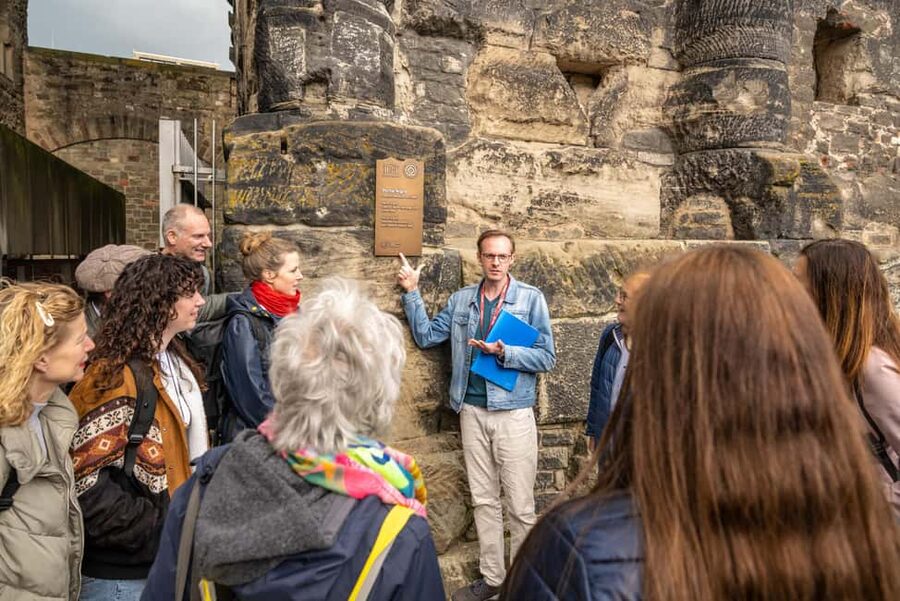
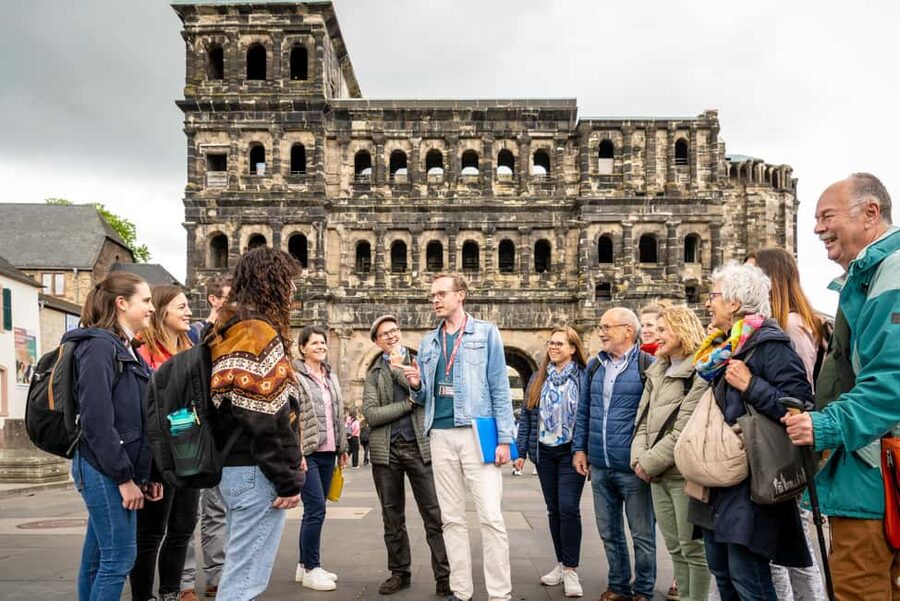
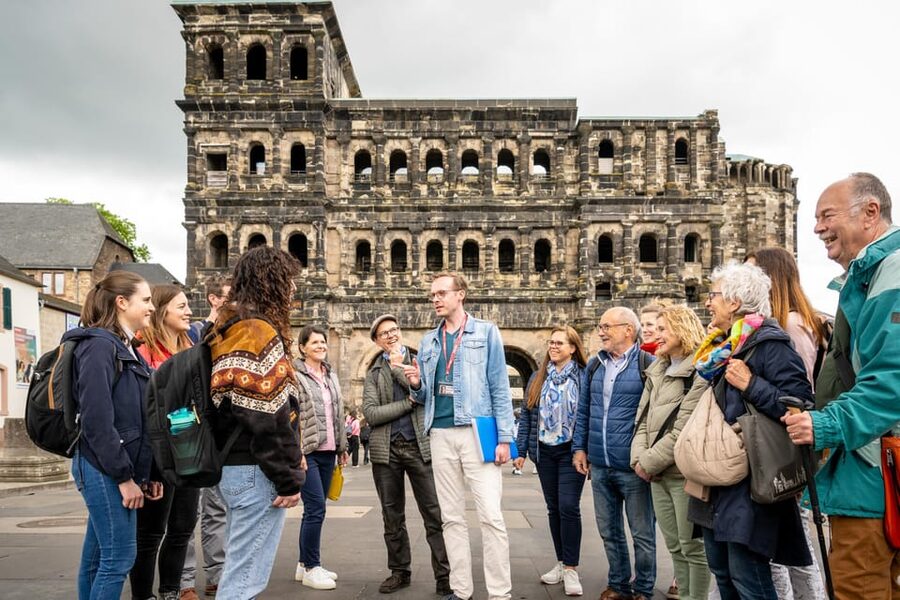
Meet in front of the Tourist Information, right beside the Porta Nigra. This is an easy place to find, especially if you are arriving in Trier for the first time, because the dark Roman gate is one of the city’s clearest landmarks.
The Porta Nigra means Black Gate, and it gives the tour a strong opening. Rather than beginning with a general orientation in a modern square, you start with the surviving face of Roman Trier. The guide uses the building as the first chapter in the city’s long story, setting up the idea that Trier is not just an attractive old town but a place shaped by several very different periods.
The meeting point also has a practical advantage. If you have questions before the walk, the Tourist Information office is immediately nearby. Look for the official tour meeting in front of the office, not at a separate transport stop or distant hotel.
Your guide speaks German or English, so check the available language when choosing a time. The guide is a local representative of Trier’s official tourism organization, rather than an informal escort arranged at the last minute.
A few more Germany trips to weigh up
- Discover Berlin Half-Day Walking Tour
★ 5.0 · 9,624 reviews - Berlin: Third Reich and Cold War 2 Hour Walking Tour
★ 4.9 · 6,830 reviews - Munich: Third Reich & WWII Walking Tour
★ 4.6 · 6,181 reviews
The Porta Nigra and Roman Trier
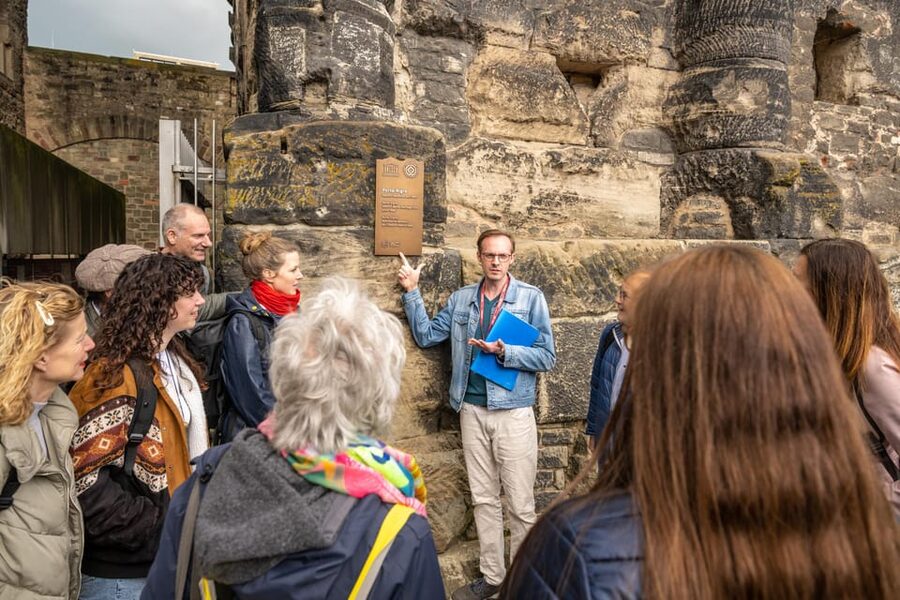
The route begins with a guided look at the Porta Nigra. You should expect commentary about the building and its place in Trier’s Roman past, rather than a long interior visit. The point is to understand why this gate became the city’s defining symbol and how it fits into the wider center.
The compact start works well. The gate is large enough to command attention, yet close to the streets that lead into the later city. Within a few minutes, you begin to see how Trier’s layers sit beside one another instead of being separated into different museum districts.
This is also where the tour gets its sense of scale. Trier’s ancient center is walkable, but the sites are not all from one period. The guide helps connect them, which is useful if your first impression is simply a series of impressive stone buildings.
If Roman archaeology is your main reason for visiting Trier, keep your expectations measured. This walk passes through the Roman heart of the city, but it is not a specialist archaeology tour. You get a broad introduction and a chance to note which sites deserve a longer return visit.
Dreikönigenhaus, Judengasse, and the medieval city
After the Roman opening, the walk shifts toward the Middle Ages. The Dreikönigenhaus and Judengasse bring you into a much more complicated chapter, one shaped by defensive architecture, religious authority, trade, and local political ambition.
The Dreikönigenhaus is especially useful for showing how medieval homes could protect wealth and status. The tour explains the architectural tricks used by fortified citizens who wanted to guard their possessions. That gives you more to notice than façades alone. Look up as you walk, since the street buildings themselves carry part of the story.
Judengasse adds another layer to the medieval center. The route does not treat the Middle Ages as a simple age of castles and churches. Instead, it points toward the people, institutions, and religious communities that shaped Trier’s urban life.
This section is a good reminder that city tours work best when they explain power, not just dates. In Trier, authority was contested. The city’s citizens did not always accept the bishop’s control, and the struggle over political rights could become very physical.
Hauptmarkt and the city’s colorful power struggles
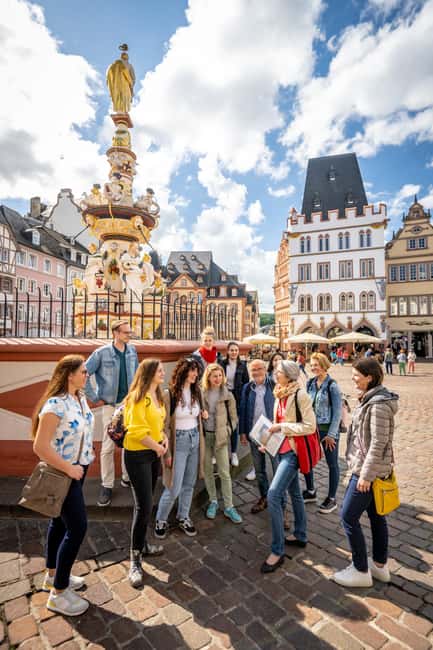
The Hauptmarkt is one of the tour’s central stops. It is a natural place to pause and consider how Trier’s commercial and civic life developed around a public square.
Here, the guide brings in the story of self-confident citizens fighting the bishop for imperial immediacy. That phrase refers to the city’s effort to answer directly to the emperor rather than remain under the authority of a local prince-bishop. You do not need a law degree to follow the basic point: Trier’s citizens wanted more control over their own affairs.
The details are unusually lively. The conflict involved knights, monkeys, and church towers, which makes this a memorable part of the walk. The monkey detail may sound odd at first, but that is exactly why it helps the political story stick. Trier’s medieval past was not a tidy parade of noble rulers. It included rivalry, symbols, clever buildings, and occasional theatrical gestures.
I like the Hauptmarkt stop because it gives the city center a social purpose. You are not just looking at old stone. You are standing in the sort of public space where money, religion, authority, and civic pride met.
The square can also be a busy part of the route, depending on the time of day. Stay close enough to hear the guide, and keep in mind that the 90-minute schedule does not allow for a long independent break here.
Same city, a completely different kind of day:
- Berlin: Reichstag, Dome and Government District Guided Tour
★ 4.7 · 18,288 reviews - Berlin: 1-Hour City Tour by Boat with Guaranteed Seating
★ 4.3 · 16,993 reviews - Hamburg: Sex and Crime in St. Pauli Tour for Ages 18+
★ 4.7 · 15,447 reviews - Hamburg: 1.5-Hour Harbor and Speicherstadt Day Cruise
★ 4.6 · 14,200 reviews
Trier Cathedral and the Church of Our Lady
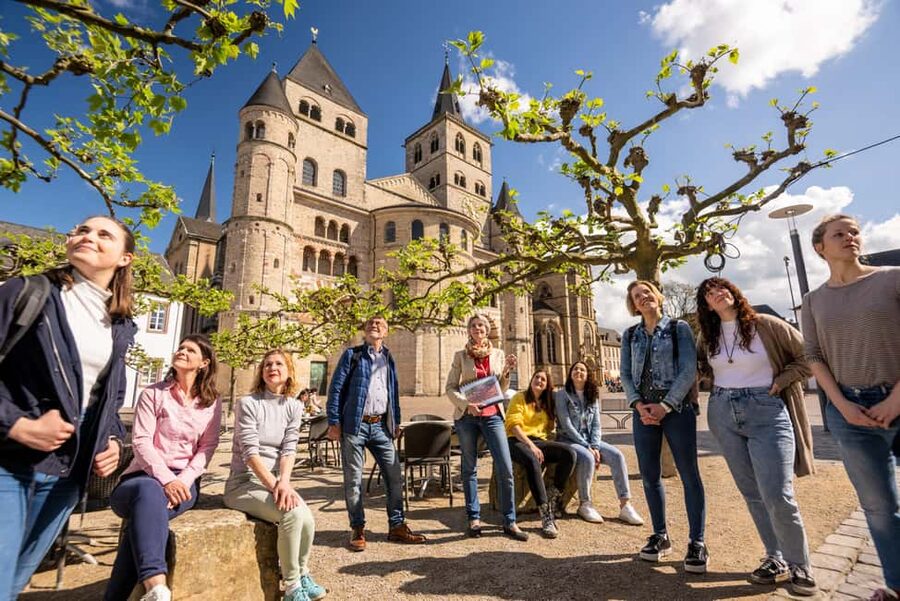
The walk then reaches two of Trier’s most important Christian buildings: Trier Cathedral and the Church of Our Lady. Both form part of Trier’s UNESCO World Heritage designation, and seeing them together helps explain the importance of the cathedral quarter.
The cathedral represents the long reach of the city’s religious and political authority. The Church of Our Lady adds a different architectural presence beside it. On this tour, you pass both buildings as part of the city route, with the guide explaining their place in Trier’s story.
Be clear about what is included. The tour includes a visit to the four UNESCO monuments in the sense that the route takes you to them and guides you around them. The information provided does not promise dedicated interior entry, reserved access, or time for a detailed architectural inspection inside each building.
That distinction matters if you are choosing between a short orientation and a full heritage visit. You can use this walk to learn what you are seeing, then return later if you want quiet time inside the cathedral or Church of Our Lady.
The cathedral courtyard is also part of the route. It provides a change from the open city streets and leads naturally toward the later chapters of Trier’s history. The movement from the religious center to the basilica and Electoral Palace keeps the walk easy to follow.
The Aula Palatina and the Roman basilica
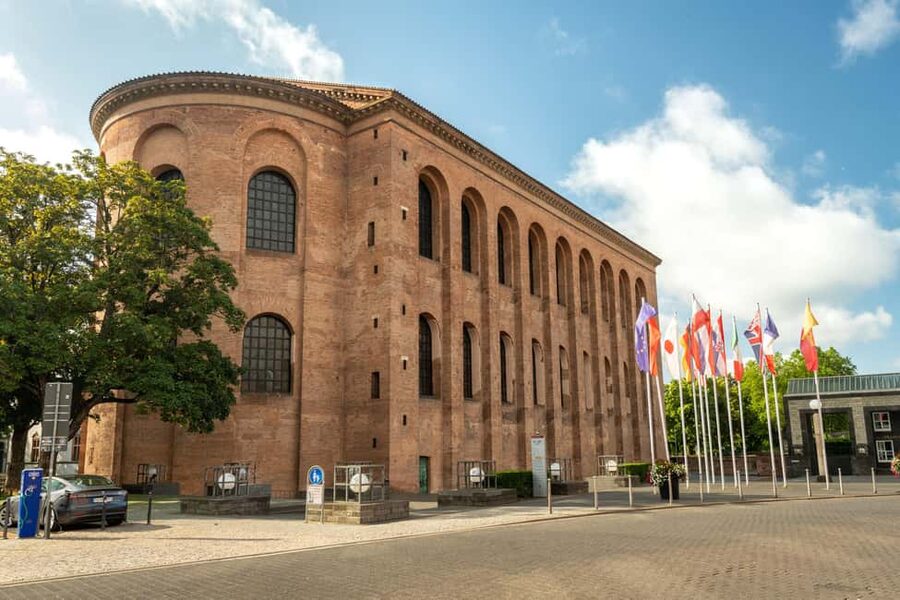
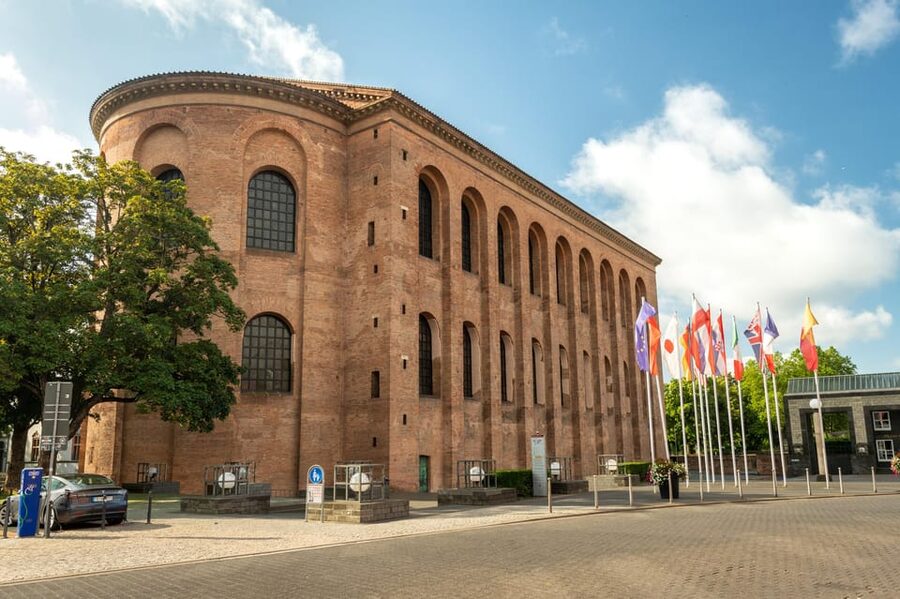
The final major historical shift comes at the Aula Palatina, also known as the basilica. This enormous Roman hall is one of Trier’s most striking reminders that the city once mattered at the highest level of the Roman world.
The basilica was a secular imperial building, not a church in its original Roman role. That difference is worth hearing on site, because later buildings in Trier can make it easy to assume that every monumental structure served a religious purpose.
The guide places the basilica within the route’s Roman chapter, even though you encounter it after medieval streets and the cathedral quarter. That return to ancient Trier reinforces one of the walk’s best ideas: the city’s past is layered rather than neatly arranged.
The Aula Palatina is also a stop where scale does much of the work. A short tour cannot cover every architectural detail, but the building’s size gives you an immediate sense of imperial ambition. If you enjoy grand Roman sites, note the basilica as a place to revisit with more time.
Baroque Trier at the Electoral Palace and palace garden
The walk ends around the Electoral Palace and its palace garden. This is the baroque finish to the tour, and it changes the mood once again. After Roman military architecture, medieval civic tension, and church power, you see the polished style of later court life.
The Electoral Palace is valuable because it shows how Trier’s rulers presented authority in a different way. The Roman gate communicates strength through mass. Medieval buildings suggest defense and local struggle. Baroque palace design uses order, decoration, and controlled space to make power look refined.
The route has two listed drop-off points around the Kurfürstliches Palais and the palace garden. That gives you a useful choice at the end. You can stop near the palace for further sightseeing, or use the location as a natural starting point for exploring the surrounding center on your own.
The ending is practical as well as historic. You finish near major landmarks rather than being returned to a remote meeting point. Since the tour lasts only 1.5 hours, you still have plenty of the day for a museum, a longer cathedral visit, or a second look at the Roman sites.
What the $17 price really buys you
At $17 per person, this is priced as a low-cost introduction rather than a full private tour. The value comes from the official guide, the tight central route, and the amount of historical ground covered in a short period.
You are paying to have the city’s main landmarks connected for you. Without a guide, it is easy to see the Porta Nigra, Hauptmarkt, cathedral, and basilica as separate photo stops. With context, you understand how Roman, medieval, religious, civic, and baroque Trier relate to one another.
The price is especially fair if you are staying only briefly or want help getting oriented on your first day. It is less compelling if you already know Trier well, have read extensively about its monuments, or want long interior visits at each UNESCO site.
A useful plan is to take the walk early in your stay, then return to the places that catch your attention. At $17, the tour can function as a map with a story attached.
Timing, language, and access
The tour lasts 90 minutes, with starting times shown according to availability. That makes it easy to fit around a train arrival, a museum visit, or an afternoon departure, but you should allow a little extra time to find the Tourist Information beside the Porta Nigra.
The route is offered in German and English. If you want the English tour, confirm the selected language before booking rather than assuming every departure uses both languages.
The tour is listed as wheelchair accessible. Since this is a walking route through the city center, access can still depend on the exact streets and conditions at the time, so it is sensible to confirm any specific needs with the Tourist Information office.
The group size is not specified. Because the route includes public squares and busy streets, your ability to hear the guide may depend on where you are standing. Stay near the guide at major stops, especially at the Hauptmarkt and around the cathedral quarter.
You can cancel up to 24 hours before the start for a full refund, and the reserve-now, pay-later option lets you hold a place without paying immediately. Those terms are useful if your train connections or wider Germany plans are still shifting.
Who will get the most from this Trier walk
I would choose this tour for a first visit to Trier, especially if you want a clear introduction without committing half a day. It suits couples, families, and independent visitors who prefer a live explanation but still want plenty of time to explore alone afterward.
It also works well for history-minded visitors who like the way a city changes over time. The route does not focus on one period. Instead, it moves from the Porta Nigra to medieval civic life, then through the cathedral quarter and on to baroque Trier.
You may want something longer if your main goal is detailed architecture, extended church interiors, or specialist Roman archaeology. The short format means the guide must keep moving, and some stops will be viewed from outside or discussed briefly.
The 4.6 rating from 118 reviews supports the tour’s strongest qualities: clear information and an articulate guide. One recent German-language booking described the tour as very informative, while another praised the guide as eloquent. That matches what this format promises best: a focused, well-paced explanation rather than a slow, highly specialized seminar.
Should you book this Trier City Walking Tour?
Book it if you want to see Trier’s key landmarks in a logical order and understand the city’s shift from Roman power to medieval rivalry and baroque court life. The $17 cost and 90-minute length make it an easy addition to a short visit.
Skip it if you want guaranteed interior access, a small private group, or a long Roman archaeology tour. For most first-time visitors, though, this is a sensible way to get your bearings, learn the stories behind four UNESCO monuments, and finish near the Electoral Palace with the rest of the day still free.
FAQ
Where does the Trier City Walking Tour meet?
The meeting point is in front of the Tourist Information, directly beside the Porta Nigra.
How long does the tour last?
The tour lasts 1.5 hours, or 90 minutes.
What languages are available?
The live tour guide is available in German and English.
Which UNESCO monuments are included?
The route passes the Porta Nigra, Trier Cathedral, the Church of Our Lady, and the Aula Palatina, also called the basilica.
Is the tour wheelchair accessible?
Yes, the tour is listed as wheelchair accessible.
How much does the tour cost?
The listed price is $17 per person.
Just added around Germany
- Aachen old town tour – GERMAN (public)★ 5.0 · 24 reviews
- Aachen Private Walking Tour With A Professional Guide★ 5.0 · 11 reviews
- Cologne Highlights: Exclusive Private Tour★ 5.0 · 5 reviews
- Bremen Private Walking Tour With A Professional Guide★ 5.0 · 7 reviews
- Private Walking Tour through the Fascinating Bremen’s City Center★ 5.0 · 5 reviews
- Explore Cologne’s best Street Art Quarter★ 4.5 · 4 reviews
- Bremen Exploration Private Game and City Tour on your Phone★ 4.5 · 7 reviews
- e-Scavenger hunt Bremen: Explore the city at your own pace★ 4.0 · 24 reviews
City Tours, compared.
1-Hour City Tour by Boat with Guaranteed Seating
Read our review →
City History Canal Sightseeing Tour on a Motorboat
Read our review →
Browse the lists this tour appears in