
Reviewed · CRUISES & BOAT TOURS
Berlin East Side Tour 2.5 hour cruise with commentary
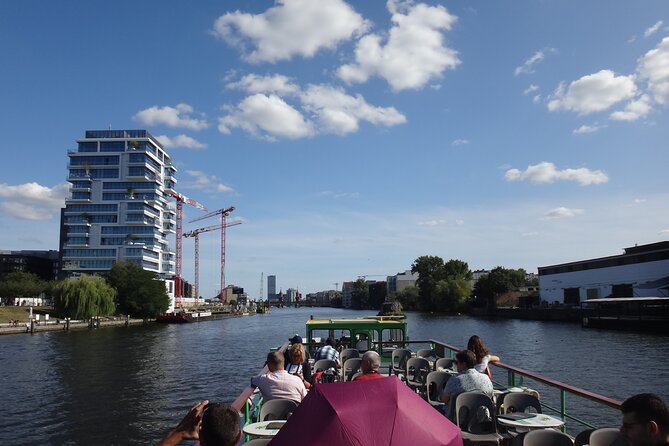
Berlin’s story reads differently from the water. On this 2.5-hour Spree cruise, you glide past the East Side Gallery, Museum Island, the Reichstag, old bridges, modern government buildings, and Molecule Man without having to navigate city traffic. The slow pace gives you time for photos and a good look at Berlin’s odd mix of grand monuments, leftover industrial buildings, and fresh development.
I like two things especially: the cruise reaches farther east than the shorter one-hour boat trips, and the lock passage at Mühlendammschleuse gives the ride a bit of action. The upper deck offers the best views, while the onboard bar makes this an easy afternoon outing. The main drawback is simple: 2.5 hours can feel long, particularly for young children or if the weather is hot, rainy, or windy.
In This Review
- Key points at a glance
- What this Berlin East Side cruise actually does
- Beginning with Berlin Cathedral and Museum Island
- The Mühlendammschleuse and the place where Berlin began
- The East Side Gallery from the river
- Oberbaum Bridge, old customs gates, and Molecule Man
- Nikolaiviertel and the Berlin TV Tower
- The government quarter from Schiffbauerdamm to the Reichstag
- Chancellery and House of World Cultures
- Commentary, seating, and the weather question
- Is the $36.04 price fair?
- Who should book this cruise?
- Should you book the Berlin East Side Tour?
- FAQ
- How long is the Berlin East Side cruise?
- Where does the cruise start?
- What time does the cruise depart?
- Where does the cruise finish?
- Is commentary included?
- Is food or drink included in the ticket?
- What major sights does the cruise pass?
- Can I get off at the East Side Gallery?
- How many people can join the cruise?
- Can I cancel for a full refund?
Key points at a glance
- Mühlendammschleuse adds a real working-waterway moment: The boat passes through a lock near the place where Berlin began.
- East Side Gallery looks best from the Spree: You see the surviving Berlin Wall section from its riverfront setting.
- The upper deck gives the clearest city views: It is best for photographs, though the bilingual commentary can be harder to hear outside.
- The ride reaches more than central Berlin: You pass Oberbaum Bridge, Molecule Man, Osthafen, Holzmarkt 25, and the area around Uber Arena.
- The commentary covers buildings as well as politics: Expect architecture and city facts, with less detailed historical storytelling than some may want.
- The $36.04 fare buys time, not a hop-on hop-off tour: You return to the starting dock and do not get off at the sights.
What this Berlin East Side cruise actually does
The boat leaves at 2:45 pm from Anlegestelle Alte Börse, at Burgstraße 27, beside the Spree in central Berlin. The cruise returns to the same place after about 150 minutes, so you can plan another activity afterward without arranging a second pickup.
This is a sightseeing ride, not a transport service. You stay aboard while the city passes by. That matters because the tour shows you places that can be awkward to connect on foot, including riverfront government buildings, the East Side Gallery, the Molecule Man sculpture, and sections of the eastern Spree.
The boat carries a maximum of 55 people. That is a moderate group size, though seating arrangements can still matter. Some tables and chairs may be reserved, and reserved upper-deck seating can be purchased at the wharf booking booth. If you care about facing forward or sitting outside, check this before boarding rather than assuming every seat is open.
Other Berlin days worth putting on the list:
- Berlin: Reichstag, Dome and Government District Guided Tour
★ 4.7 · 18,288 reviews - Berlin: 1-Hour City Tour by Boat with Guaranteed Seating
★ 4.3 · 16,993 reviews - Berlin: Boat Tour Along the River Spree
★ 4.4 · 11,252 reviews
Beginning with Berlin Cathedral and Museum Island
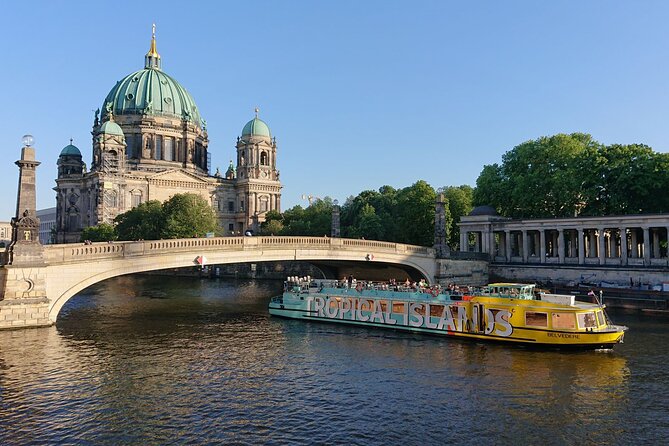
The opening stretch gives you Berlin’s grandest central landmarks. Berlin Cathedral rises beside the Lustgarten with its large dome and ornate Neo-Renaissance and Neo-Baroque design. Built between 1894 and 1905, it is Germany’s largest Protestant church by area and an important burial place for the Hohenzollern dynasty.
From the boat, the value is the setting. Cathedral, park, river, and museum buildings come together in one view. You do not get time to tour the church, climb its dome, or inspect the interior, so think of this as an orientation rather than a replacement for a museum visit.
Next comes the Humboldt Forum, built in the form of the former Berlin Palace. It houses the Ethnological Museum, the Museum of Asian Art, Berlin city displays, and the Humboldt Laboratory. From the river, you mainly appreciate its large palace-like frontage and its place within the rebuilt center of Berlin.
Museum Island follows, or appears as part of this central cluster, depending on the boat’s exact position. The island’s five major museums were built between 1830 and 1930 and are protected as a UNESCO World Heritage site. The group includes the Old Museum, New Museum, Old National Gallery, Bode Museum, and Pergamon Museum, along with the James Simon Gallery visitor center.
I find this first section useful on a first afternoon in Berlin because it puts several major sights on one mental map. You see how close they are to one another, then you can return later to the museums that interest you most.
The Mühlendammschleuse and the place where Berlin began
The boat pauses at Mühlendammschleuse, a lock on the Spree-Oder waterway. The lock overcomes a drop of about 1.51 meters, and the passage can take roughly 20 minutes. That is not wasted time. You get to watch the boat adjust to the different water level while the commentary explains why this stretch mattered.
The lock sits near Fischerinsel and the historic crossing between the early settlements of Berlin and Cölln. This is generally treated as the place where Berlin developed. A medieval weir and passage once helped control movement on the river and collect customs duties.
The lock itself dates to 1942, so what you see is not medieval Berlin. Its importance comes from the location and from the continuing role of the river. This is one of the more distinctive parts of the long cruise, and it is a key reason to choose the 2.5-hour route instead of a shorter central loop.
The pause also gives you a break from constant narration. The commentary does not continue every second of the cruise, and the lock passage is a good chance to order a drink, take photographs, or simply watch the mechanism work.
The East Side Gallery from the river
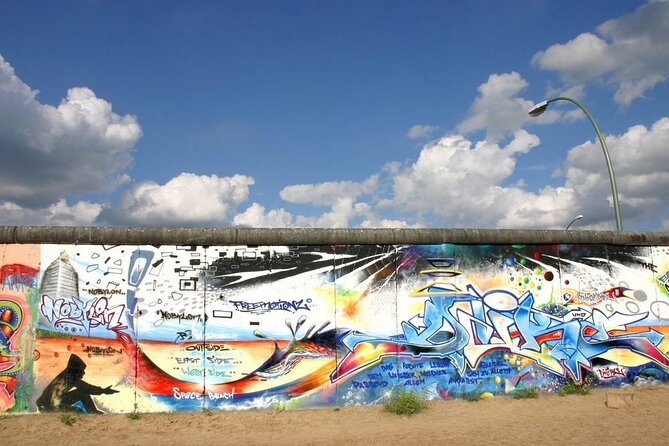
The East Side Gallery is the longest surviving section of the Berlin Wall, running for 1,316 meters along Mühlenstraße between Ostbahnhof and Oberbaum Bridge. In 1990, 118 artists from 21 countries painted more than 100 works on the former East Berlin side of the wall.
From the boat, you see the wall in context. The river was the actual border here, while the painted section is the hinterland wall that closed off the East Berlin side of the border zone. That detail helps explain why the gallery sits beside the Spree yet is not itself the original river barrier.
Most of the paintings you see today are replicas made in 2009, following damage and urban changes. That does not make the stop meaningless, but it is worth knowing what you are looking at. The cruise provides a wide view of the wall, the opposite bank, and the changing district around it. It does not let you get off for a close look at individual murals.
One person wished for even five minutes on land at the gallery. That is a fair limitation to keep in mind. If your main goal is to photograph the murals up close, visit separately on foot. If you want to understand the wall as part of Berlin’s riverfront, the boat gives you a useful angle.
Same city, a completely different kind of day:
- Discover Berlin Half-Day Walking Tour
★ 5.0 · 9,624 reviews - Berlin: Hop-on Hop-off Bus Tour with Live Commentary
★ 4.3 · 8,579 reviews - Berlin: Government District around the Reichstag Guided Tour
★ 4.7 · 8,447 reviews - Berlin: Reichstag, Plenary Chamber, Cupola & Government Tour
★ 4.6 · 8,422 reviews
Oberbaum Bridge, old customs gates, and Molecule Man
Oberbaum Bridge is one of the visual highlights of the ride. Its red-brick towers, arches, and upper railway line connect Friedrichshain and Kreuzberg. The bridge is not just pretty. It recalls the old eastern entrance to Berlin, when bridges and gates helped control traffic and collect customs.
The earlier bridge tradition included a wooden crossing with a narrow passage for boats. At night, a heavy iron-nailed tree trunk could close the channel. Later, the upper tree and Stralauer Tor marked the eastern approach to the city. The commentary turns these structures into part of a bigger story about Berlin growing outward from a fortified center.
After the bridge, look for Molecule Man in the Spree. American sculptor Jonathan Borofsky created the three-person sculpture in 1999. It sits near the meeting point of Kreuzberg, Alt-Treptow, and Friedrichshain, between Elsen Bridge and Oberbaum Bridge.
This is one of the best photo moments on the cruise. The three perforated human figures appear to lean toward one another while the boat moves past. From land, the work can feel tied to one section of river. From the water, you get the full silhouette and its relationship to the banks.
The eastern section also brings views of the newer Osthafen, the alternative cultural center Holzmarkt 25, the Badeschiff, and the district around Uber Arena. These places do not have the same fame as the Reichstag or Cathedral, but they help you see present-day Berlin beyond the postcard center.
Nikolaiviertel and the Berlin TV Tower
Back toward Mitte, the cruise passes the Nikolaiviertel and the television tower. Nikolaiviertel is considered Berlin’s oldest settlement area. World War II destroyed most of it, and East Berlin rebuilt the quarter between 1980 and 1987 around the reconstructed Nikolaikirche.
The result is a planned historic-looking district with reconstructed town houses and adapted prefabricated buildings. From the river, you get the broad arrangement rather than the small lanes and courtyards. I would not use the cruise as a substitute for walking through Nikolaiviertel, but the view helps explain how the old center was rebuilt during the East German period.
The Berlin TV Tower is hard to miss. At 368 meters, it is Germany’s tallest building and a major symbol of the city. It was completed in 1969, when it was the world’s second-highest television tower. Its placement near Alexanderplatz makes it a useful marker as the boat works through central Berlin.
This section can feel more architectural than historical. If you want a tour centered on major political events, the commentary may seem light. If you enjoy seeing how old, reconstructed, modern, and utilitarian buildings share one skyline, the changing view is rewarding.
The government quarter from Schiffbauerdamm to the Reichstag
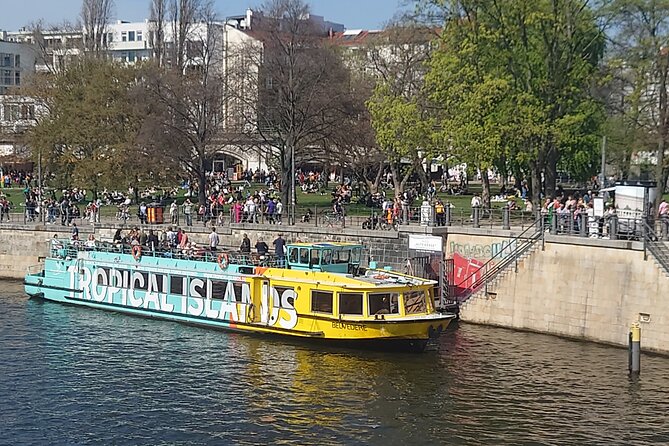
The route then follows central riverfront streets and bridges, including Schiffbauerdamm and Weidendammer Bridge. Schiffbauerdamm takes its name from the shipbuilding firms once located along the bank. Weidendammer Bridge crosses Friedrichstrasse and has been protected as a historic structure since the 1970s.
The Palace of Tears is nearby at Friedrichstrasse station. This former departure hall handled border controls for people leaving East Berlin by train for West Berlin or the Federal Republic. East Germans generally could not make the same trips freely, so the hall became associated with painful farewells.
The boat cannot give you the same close look as a museum visit, but the river view places the site within the transport network that divided Berlin. You can visit the Palace of Tears separately if this part of the city’s Cold War story interests you.
The Reichstag comes next, on Republic Square. Paul Wallot’s Neo-Renaissance building was constructed between 1884 and 1894, later damaged by the 1933 fire and World War II, and rebuilt in modern form. Norman Foster redesigned it between 1995 and 1999 for the German Bundestag, adding the famous accessible glass dome.
From the water, the Reichstag is one of the clearest landmarks in the government quarter. You will not enter the dome on this cruise, and no admission to the building is included. Still, the low river-level view shows the parliament building alongside its newer neighbors.
The Kronprinzenbrücke connects Mitte and Tiergarten near the government district. The bridge carries roads, cycle paths, and pedestrian paths, with the Spreebogenpark and the Bundestag day-care center nearby. Then comes Humboldthafen, a listed dock with a water surface of about 33,500 square meters, designed according to plans by landscape architect Peter Joseph Lenné.
Chancellery and House of World Cultures
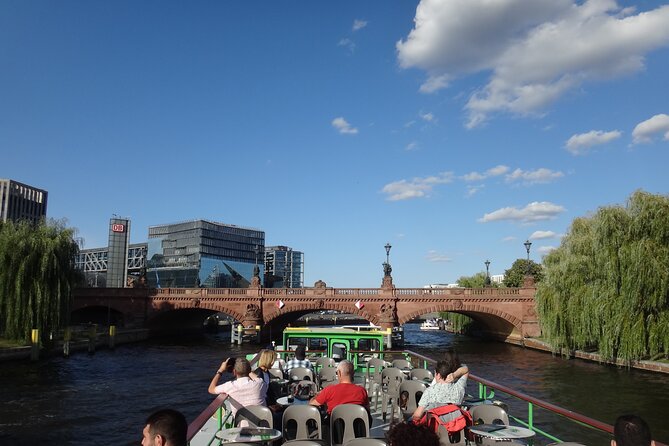
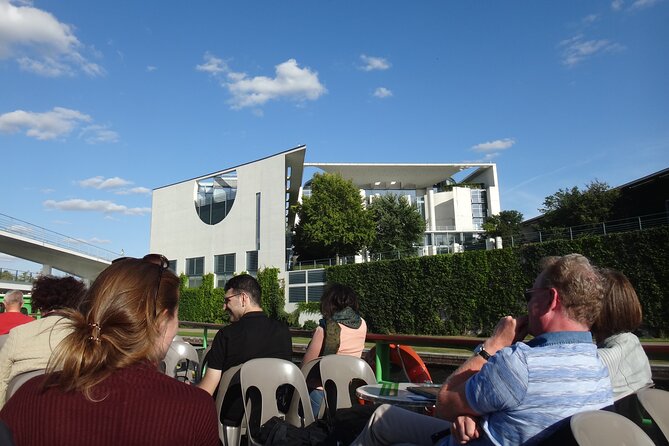
The Federal Chancellery is part of the modern government group along the Spree. The current Berlin building opened in 2001 and was designed by Axel Schultes. It supports the German Federal Chancellor and is separated from the Reichstag by Platz der Republik.
Seen from the boat, the Chancellery is a lesson in the visual language of reunified Germany. The clean, large-scale forms are a sharp contrast to the ornate cathedral and museums earlier in the ride. The commentary explains the buildings, though you should expect more city description than a detailed seminar on federal politics.
The House of World Cultures occupies the former Congress Hall on the Tiergarten riverbank. Its curved shape earned it the local nickname Pregnant Oyster. It presents international contemporary art, with a focus on non-European cultures and societies.
The building looks especially interesting from the water because its form is easy to read from a distance. If you visit Berlin for architecture, this is one of the more enjoyable parts of the return route. If your interest is only in famous monuments, it may feel like a quieter stretch.
Commentary, seating, and the weather question
Live commentary is provided in German and English. The German explanation generally comes first, followed by the English version. That arrangement can be awkward if the boat passes a building before the English description begins, especially from the upper deck.
Sound also changes with your seat. Several people found the indoor narration clear, while the upper deck offered better views but made the commentary harder to hear at times. Sit close to the speaker if the explanation matters to you, and keep your attention on the river if photographs matter more.
The open upper deck is the place to sit on a clear day. You get wider views and better photographs, but direct sun and wind can make the ride uncomfortable. The lower salon offers shelter and large screens showing the journey, but the indoor area may become hot if ventilation or air conditioning is not working properly.
Seating can be tight. Some chairs are connected in rows of three, which helps keep aisles clear for crew and emergency access but gives you less freedom to spread out. A rowdy group can also change the feel of the ride, and moving downstairs may mean giving up the best view.
The onboard bar sells food and drinks at your own expense. Coffee and beer are available, but supplies can run out, so do not count on the food menu as your only meal plan. Bring weather-appropriate clothing, and remember that outside food is not permitted onboard according to one reported experience.
Is the $36.04 price fair?
At $36.04 per person, this is not the cheapest way to see Berlin. A one-hour Spree cruise costs less and may be a better fit for children, short attention spans, or anyone who wants a quick look at the central sights.
The longer cruise earns its extra cost through distance and time. You get the lock passage, the East Side Gallery, Oberbaum Bridge, Molecule Man, the eastern harbor area, and the government quarter. The boat also moves slowly enough for photographs, rather than rushing past every building.
The value depends on how you like to sightsee. I think the price is fair if you want to sit down for an afternoon and cover a wide section of Berlin without changing trains or walking long distances. It is weaker value if you only want the wall murals or if you already know the riverfront and prefer a fast overview.
A mobile ticket and a maximum group size of 55 make the arrangement simple. The meeting point is near public transportation, and the cruise includes a toilet onboard. Service animals are allowed, and most people can take part, though the boat may not be practical for a wheelchair user.
Who should book this cruise?
I would choose this cruise on a first or second day in Berlin, especially if you want to see the city before deciding where to return on foot. It suits adults, couples, and anyone who enjoys architecture, city planning, bridges, and the contrast between imperial Berlin, divided Berlin, and the rebuilt capital.
It also works well when you want a restful afternoon. You can sit, order a drink, and let the river do the work. The slow pace is a strength for photographers and a weakness for anyone who needs constant activity.
Families with very young children should consider the one-hour cruise instead. The final half hour may feel repetitive, and the bilingual commentary extends the time between major landmarks. People who want detailed political history should also set modest expectations, since the narration gives substantial attention to buildings and everyday structures.
Free cancellation is available until 24 hours before the 2:45 pm start. After that point, cancellation or changes are not accepted for a refund.
Should you book the Berlin East Side Tour?
Book it if you want the widest river view of Berlin for one sitting, with the East Side Gallery, Mühlendammschleuse, Oberbaum Bridge, Molecule Man, Museum Island, the Reichstag, and the government quarter in one trip.
Choose the one-hour option if you have young children, dislike bilingual narration, or want only a short introduction. For the longer cruise, arrive ready for changing weather, check seating at the dock, and favor the upper deck if views matter most. At around $36.04, it is a sensible buy for a relaxed city orientation, but not a substitute for walking the wall, touring the museums, or entering Berlin’s major buildings.
FAQ
How long is the Berlin East Side cruise?
The cruise lasts approximately 2 hours and 30 minutes, or 150 minutes.
Where does the cruise start?
It starts at Anlegestelle Alte Börse, BWSG Berliner Wassersport und Service GmbH, Burgstraße 27, 10178 Berlin, Germany.
What time does the cruise depart?
The scheduled start time is 2:45 pm.
Where does the cruise finish?
The boat returns to the same meeting point at Anlegestelle Alte Börse.
Is commentary included?
Yes. Live commentary is included in German and English.
Is food or drink included in the ticket?
No. Food and drinks are not included, but an onboard bar sells food and drinks for an additional charge.
What major sights does the cruise pass?
The route includes Berlin Cathedral, the Humboldt Forum, Mühlendammschleuse, the East Side Gallery, Oberbaum Bridge, Molecule Man, Nikolaiviertel, the Berlin TV Tower, Museum Island, the Reichstag, the Federal Chancellery, the House of World Cultures, the Palace of Tears, Weidendammer Bridge, and the Bode Museum.
Can I get off at the East Side Gallery?
No. This is a cruise that returns to its starting point. The East Side Gallery is viewed from the boat.
How many people can join the cruise?
The activity has a maximum of 55 participants.
Can I cancel for a full refund?
Yes, if you cancel at least 24 hours before the experience start time. Cancellations or changes made less than 24 hours before the start are not accepted for a refund.
Just added around Berlin
- Love and War in Berlin: Self-Guided Story Puzzle Walk★ 5.0 · 7 reviews
- Rickshaw Tours Berlin – Groups of up to 16 people with several rickshaws★ 4.0 · 97 reviews
- Walking on the Wall: 3-Hour Tour in Berlin★ 4.5 · 34 reviews
- eSIM for Germany and 34 European Countries★ 4.5 · 16 reviews
- Warnemuende Shore Excursion: Berlin Private Sightseeing Tour from Rostock★ 5.0 · 4 reviews
- Your ticket to The Wall Museum Berlin★ 3.0 · 60 reviews
- Warnemuende Shore Excursion: Private Berlin Tour★ 4.5 · 27 reviews
- Berlin’s Gay, Lesbian, and Queer Scene Small-Group Walking Tour★ 4.5 · 66 reviews
Cruises & Boat Tours, compared.

1-Hour City Tour by Boat with Guaranteed Seating
Read our review →
1.5-Hour Harbor and Speicherstadt Day Cruise
Read our review →

River Main Sightseeing Cruise with Commentary
Read our review →
Browse the lists this tour appears in