

Reviewed · CASTLE & PALACE TOURS
Berlin: Decolonial Berlin Castle/ Humboldt Forum Guided Tour
Berlin’s reconstructed palace looks grand, but this tour asks you to look past the stonework and ask harder questions. Who built the power behind the palace? How did missionary work help colonial systems grow? Why does a cross sit on the roof of a museum holding objects from across the world? This is a decolonial, Afrocentric tour of the Humboldt Forum, not a standard palace history walk.
I like two things right away. First, the long outdoor discussion gives the Berlin Palace a political and social setting before you enter the museum. Second, the tour does not treat the ethnological collection as a neutral display. You are encouraged to examine how objects were acquired, labeled, and presented. The main consideration is clear: the museum visit itself is relatively short, since about an hour is spent outside.
In This Review
- Key points to know
- Starting at the Sanchi Gate
- Why the Berlin Palace needs a second reading
- Missionaries, science, and the Humboldt brothers
- Inside the Humboldt Forum’s ethnological collection
- A tour built around conversation, not spectacle
- What the two-hour schedule really gives you
- Is $41 a fair price?
- How to prepare for a better experience
- Who should book this Berlin tour?
- Should you book the Decolonial Berlin Castle tour?
- FAQ
- How long does the tour last?
- What language is the tour conducted in?
- Where is the meeting point?
- How much time is spent outside?
- Is entry to the ethnological collection included?
- Is a tour guide included?
- Is the tour wheelchair accessible?
- What should I bring?
- Can I bring food, drinks, luggage, or a large bag?
- Can I cancel the booking for a refund?
Key points to know
- Meet at the reconstructed Sanchi Gate: Look for the white chairs near the gate and arrive ready to sit outside.
- Expect an Afrocentric reading of Berlin: The guide connects the palace and museum to colonial power, missionary activity, and modern cultural memory.
- About one hour is outdoors: Wear weather-appropriate clothing, even if the forecast looks mild.
- The ethnological collection is examined critically: An audio walk helps you consider how museum objects are framed and interpreted.
- English is the tour language: A live guide leads the experience, and wheelchair access is available.
- The strongest value is the discussion: At $41, this suits you best if you want ideas and context, not simply a quick look at palace rooms.
Starting at the Sanchi Gate

Your meeting point is near the reconstructed Sanchi Gate, close to the Humboldt Forum. The practical detail matters because the palace complex has several grand entrances and open spaces, and a first-time visitor could easily wait in the wrong place. Look for the white chairs near the gate, where the group sits before the museum portion begins.
The first hour takes place outside. That means the tour begins less like a conventional museum visit and more like a guided conversation in the middle of Berlin’s reconstructed historic center. Comfortable shoes help, but clothing matters just as much. Bring a coat, rain layer, or sun protection as needed.
There is no food or drink allowed during the activity, and large bags or luggage are not permitted. Plan to arrive without bulky belongings. You do not want to spend the opening discussion worrying about a suitcase or an uncomfortable seat.
More Castle & Palace Tours in Berlin
- Berlin: Charlottenburg Palace Entry Ticket
★ 4.4 · 2,076 reviews - From Berlin: Potsdam and Sanssouci Palace Tour with Entry
★ 4.5 · 1,094 reviews - Potsdam Tour from Berlin With Guided Sanssouci Palace Visit
★ 4.5 · 364 reviews
Why the Berlin Palace needs a second reading
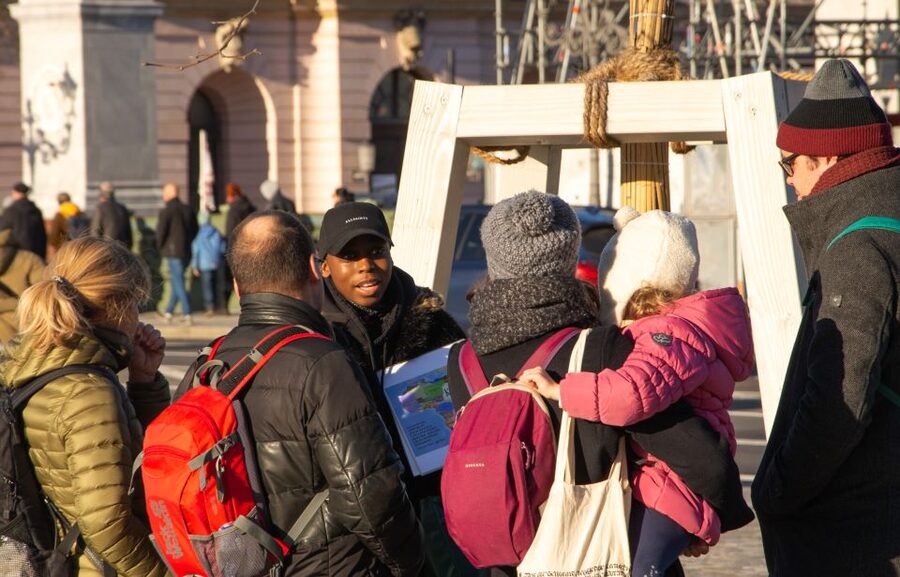
The Berlin Palace has a history stretching back about 500 years, but the tour does not present that story as a simple royal timeline. Instead, it examines the building as a symbol of authority, empire, national memory, and cultural ownership.
That approach is useful because reconstructed buildings can appear timeless. They are not. A palace tells you who held power, whose taste was treated as important, and which parts of the past a city chooses to rebuild. The Humboldt Forum occupies this charged setting, so its collections cannot be separated entirely from the building around them.
You will consider the link between colonialism and the Berlin Palace, rather than treating colonial history as something that happened far away. The point is not only to learn dates or names. It is to see how political power, scientific study, religious activity, and collecting practices could support one another.
The discussion also gives the roof cross a special role. The cross is not treated as a small decorative detail. Its symbolic meaning becomes part of the larger question of how Christianity, monarchy, German identity, and colonial power are displayed on a public museum.
Missionaries, science, and the Humboldt brothers
The tour introduces Wilhelm and Alexander von Humboldt, two important figures in German history and science. The brothers are presented as more than famous names attached to a cultural center. You will consider their legacy and why the museum uses their name.
The supplied information does not promise a full biography of both men, so you should not expect a complete academic lecture on every part of their lives. Instead, their importance fits into the tour’s wider discussion of knowledge, exploration, classification, and the way European institutions described the wider world.
Missionaries also receive attention. The tour looks at how missionary activity helped establish colonial structures. This is a useful reminder that colonial systems did not rely only on soldiers or government officials. Religious networks, schools, scientific projects, and collecting practices could also shape relationships between Europe and societies under colonial pressure.
I appreciate this wider frame because it links the museum’s displays to real systems of power. You are not only looking at an object behind glass. You are asking how it reached Berlin, who had the authority to remove or classify it, and how its meaning may have changed in the process.
Inside the Humboldt Forum’s ethnological collection

After roughly an hour outside, the group heads into the museum. Entry to the ethnological collection is included in the activity price. The indoor section is not designed as a long, independent museum visit. It is a guided examination of selected ideas and displays.
An audio walk forms part of this portion. Use it as a tool for close looking rather than as background noise. The goal is to analyze the presentation from a critical perspective, including the language and assumptions that shape the display.
That may change how you read museum labels. A label can identify an object, but it can also leave out the circumstances of acquisition, the voice of the community connected to it, or the colonial setting in which it was collected. This tour asks you to pay attention to those gaps.
The collection is therefore best suited to visitors who enjoy asking questions. If you want a fast route through the most famous pieces, you may find the approach slower than expected. If you want to think about who controls cultural narratives, the time inside can be the most useful part of the experience.
Same city, a completely different kind of day:
- Berlin: Reichstag, Dome and Government District Guided Tour
★ 4.7 · 18,288 reviews - Berlin: 1-Hour City Tour by Boat with Guaranteed Seating
★ 4.3 · 16,993 reviews - Berlin: Boat Tour Along the River Spree
★ 4.4 · 11,252 reviews - Discover Berlin Half-Day Walking Tour
★ 5.0 · 9,624 reviews
A tour built around conversation, not spectacle

The strongest positive feedback points to the guide’s ability to keep the subject engaging and informative. Several comments describe the guide as competent, very good, and able to prevent the tour from becoming dull. That fits the structure: the experience depends heavily on explanation, tone, and the quality of the conversation.
There is no guide name provided, so I would not book this expecting a particular individual. The important thing is the format. You receive a live English guide and a clear point of view rather than a neutral audio recording or a standard architectural tour.
The perspective is openly Afrocentric. That is central to the experience, not a minor theme added at the end. You will hear new narratives about colonial history and its cultural legacy, with attention to how European institutions have presented the past.
This direct approach will suit you if you are ready to question familiar interpretations. It may not suit you if you want the guide to avoid present-day debates or present several interpretations with equal weight. One dissatisfied participant objected strongly to the tour’s reinterpretation of history and felt that the presentation dismissed older generations. That reaction signals an important booking point: this is an advocacy-minded historical tour, not a detached overview.
What the two-hour schedule really gives you
Two hours sounds generous for a museum visit, but the schedule is split. You spend approximately one hour seated outside, then continue indoors. That division is not a flaw by itself. The outdoor portion provides the setting and arguments needed to understand the palace and the museum.
Still, you should set realistic expectations. You will not have two full hours to inspect every part of the Humboldt Forum. The indoor tour may feel brief if your main goal is to see the ethnological collection in detail. One piece of feedback specifically found that the historical discussion took time away from the Forum itself.
I see that tradeoff as the defining feature of the booking. You are paying for interpretation, not just admission. The entry ticket is included, but the real product is the guide’s framing of the palace, the collection, and German colonial memory.
The tour is also wheelchair accessible, according to the activity details. Since the opening hour is outdoors on white chairs, you may want to confirm the exact meeting arrangement if you need a particular seating position or have mobility concerns. The listed information supports accessibility, but it does not describe every surface or restroom detail.
Is $41 a fair price?
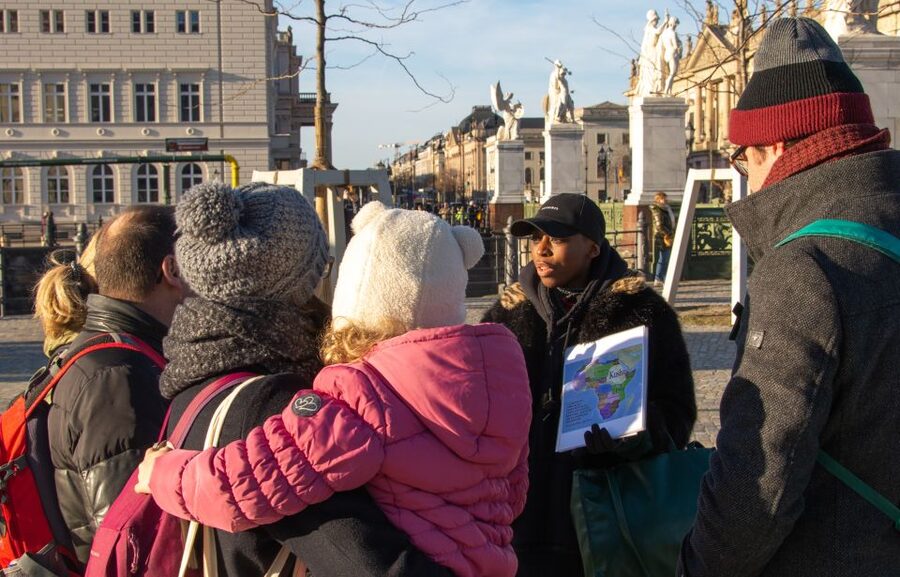
At $41 per person, the price is reasonable if you want a focused guided discussion and museum entry. It becomes less attractive if you mainly want to wander through the building or spend a long time with the collection on your own.
I would compare the cost to the value of a specialist walking tour rather than to a basic museum ticket. The guide connects architecture, colonial history, missionary activity, science, collecting, religion, and public memory in one short experience. That combination is difficult to assemble by yourself in a first visit.
The value also depends on your interest in the subject. A visitor with little interest in colonial history may find the emphasis demanding. Someone already thinking about restitution, representation, or museum ethics may find the tour gives useful structure to questions that can otherwise feel scattered.
You also receive flexibility at booking. You can reserve now and pay later, and cancellation is free up to 24 hours before the start time. Those terms help if your Berlin schedule is still moving, though they do not change the tour’s central limitation: its content is discussion-heavy and its museum time is limited.
How to prepare for a better experience
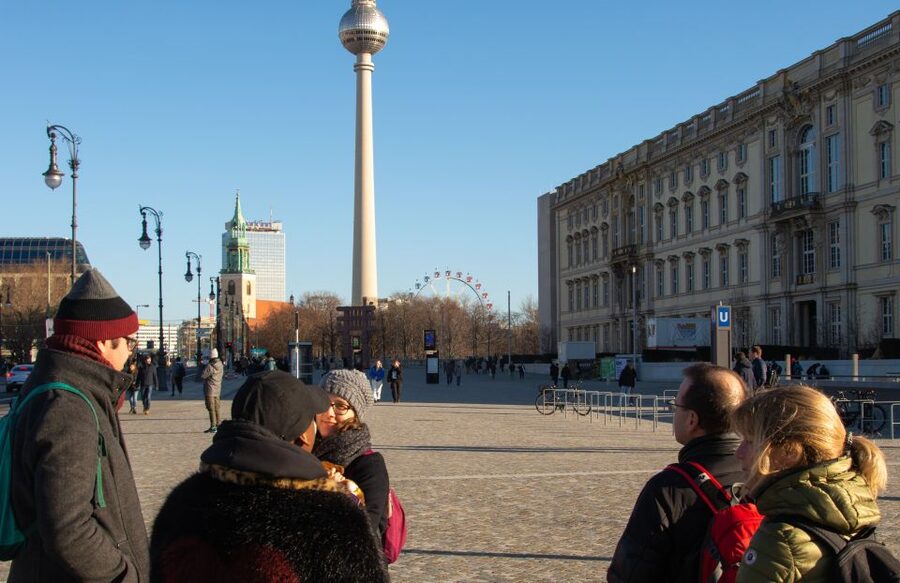
Wear comfortable shoes, but do not stop there. The first half is outdoors, so dress for the actual weather. Berlin can feel cool when you are sitting still, even if walking conditions seem pleasant.
Arrive at the Sanchi Gate with enough time to identify the white chairs. The meeting point is specific, and the previous no-show complaint shows why it is wise to confirm the start time and location carefully before leaving your hotel. That issue appears to be an isolated logistical failure, but it is still worth taking sensible precautions.
Avoid bringing food, drinks, luggage, or large bags. A small, practical day bag is the safer choice, provided it fits the venue’s rules. The tour does not list refreshments, so eat beforehand if you need a meal.
Most important, bring curiosity and patience. You will get more from the tour if you listen for the links between physical objects and larger systems. Consider the palace, roof cross, missionary work, scientific naming, and museum labels as connected parts of one story.
Who should book this Berlin tour?
I would recommend it to you if you want to:
- Examine the Humboldt Forum through an Afrocentric viewpoint
- Understand how colonial structures shaped German cultural institutions
- Think critically about ethnological displays and museum language
- Learn why the Humboldt brothers matter to German science and public memory
- Discuss the symbolic meaning of the palace and its roof cross
- Join an English-language tour led by a live guide
It is also a good choice for repeat visitors to Berlin who have already seen the city’s main monuments and want a more questioning approach to familiar places. The tour gives the palace a different purpose. Instead of treating it as a grand backdrop, it asks you to consider what its reconstruction communicates today.
I would hesitate if you want a purely architectural tour, a traditional royal history lesson, or a long period of independent museum viewing. The strong Afrocentric and decolonial approach is the reason to book, but it is also the reason some visitors may find the experience confrontational.
Should you book the Decolonial Berlin Castle tour?
Book it if you want the Humboldt Forum explained through colonial power, cultural ownership, and competing historical narratives. The best parts are the outdoor setting, the clear focus, the discussion of missionaries and the roof cross, and the critical reading of the ethnological collection.
Skip it if you want two hours inside the museum or prefer a neutral, conventional account of Berlin Palace. At $41, the tour earns its price through context and conversation, not through the number of rooms you visit.
For the right audience, this is a useful way to see a familiar Berlin landmark with fresh questions in mind. Dress for an hour outside, keep your bags small, and arrive ready to listen closely.
FAQ
How long does the tour last?
The tour lasts two hours.
What language is the tour conducted in?
The live guided tour is conducted in English.
Where is the meeting point?
Meet your guide near the reconstructed Sanchi Gate. Look for the white chairs.
How much time is spent outside?
You will be seated outside for approximately one hour before entering the museum.
Is entry to the ethnological collection included?
Yes, entry to the ethnological collection is included.
Is a tour guide included?
Yes, a live tour guide is included.
Is the tour wheelchair accessible?
Yes, the activity is listed as wheelchair accessible.
What should I bring?
Bring comfortable shoes and weather-appropriate clothing.
Can I bring food, drinks, luggage, or a large bag?
Food and drinks are not allowed, and luggage or large bags are not allowed.
Can I cancel the booking for a refund?
Yes. You can cancel up to 24 hours in advance for a full refund. You can also reserve now and pay later.
Just added around Berlin
- Love and War in Berlin: Self-Guided Story Puzzle Walk★ 5.0 · 7 reviews
- Rickshaw Tours Berlin – Groups of up to 16 people with several rickshaws★ 4.0 · 97 reviews
- Walking on the Wall: 3-Hour Tour in Berlin★ 4.5 · 34 reviews
- eSIM for Germany and 34 European Countries★ 4.5 · 16 reviews
- Warnemuende Shore Excursion: Private Berlin Tour★ 4.5 · 27 reviews
- Warnemuende Shore Excursion: Berlin Private Sightseeing Tour from Rostock★ 5.0 · 4 reviews
- Your ticket to The Wall Museum Berlin★ 3.0 · 60 reviews
- Berlin’s Gay, Lesbian, and Queer Scene Small-Group Walking Tour★ 4.5 · 66 reviews
Castle & Palace Tours, compared.

Neuschwanstein & Linderhof Castle-Fairytale Day Tour from Munich
Read our review →


Premium Neuschwanstein Castle and Linderhof VIP Tour from Munich
Read our review →

Sanssouci Palace and Prussian Palaces Entry Ticket
Read our review →Browse the lists this tour appears in