
Reviewed · HISTORICAL TOURS
Historical Walking Tour of Augsburg
Augsburg’s story comes together in a surprisingly compact walk, from the gilded Rathaus to the homes of Bertolt Brecht and Leopold Mozart. I like the way this tour links merchant wealth and music rather than treating the old town as a row of pretty façades. I also like that it includes the cathedral, including its remarkable medieval stained glass.
The main drawback is the pace and footing. Two and a half hours on city streets can feel long if you have mobility limits, and the tour is not suitable for wheelchair users. It also does not run in rain or snow, so check the forecast before you commit.
In This Review
- Key points at a glance
- Why this Augsburg walk works well for a first visit
- Rathausplatz and the Goldener Saal
- Fugger Square and the power of one family
- Little Venice and Augsburg’s canals
- Brechthaus and the Augsburg of Bertolt Brecht
- Leopold Mozart Haus and the Mozart family link
- Augsburg Cathedral and its medieval details
- Walking conditions, timing, and what to bring
- Who will get the most from this tour
- Is the $20 price good value?
- Should you book the Augsburg historical walking tour?
- FAQ
- Where does the Augsburg walking tour start?
- Where does the tour end?
- How long does the tour last?
- What language is the tour in?
- Is Augsburg Cathedral admission included?
- Are food and drinks included?
- Does the tour offer hotel pickup?
- Can I cancel for a full refund?
Key points at a glance
- Rathausplatz begins the story: Start beneath the yellow umbrella at 11 am in the city’s main square.
- Elias Holl’s Rathaus is the visual centerpiece: The Renaissance building leads to the famous Goldener Saal.
- The Fugger connection adds real depth: Fugger Square explains how one merchant family shaped Augsburg and Europe.
- Little Venice changes the mood: Canals and quieter lanes offer a different view of the city.
- Two famous births appear on the route: Stop at the Brechthaus and Leopold Mozart Haus.
- The cathedral finishes with art and atmosphere: Romanesque and Gothic details, 12th-century windows, and a bronze door are included.
Why this Augsburg walk works well for a first visit
Augsburg is easy to underestimate. It is not simply a smaller version of Munich, and its importance is not all packed into one grand palace. The city grew through trade, banking, religion, industry, and the work of major families. This walk gives you a useful map of those forces in one morning or afternoon.
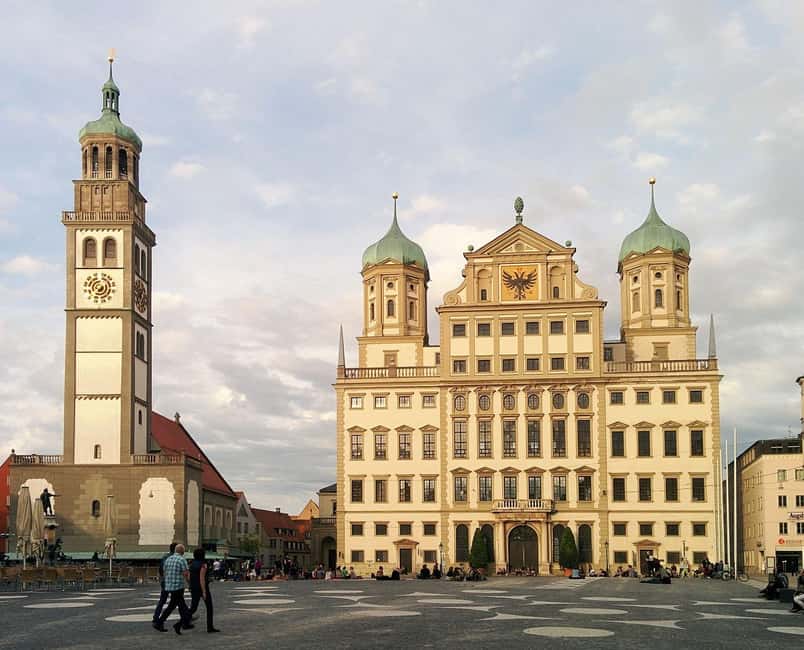
You meet at Rathausplatz, the natural heart of the old town. Look for the yellow umbrella at 11 am. That detail matters because a busy square can be confusing, especially if you arrive by tram, bus, or on foot from the station.
The route is guided in English by Michael, also called Mike in the tour information. His approach, based on the available feedback, includes humor, lesser-known details, and a willingness to adjust the walk to the group. One particularly useful point is that Mike has responded to individual interests, which can make the tour feel less like a memorized speech.
You pay $20 per person for 2.5 hours. That is a fair price for a live guide and entry to Augsburg Cathedral, especially if you want the city’s major sights explained in context. It is less attractive if you prefer to move quickly, take long photographs, or enter every museum independently. Food, drinks, hotel pickup, and any museum admission beyond the stated cathedral access are not included.
A few more Germany trips to weigh up
- Leipzig: City History Canal Sightseeing Tour on a Motorboat
★ 4.7 · 6,232 reviews - Berlin: Natural History Museum Entrance Ticket
★ 4.6 · 3,382 reviews - Leipzig: 1.5-Hour Historical Walking Tour in German
★ 4.7 · 2,217 reviews
Rathausplatz and the Goldener Saal
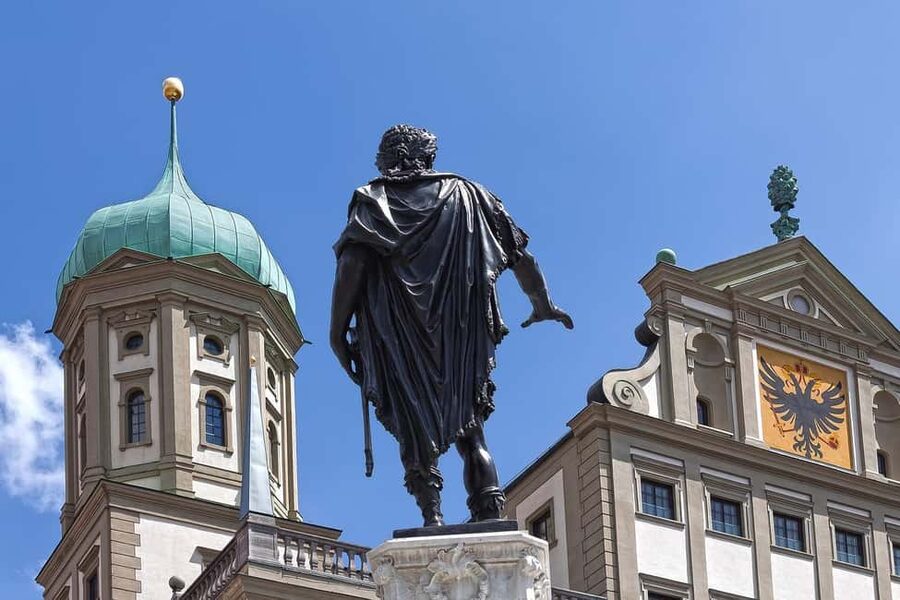
The first stop gives you Augsburg’s grandest introduction. The Augsburg Town Hall, or Rathaus, is a Renaissance masterpiece designed by Elias Holl. Its pale exterior and formal lines make it an obvious landmark, but the interior is the real prize.
The famous Goldener Saal is known for its lavish decoration. Even if you do not spend long inside, the room helps explain the confidence and wealth of Augsburg during its most powerful period. A guide can point out why a city hall of this scale mattered. It was not just an office building. It announced civic power.
The tour’s meeting point is also convenient for orientation. Rathausplatz connects several key parts of the old town, so you can return later to explore on your own. If you are taking photographs, the square gives you a strong first view of both the Rathaus and the Perlach Tower.
One practical point: the tour description highlights the building and its Goldener Saal, but it does not clearly state that interior admission to the Rathaus is included. The only attraction specifically listed as included is Augsburg Cathedral. If entering the Goldener Saal is important to you, confirm that before booking.
Nearby, Perlach Tower rises above the square. It began as a watchtower and now provides one of the city’s best-known high views. The walking tour introduces the tower and its role in Augsburg, but tower access is not listed as part of the tour. Think of this stop as an explanation and a photo opportunity unless your guide tells you otherwise.
Fugger Square and the power of one family
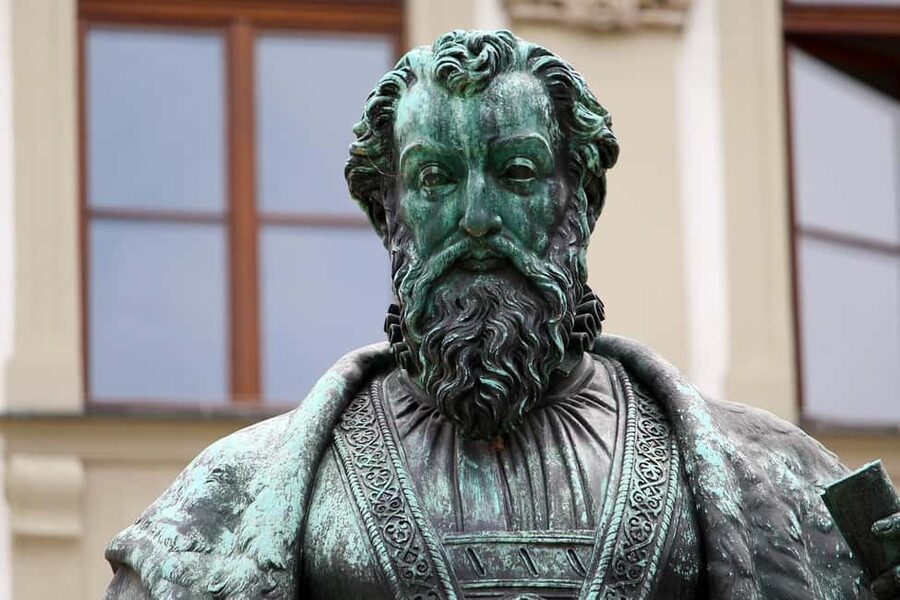
From the civic center, the route turns toward the Fuggers. Their name is central to Augsburg, and Fugger Square gives the story a physical setting.
The Fugger family became one of Europe’s most powerful merchant and banking families. Their influence reached far beyond this city, and their money affected politics, religion, architecture, and daily life. You do not need to be interested in finance to enjoy this part of the walk. The key is seeing how private wealth helped shape public Augsburg.
This is one of the strongest reasons to take a guide instead of simply strolling through the old town with a map. A doorway, courtyard, or square can look decorative until you understand who paid for it and why. The Fugger story also gives you a way to read the rest of the city. Augsburg’s large civic buildings and religious sites were connected to trade and money as much as to faith.
The tour information specifically highlights the history of the Fuggers, and that emphasis should appeal to anyone who wants more than dates and names. It also helps break up the architecture. You move from the Rathaus as a symbol of civic pride to Fugger Square as evidence of private power.
The Fuggers are often associated with the Fuggerei, although the supplied route does not list a visit there. Do not assume that the famous social housing complex is included. If it is high on your list, ask whether the route passes close enough for you to continue there after the tour.
Little Venice and Augsburg’s canals
The next change is visual and atmospheric. Little Venice is a picturesque part of Augsburg with canals that recall Venice, though this is a much smaller and quieter setting.
I like this section because it prevents the walk from becoming a parade of major monuments. Water, narrow lanes, and old buildings give you a more everyday view of the city. The canals also show that Augsburg’s identity was tied to water as well as commerce and politics.
The name may set an unfair expectation if you picture broad Venetian views or gondolas. This is not a substitute for Venice. It is a compact district with charming waterways, and its value lies in contrast. After the formal Rathaus and the financial story of the Fuggers, Little Venice gives you a slower visual pause.
This is a good place to have your camera ready. Photography is allowed throughout the tour. You should still bring weather-appropriate clothing, since the experience takes place outdoors for much of its 2.5-hour duration.
Same city, a completely different kind of day:
- Berlin: Reichstag, Dome and Government District Guided Tour
★ 4.7 · 18,288 reviews - Berlin: 1-Hour City Tour by Boat with Guaranteed Seating
★ 4.3 · 16,993 reviews - Hamburg: Sex and Crime in St. Pauli Tour for Ages 18+
★ 4.7 · 15,447 reviews - Hamburg: 1.5-Hour Harbor and Speicherstadt Day Cruise
★ 4.6 · 14,200 reviews
Brechthaus and the Augsburg of Bertolt Brecht
The walk then turns to Bertolt Brecht, one of Germany’s best-known playwrights and poets. The Brechthaus marks his birthplace and now serves as a museum devoted to his life and work.
Brecht’s presence adds a modern cultural layer to the route. You have already seen Renaissance civic power and merchant wealth. Here, the focus shifts to literature, theatre, and political thought. That range is one of the tour’s best features.
The stop is especially useful if you know Brecht’s name but not his connection to Augsburg. A guide can place his early life within the city rather than presenting him as a famous figure with no local context. You might find the stop more interesting if you have read his plays, but the birthplace is still a worthwhile connection for general sightseeing.
Take care with the wording of the inclusions. The Brechthaus is described as a museum, but the tour specifically includes guided walking and access to Augsburg Cathedral. Museum admission to the Brechthaus is not listed separately. You should not count on a full museum visit unless the guide confirms it.
Leopold Mozart Haus and the Mozart family link
The next cultural stop is the Leopold Mozart Haus, the birthplace of Leopold Mozart. He was the father of Wolfgang Amadeus Mozart, and the house now presents the musical history of the Mozart family.
This connection is easy to miss if you think of Mozart only in relation to Salzburg and Vienna. Augsburg adds another part of the family story. The stop also gives the tour a pleasant change in subject after Brecht. Instead of theatre and literature, you are looking at music, family, and the way famous names connect across German-speaking Europe.
Again, treat the house as a scheduled point of interest rather than automatically assuming a museum entry. The supplied details do not list admission to the Leopold Mozart Haus as included. If you want time inside, ask before the tour or plan to return independently.
These two birthplace stops work well together. They show that Augsburg’s cultural importance is not limited to medieval churches and Renaissance buildings. The city also connects with major figures from German literature and European music.
Augsburg Cathedral and its medieval details
The final major stop is Augsburg Cathedral, or Dom. This is where the tour’s included admission gives the $20 price extra value.
The cathedral combines Romanesque and Gothic elements, so it is not a single-period building. That mixture gives your guide plenty to explain, from the older structure to later changes in style. You will want to slow down inside, even if the rest of the route has been brisk.
The most important detail is the 12th-century stained glass. Medieval glass can be easy to overlook when you are surrounded by large walls and tall ceilings, but these windows are among the cathedral’s special features. Look up and give your eyes time to adjust. Their age is part of what makes them important.
Do not miss the detailed bronze door. It provides a different kind of visual interest from the windows, with its solid material and close-up craftsmanship. The contrast between glass, stone, and bronze helps make the cathedral a strong ending rather than just another stop.
The tour finishes back at Rathausplatz. That return is convenient. You can continue to the Fuggerei, find lunch, revisit the Rathaus, or make your way to your next Augsburg sight without arranging transport.
Walking conditions, timing, and what to bring
The tour lasts 2.5 hours and involves a moderate amount of walking. Wear comfortable shoes with good support. This is not the right outing for anyone who needs a fully step-free route, and the activity is not suitable for people with mobility impairments or wheelchair users.
Bring water, a camera, and clothing suited to the weather. The tour runs in conditions other than rain or snow, but much of the experience is outside. A light jacket can be useful even on a mild day, particularly if you spend time in open squares and along the canals.
The fixed 11 am meeting time makes planning simple, but it also means you should allow enough time to reach Rathausplatz. There is no hotel pickup. Look for the yellow umbrella rather than waiting for a vehicle.
Since the tour returns to its starting point, you do not need to arrange a separate ride at the end. That is helpful if Augsburg is one stop on a larger Bavarian itinerary and you want to keep the rest of your day flexible.
Who will get the most from this tour
I would choose this walk if you are visiting Augsburg for the first time and want the major pieces connected by a local guide. It suits people who enjoy architecture but also want stories about money, family, literature, and music.
It is also a good fit for anyone who wants a quick but substantial introduction before exploring alone. After the tour, you will know which places deserve more of your time, and you will have a better sense of how the old town fits together.
The tour may be less suitable for you if you want long interior visits at every museum. The itinerary includes several cultural houses, but only cathedral access is clearly included. It is also not ideal if rain is likely, if you dislike walking, or if you need wheelchair access.
The strongest praise attached to this experience centers on the guide. Michael, or Mike, is described as funny, flexible, and full of details that are easy to miss on your own. That matters here because Augsburg’s appeal is often in the connections between sites, not just in the buildings themselves.
Is the $20 price good value?
For $20, you receive a live English-speaking guide, a 2.5-hour route, and access to Augsburg Cathedral. The price is modest for a guided city walk, particularly if you would otherwise pay separately for an organized introduction and cathedral entry.
The value depends on how you use it. If you arrive without much background, the tour can save you time and give meaning to places that might otherwise blur together. If you already know Augsburg well, you may prefer a self-guided walk and spend the money on museum entries instead.
The flexible booking terms also reduce the risk. You can reserve now and pay later, and cancellation is free up to 24 hours in advance for a full refund. That is useful when your Bavarian schedule depends on trains or changing weather.
Should you book the Augsburg historical walking tour?
Book it if you want a friendly, story-led introduction to Augsburg, with the Rathaus, Fuggers, canals, Brecht, Mozart, and the cathedral in one route. The combination is unusually broad for a 2.5-hour walk, and Mike’s personal style appears to be a major part of the appeal.
Skip it if you need a wheelchair-friendly route, want extensive museum time, or expect to climb Perlach Tower and enter every featured building. For most first-time visitors who can manage moderate walking, $20 is a sensible way to get oriented and see Augsburg through more than its postcard views.
FAQ
Where does the Augsburg walking tour start?
The tour starts at 11 am in Rathausplatz, Augsburg. Look for the yellow umbrella.
Where does the tour end?
The tour ends back at the meeting point in Rathausplatz.
How long does the tour last?
The walking tour lasts 2.5 hours. Check availability for the current starting times.
What language is the tour in?
The live tour guide speaks English.
Is Augsburg Cathedral admission included?
Yes. Access to Augsburg Cathedral is included in the tour.
Are food and drinks included?
No. Food and drinks are not included, so bring water and make your own plans for refreshments.
Does the tour offer hotel pickup?
No. Hotel pickup is not included. You need to make your own way to Rathausplatz.
Can I cancel for a full refund?
Yes. You can cancel up to 24 hours in advance for a full refund.
Just added around Germany
- Aachen old town tour – GERMAN (public)★ 5.0 · 24 reviews
- Aachen Private Walking Tour With A Professional Guide★ 5.0 · 11 reviews
- Cologne Highlights: Exclusive Private Tour★ 5.0 · 5 reviews
- Bremen Private Walking Tour With A Professional Guide★ 5.0 · 7 reviews
- Private Walking Tour through the Fascinating Bremen’s City Center★ 5.0 · 5 reviews
- Explore Cologne’s best Street Art Quarter★ 4.5 · 4 reviews
- Bremen Exploration Private Game and City Tour on your Phone★ 4.5 · 7 reviews
- e-Scavenger hunt Bremen: Explore the city at your own pace★ 4.0 · 24 reviews
Historical Tours, compared.

City History Canal Sightseeing Tour on a Motorboat
Read our review →






Browse the lists this tour appears in