
Reviewed · HISTORICAL TOURS
Augsburg – Private Historic Tour
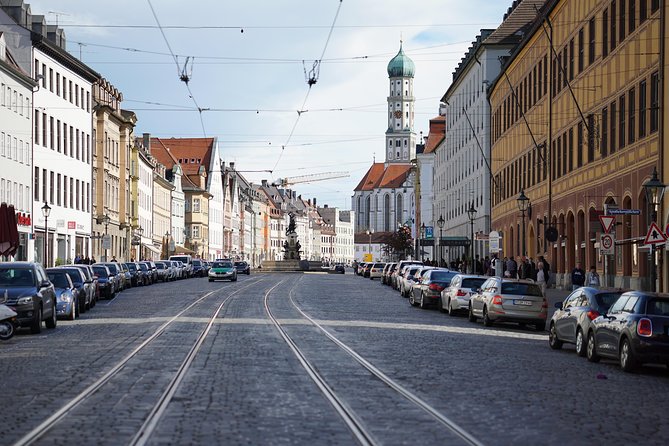
Augsburg’s story comes together quickly on this private three-hour walk, which links Roman-era religious roots, Renaissance wealth, baroque elegance, and one of the world’s oldest social housing projects. You move from the red Rotes Tor to the Fuggerei, with the city’s fountains, churches, palace, and town hall filling in the gaps along the way.
I like the one-group format, especially if you want to stop and ask why the Fugger family mattered or how Augsburg rebuilt its town hall after wartime destruction. I also like the flexible approach: guides Kristen and Stephanie have met people at a hotel or train station and shaped the walk around their interests.
The main drawback is the price. At $417.72 per group of up to 15, it can be good value for a full group, but expensive for one or two people. You also pay separately for the Schaezlerpalais and Goldener Saal, and the non-refundable booking requires firm plans.
In This Review
- Key points at a glance
- Why Augsburg works well with a private guide
- Starting at the Rotes Tor
- Gothic stonework at St. Ulrich and Afra
- The baroque rooms of Schaezlerpalais
- Hercules and Augsburg’s fountain story
- Goldener Saal and the rebuilt town hall
- Perlach Tower and Augustusbrunnen
- St. Anne’s Church and the Reformation connection
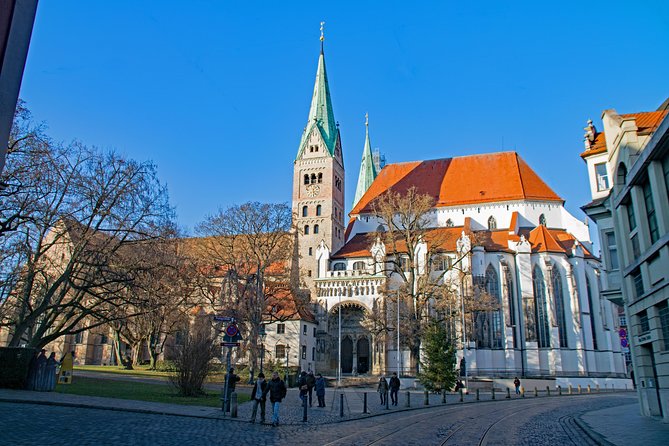
- Augsburg Cathedral’s long timeline
- Fuggerei, the tour’s most distinctive stop
- How the flexible format affects your day
- Who gets the best value
- Should you book the Augsburg private historic tour?
- FAQ
- How long does the Augsburg private historic tour last?
- How many people can join the private tour?
- Where does the tour start and finish?
- Are entrance fees included?
- Is the tour private?
- Can the tour meet me at a hotel or train station?
Key points at a glance
- A private route through ten major sights: You see the Rotes Tor, Basilica of St. Ulrich and Afra, Schaezlerpalais, three famous fountains, the Perlach Tower, St. Anne’s Church, Augsburg Cathedral, and Fuggerei.
- Fuggerei gives the walk a human side: Founded in 1516, this working social housing complex was created to house people in need.
- The guide can adjust the pace: A private booking lets you ask questions and request more attention for art, religion, architecture, or local history.
- Two paid interiors add to the cost: Schaezlerpalais costs €7 per person and Goldener Saal costs €2.50 per person.
- The route is a point-to-point walk: You start at Augsburg Town Hall and finish at Fuggerei, which is useful if you want to continue sightseeing there.
- Personal assistance may be possible: Kristen has met a participant at the train station and accompanied her back, while Stephanie met a group at its hotel and adapted the tour to its needs.
Why Augsburg works well with a private guide
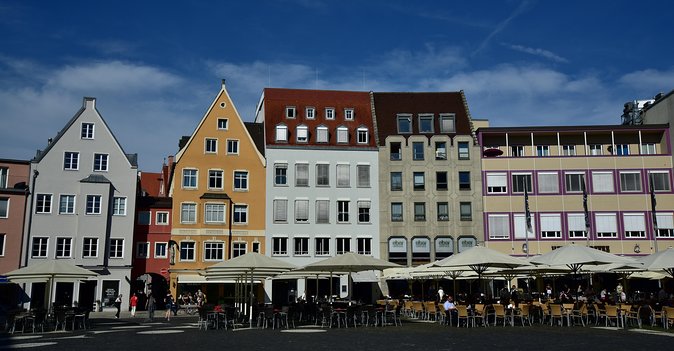
Augsburg is old enough to make a self-guided walk feel like homework. The city brings together Roman Catholic saints, medieval trade, Renaissance civic pride, baroque art, and the enormous influence of the Fugger banking family.
I like this tour because it gives you a clear sequence instead of a pile of disconnected monuments. The guide can explain why a fountain matters, point out the practical purpose of a gate, and connect the Fugger family’s wealth with the Fuggerei that still carries its name.
The private format matters most when you have specific interests. You can ask for more time at the churches, focus on architecture at the palace, or move briskly through sights that matter less to you. The listed route includes several short stops, so your guide’s explanations help turn a three-hour walk into a coherent picture of Augsburg.
The tour is priced by group, not by individual. That makes the $417.72 cost easier to justify for a family or party of several people, particularly a group close to the 15-person limit. For a solo visitor or couple, the price is a serious consideration, even before the €7 palace entry and €2.50 Goldener Saal fee.
A few more Germany trips to weigh up
- Leipzig: City History Canal Sightseeing Tour on a Motorboat
★ 4.7 · 6,232 reviews - Berlin: Natural History Museum Entrance Ticket
★ 4.6 · 3,382 reviews - Leipzig: 1.5-Hour Historical Walking Tour in German
★ 4.7 · 2,217 reviews
Starting at the Rotes Tor
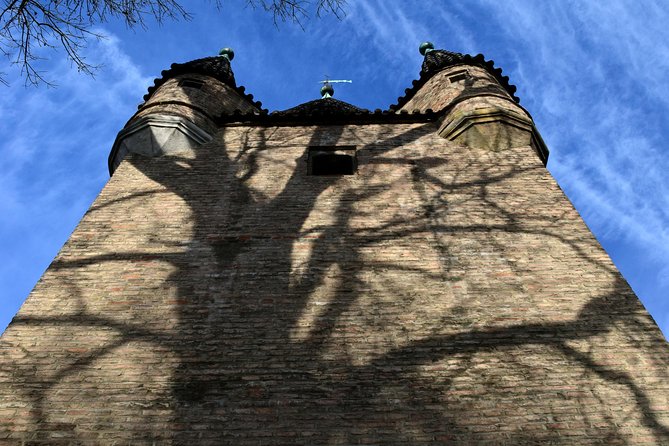
The walk begins at Augsburg Town Hall, but the first listed sight is the Rotes Tor, or Red Gate. This famous tower formed part of the city’s historic defenses and was renovated in the 20th century.
You spend about 15 minutes here, with no admission charge. I see this as a useful opening stop because a gate gives you a simple way to think about old Augsburg: this was not just a collection of churches and grand buildings, but a city organized around movement, protection, and controlled entrances.
The Rotes Tor is a brief stop, so do not expect an extended interior visit. Its value comes from the guide’s explanation and from seeing a recognizable piece of the city’s older structure before moving to the religious monuments.
Gothic stonework at St. Ulrich and Afra
The Basilica of St. Ulrich and Afra follows, with another 15-minute stop and no separate admission fee listed. The Catholic parish church has Gothic architecture and roots connected with the Roman tomb of St. Afra, who was martyred in 304.
That detail gives the church more weight than its short scheduled visit suggests. You are not simply looking at pointed arches. You are hearing about an early Christian connection that reaches back to the Roman period and about a saint tied closely to Augsburg’s religious identity.
I would pay attention to the contrast between the age of the story and the later Gothic form of the building. A private guide can help you separate the church’s early origins from the architectural features you see today.
The baroque rooms of Schaezlerpalais
The Schaezlerpalais is scheduled for about 30 minutes, making it one of the longer stops. Built in 1765, the palace is an important historical monument and a strong example of baroque design.
This is the first stop where the extra admission fee matters. Entry costs €7 per person, and that charge is not part of the tour price. If you care about decorative interiors and aristocratic architecture, I think the fee is reasonable. If you prefer a street-level history walk, you may want to confirm how much time you will spend inside before booking.
The palace adds a useful counterpoint to the churches and defensive gate. Its grand style reflects the money and status available to Augsburg’s elite, while the later Fuggerei shows a very different use of wealth. That contrast is one of the tour’s strongest themes.
Same city, a completely different kind of day:
- Berlin: Reichstag, Dome and Government District Guided Tour
★ 4.7 · 18,288 reviews - Berlin: 1-Hour City Tour by Boat with Guaranteed Seating
★ 4.3 · 16,993 reviews - Hamburg: Sex and Crime in St. Pauli Tour for Ages 18+
★ 4.7 · 15,447 reviews - Hamburg: 1.5-Hour Harbor and Speicherstadt Day Cruise
★ 4.6 · 14,200 reviews
Hercules and Augsburg’s fountain story
At Hercules’ Fountain, you pause for about 15 minutes. There is no admission charge, and the centerpiece is a bronze Hercules fighting the seven-headed Hydra, a monster from Greek mythology.
The fountain dates to 1597 and is described as the third famous fountain in Augsburg. That small point is worth asking about during the walk, since the tour also includes Augustusbrunnen and gives you a chance to compare the city’s public fountains rather than treating each one as an isolated photo stop.
I enjoy fountains on city walks because they show how public space once carried political and artistic messages. Hercules is not a quiet decorative figure. The sculpture presents strength and victory in a prominent civic setting.
Goldener Saal and the rebuilt town hall
The Goldener Saal is inside Augsburg’s town hall and receives about 30 minutes, another major stop. The ceremonial room is known for ceiling paintings and gold wall decoration, and it was completed in 1643.
The room also carries the marks of modern war. Augsburg’s town hall and Goldener Saal were destroyed by an air raid in 1944 and reconstructed after the war. That makes the visit about more than ornament. You are seeing a restored civic interior and hearing how the city brought a major symbol back into use.
Admission is €2.50 per person, separate from the tour price. This is a modest extra cost, and I would be inclined to include it if the room is open during your visit. The 30-minute slot gives the guide enough time to explain the decoration and the rebuilding rather than sending you through in a quick glance.
Perlach Tower and Augustusbrunnen
The Perlach Tower is a short 10-minute stop. The tower rises about 70 meters in Augsburg’s central district and began as a watchtower in the 10th century.
That original function helps you read the city vertically. The tower was not built simply to look impressive. It gave Augsburg a way to watch over the city, while its height remains a useful marker as you move through the center.
Next comes Augustusbrunnen in the town hall square, with another 10-minute visit. The fountain was cast between 1588 and 1594, placing it in the same broad period as Hercules’ Fountain.
These two short stops work well together. One represents watchfulness and defense, while the other shows the city using public art to express civic identity. You will want comfortable shoes, since the tour keeps you moving between several central sights.
St. Anne’s Church and the Reformation connection
St. Anne’s Church receives about 15 minutes. It was built in 1321, originally formed part of a monastery, and is noted for its elaborate interior decoration.
The church adds a medieval layer to the route, after the baroque palace and Renaissance fountains. I would ask the guide to point out what belongs to the original medieval foundation and what reflects later decoration, since a short visit can otherwise blur those periods together.
The free entry listed here makes it an easy stop to include. It also helps vary the day. You move from open squares and civic monuments into a church interior, then continue to the cathedral.
Augsburg Cathedral’s long timeline
Augsburg Cathedral is a Roman Catholic church founded in the 11th century, with Gothic additions from the 14th century. Its tower measures about 62 meters, and the scheduled stop lasts around 15 minutes.
The cathedral is a good place to see how a major church changes over time. Its foundation belongs to one period, while the Gothic additions came centuries later. That layered construction is often more useful than a single build date because it shows how religious buildings continued to change with the city.
No admission charge is listed for this stop. The time is short, so you may not see every part of the building. Still, the cathedral gives the tour a fitting religious finish before the route turns toward the practical story of housing at Fuggerei.
Fuggerei, the tour’s most distinctive stop
The final stop is Fuggerei, founded in 1516 by the Fugger family. It remains in use as the world’s oldest social housing complex, and it was created to provide homes for people in need in Augsburg.
This is the point that gives the tour its strongest human scale. Grand town halls and decorated palaces can tell you about power, but Fuggerei asks what wealth was used for. The complex is not only a historic site. It is a social project that continues to function.
You spend about 15 minutes walking through it. That is enough for an introduction, but you should not expect a long, unhurried examination of every corner. Since the tour ends here, you can also use the location as a natural stopping point for the day.
The ending works well. You begin with walls and towers, pass through churches and civic spaces, and finish with a neighborhood built around daily life. The Fugger name links several parts of Augsburg’s story, and the guide can help you understand that connection.
How the flexible format affects your day
The stated start is Augsburg Town Hall, Rathausplatz 2, and the end is at Fuggerei by St. Jakobskirche. The route is therefore useful if you plan to visit the town hall area first and continue exploring near Fuggerei afterward.
The timing is described as flexible, and the private setup means only your group participates. That does not guarantee every request, but it gives you a better chance to ask for a different pace or focus than you would have on a fixed group walk.
The personal service described for Kristen and Stephanie is worth noting. Kristen offered to meet a participant at the train station and later accompanied her back there. Stephanie met a group at its hotel and adjusted the visit to its needs. If you arrive by train or are staying at a hotel, ask about this before the day of the tour rather than assuming the meeting point will change.
The tour is near public transportation, and most people can participate. The information provided does not promise wheelchair access or describe the exact walking distance, so you should ask before booking if mobility is a concern.
Who gets the best value
I would consider this tour for a family, group of friends, or private party that wants a single guide to organize Augsburg’s main historic sights. The group price becomes more attractive as more people share it, and the ability to ask questions is useful when ages and interests differ.
It also suits a first visit when you want the broad outline of the city in three hours. You see major religious buildings, civic monuments, fountains, a palace, and Fuggerei without spending time researching each stop in advance.
I would hesitate if you are traveling alone or as a couple on a tight budget. The price is high for a short walking tour, and the two interior admissions increase the total. You may also prefer a slower visit if you want extended time inside the Schaezlerpalais or Goldener Saal, since the route covers ten stops in roughly three hours.
The tour is confirmed at booking, but the cancellation terms are strict. It is non-refundable and cannot be changed for any reason, so book only when your Augsburg plans are settled.
Should you book the Augsburg private historic tour?
Book it if you want personal attention and a clear historical route, especially with a group large enough to share the cost. The strongest parts are the private questions, the flexible pacing, and the final visit to Fuggerei, which gives the tour more purpose than a simple monument checklist.
Skip it if you want the cheapest way to see Augsburg or prefer to spend a long time inside one or two buildings. For a group, the price can make sense. For one or two people, compare the cost with your interest in a private guide before committing.
FAQ
How long does the Augsburg private historic tour last?
The tour lasts approximately three hours.
How many people can join the private tour?
The price covers one private group of up to 15 people.
Where does the tour start and finish?
It starts at Augsburg Town Hall, Rathausplatz 2, 86150 Augsburg, Germany, and ends at Augsburg, Fuggerei by St. Jakobskirche, 86152 Augsburg, Germany.
Are entrance fees included?
No. Admission to Schaezlerpalais costs €7 per person, and admission to Goldener Saal costs €2.50 per person. The listed tour price includes the official guide but not these entrance fees.
Is the tour private?
Yes. Only your group participates in the activity.
Can the tour meet me at a hotel or train station?
The tour information gives Augsburg Town Hall as the start point, but the guides have met participants at a hotel or train station and provided personal assistance. Ask about your preferred meeting point before booking.
Just added around Germany
- Aachen old town tour – GERMAN (public)★ 5.0 · 24 reviews
- Aachen Private Walking Tour With A Professional Guide★ 5.0 · 11 reviews
- Cologne Highlights: Exclusive Private Tour★ 5.0 · 5 reviews
- Bremen Private Walking Tour With A Professional Guide★ 5.0 · 7 reviews
- Private Walking Tour through the Fascinating Bremen’s City Center★ 5.0 · 5 reviews
- Explore Cologne’s best Street Art Quarter★ 4.5 · 4 reviews
- Bremen Exploration Private Game and City Tour on your Phone★ 4.5 · 7 reviews
- e-Scavenger hunt Bremen: Explore the city at your own pace★ 4.0 · 24 reviews
Historical Tours, compared.

City History Canal Sightseeing Tour on a Motorboat
Read our review →






Browse the lists this tour appears in