
Reviewed · CITY TOURS
Public tour With Bertha Benz through the city of inventors Costume tour
The most unusual thing about this Mannheim tour is its guide: Maria appears in character as Bertha Benz, the woman who took Carl Benz’s untested motor car on the world’s first long-distance drive. Her story gives the city walk a clear thread, from ridicule of the automobile to the bold trip that helped prove it had a future. I like the way the tour joins automotive history with Mannheim’s wider age of invention. You hear about the wheel, the tractor, music, theater, and everyday problems such as driving licenses, milk carts, and chickens. I also like its lively tone. Maria uses wordplay and draws people into the action, making the two hours more than a list of buildings.
The main thing to consider is language. This is a German-language tour, and the walking route covers about 4 kilometers. That is a fair amount of ground for two hours, and the costume and humor will have their full effect only if you understand German. Booking information also gives slightly different end-point wording, so check the current details when you reserve.
In This Review
- Key points at a glance
- Why Bertha Benz is the right guide for Mannheim
- Starting beside the Carl Benz memorial
- The Water Tower and Friedrichsplatz: invention meets city design
- Planken: Mannheim’s central urban stage
- Marktplatz and the everyday problems of new machines
- Schillerplatz and the cultural side of Mannheim
- The Jesuit Church: a change of pace
- Lanz Stadthaus and the industrial thread
- Ending at Mannheim Baroque Palace
- What makes the costume format work
- The walking effort and timing
- Is $17 a fair price?
- Who should book this Mannheim walk?
- Should you book the Bertha Benz costume tour?
- FAQ
- Where does the tour start?
- Where does the tour finish?
- How long is the tour?
- How far does the walking route cover?
- What language is the tour conducted in?
- Is the tour private?
- What sights are included on the route?
- Can I cancel the booking?
Key points at a glance
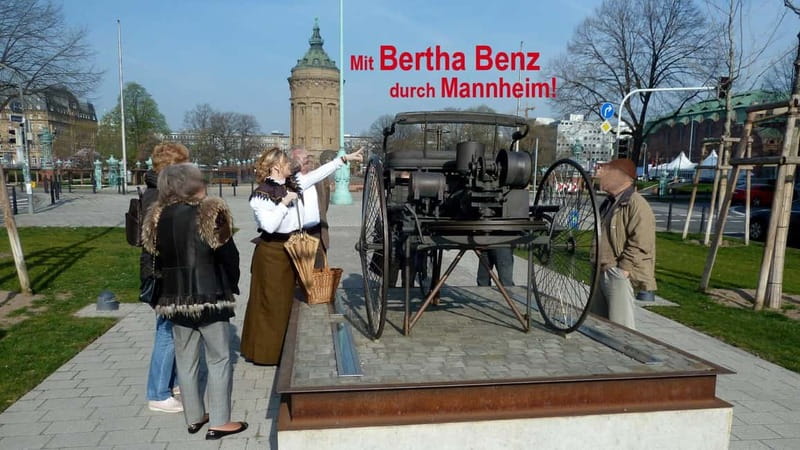
- Bertha Benz leads the story: Maria presents the tour in costume as the pioneering driver who supported Carl Benz and took his motor car on its first long journey.
- A 4-kilometer city walk: The route links Mannheim’s Water Tower, Friedrichsplatz, Planken, Marktplatz, Schillerplatz, Jesuit Church, and Baroque Palace.
- More than car history: You also hear about the wheel, tractor, music, theater, industrial progress, and the odd practical troubles of early motoring.
- A strongly interactive style: Wordplay, funny stories, and audience involvement keep the walk from feeling like a formal lecture.
- Useful for families: The mix of chickens, milk carts, inventions, and mechanical history gives children several easy ways into the story.
- Good value at $17: For two hours with a live guide and a long central-Mannheim route, the price is modest, especially if you want both sightseeing and local history.
Why Bertha Benz is the right guide for Mannheim
Carl Benz usually gets the headline in automobile history. Bertha Benz makes the story human.
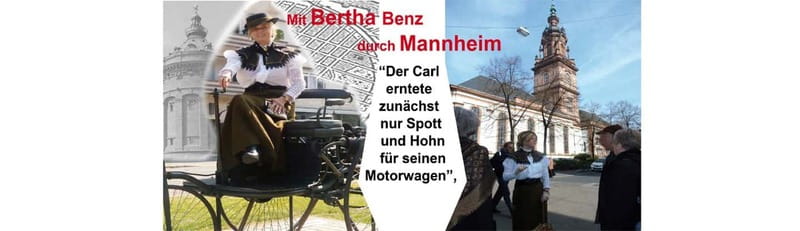
The tour begins with the early response to Carl’s motor car. It was not greeted as an obvious improvement. People mocked the machine, treated it as foolish, and even linked it with the devil’s work. That detail matters because it shifts the story away from a neat invention myth. New technology did not win simply because it was clever. Someone had to use it, defend it, and show that it could work outside a workshop.
Bertha took on that job with considerable nerve. Her long-distance drive is the central adventure of the walk, but the tour also covers the smaller successes and comic problems around the car’s beginnings. You hear about the driver’s license, the milk cart, chickens, and other practical details. Those subjects help you picture the confusion caused by a new machine on ordinary roads.
Maria’s Bertha is not simply a figure who recites dates. She brings the character into the streets and uses humor to keep the story moving. That approach suits Mannheim, a city where invention is presented as part of local identity rather than as a single isolated achievement by one famous man.
A few more Germany trips to weigh up
- Berlin: 1-Hour City Tour by Boat with Guaranteed Seating
★ 4.3 · 16,993 reviews - Leipzig: City History Canal Sightseeing Tour on a Motorboat
★ 4.7 · 6,232 reviews - Cologne: Panoramic City Cruise
★ 4.3 · 5,698 reviews
Starting beside the Carl Benz memorial
The meeting point is the Carl Benz memorial near the Water Tower and Augustaanlage. This is a sensible place to begin. You meet the person at the center of the automobile story before moving into the larger city.
The memorial gives the opening a clear focus, but the tour does not stay locked on Carl Benz. Bertha’s role quickly broadens the subject. You learn about the partnership between Carl and Bertha, the resistance to the motor car, and the daring decision to take the invention on the road.
I would arrive with comfortable shoes and enough time to locate the memorial. The full walk lasts two hours, and the route later crosses several central streets and squares. Since the tour is conducted in German, you may also want to decide in advance how much detail you need from the guide. The presentation relies on spoken stories, humor, and interaction.
The Water Tower and Friedrichsplatz: invention meets city design
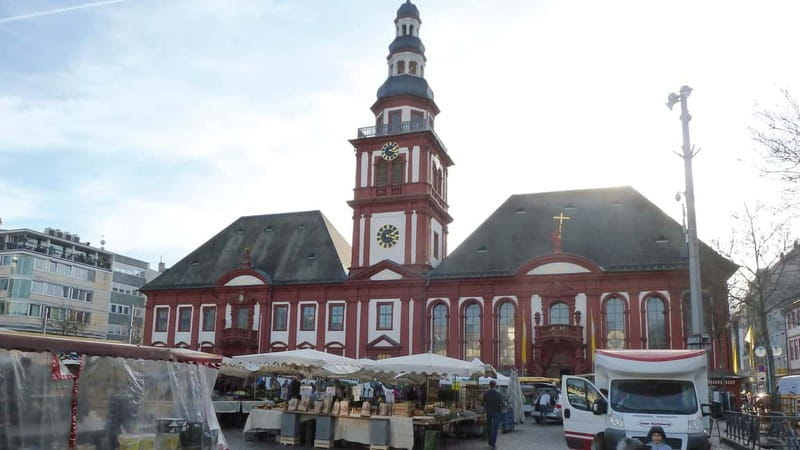
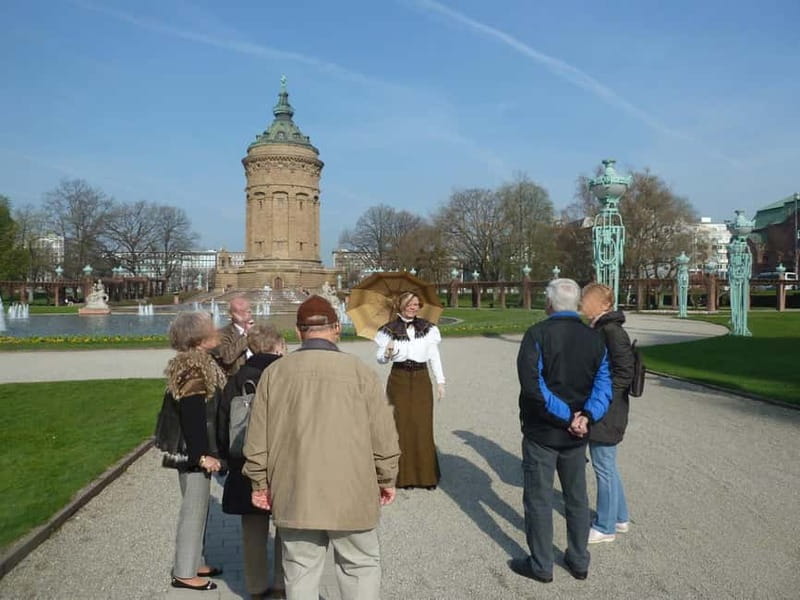
The Mannheim Water Tower is the next listed stop and one of the city’s most recognizable points. Here, the tour can place industrial progress against the grand civic setting around Friedrichsplatz.
The 19th century is presented as an age of inventions and industrial growth. The Water Tower and its surrounding urban spaces help you think about that period beyond the automobile alone. The subject becomes the changing city: new machines, new systems, and new expectations about how people and goods should move.
This is also where the city-tour side of the experience becomes important. You are not being taken from one automobile plaque to another. The route uses Mannheim’s central landmarks to show how the city itself forms part of the invention story.
The information provided does not promise a visit inside the Water Tower or any other building. Expect guided commentary from the street rather than an indoor museum visit.
Planken: Mannheim’s central urban stage
From the Water Tower, the walk continues through Planken. This gives you a sense of Mannheim’s modern central street life while Bertha’s story keeps pointing back to the era when the automobile was still strange and unproven.
Planken is useful in the route because it breaks up the historical subjects with a major city street. You get a change of setting while continuing to hear about wheels, transport, and the practical effects of invention.
The route is made for seeing Mannheim on foot rather than rushing between distant sights. Still, keep the 4-kilometer total in mind. The walk is not a short character appearance followed by a seated talk. You will spend the full session moving through the city, with stops for explanation.
Same city, a completely different kind of day:
- Berlin: Reichstag, Dome and Government District Guided Tour
★ 4.7 · 18,288 reviews - Hamburg: Sex and Crime in St. Pauli Tour for Ages 18+
★ 4.7 · 15,447 reviews - Hamburg: 1.5-Hour Harbor and Speicherstadt Day Cruise
★ 4.6 · 14,200 reviews - From Munich: Neuschwanstein & Linderhof Castle Full-Day Trip
★ 4.5 · 12,494 reviews
Marktplatz and the everyday problems of new machines
At Marktplatz, the tour returns to the human scale of technological change. Early automobiles did not enter an empty world. They shared streets and roads with carts, pedestrians, animals, and established habits.
That is why the stories about milk carts and chickens are so useful. They make the arrival of the motor car easier to understand. A new vehicle had to fit into daily life before people could accept it as progress. The funny details are not side decoration. They explain why the machine caused concern and why its first users needed both patience and courage.
The Marktplatz stop also supports the broader Mannheim story. The city’s inventions are treated as part of a working industrial culture, not just as names in a textbook. The wheel and tractor appear alongside the automobile, giving you a wider view of how transport and mechanical ideas developed.
Schillerplatz and the cultural side of Mannheim
Schillerplatz brings another layer to the walk. The tour covers Mannheim’s city history and connects it with figures and subjects including Schiller, Mozart, and the Elector.
This stop helps prevent the tour from becoming only a car biography. Mannheim is presented as a place of civic, cultural, and technical activity. The same city associated with machines also has stories tied to music, theater, and major historical personalities.
You should not expect a separate long lecture on each figure. The experience lasts two hours and covers a sizeable route, so these subjects are woven into the walk. That is a strength if you prefer a broad introduction to Mannheim. If you want a specialist tour devoted only to Schiller, Mozart, or the palace, this is not that.
The Jesuit Church: a change of pace
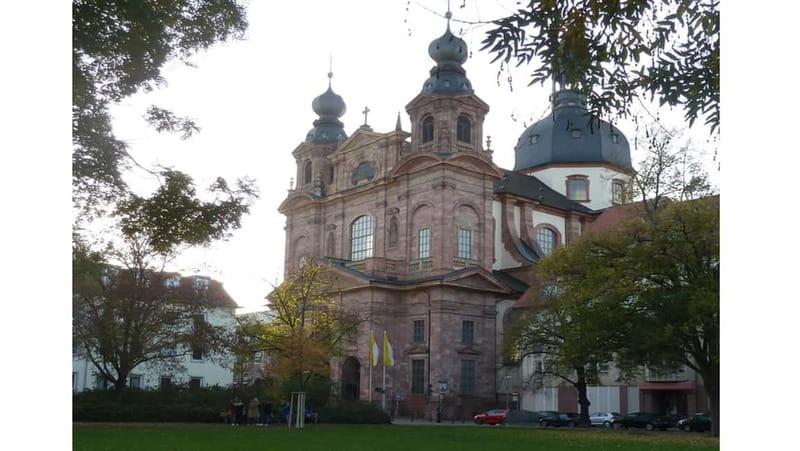
The Jesuit Church is another guided stop. Its presence adds an architectural and religious landmark to a route otherwise shaped by streets, squares, industry, and invention.
A stop here gives the walk a useful change of pace. You move from the practical world of engines and transport to one of Mannheim’s major historic buildings, while the guide continues explaining the city around you.
The tour information does not specify an interior visit, so plan on hearing the commentary as part of the walking route. The church works best here as part of the larger city picture. It shows that Mannheim’s story cannot be reduced to the motor car, even when Bertha is leading the group.
Lanz Stadthaus and the industrial thread
Lanz Stadthaus appears in the stated route between the Jesuit Church and the Baroque Palace. Although it is not listed as a separate numbered stop, it fits the tour’s focus on Mannheim’s industrial and inventive past.
The route mentions the tractor among Mannheim inventions, and Lanz helps reinforce that mechanical tradition. This is one of the tour’s most interesting ideas: Carl Benz is not treated as a lone miracle worker. The automobile belongs to a city with a wider record of making, testing, and using machines.
You may find this section especially useful if you enjoy technology but do not want a narrow museum lecture. The stories connect inventions with the streets and institutions around you, so the city becomes part of the explanation.
Ending at Mannheim Baroque Palace
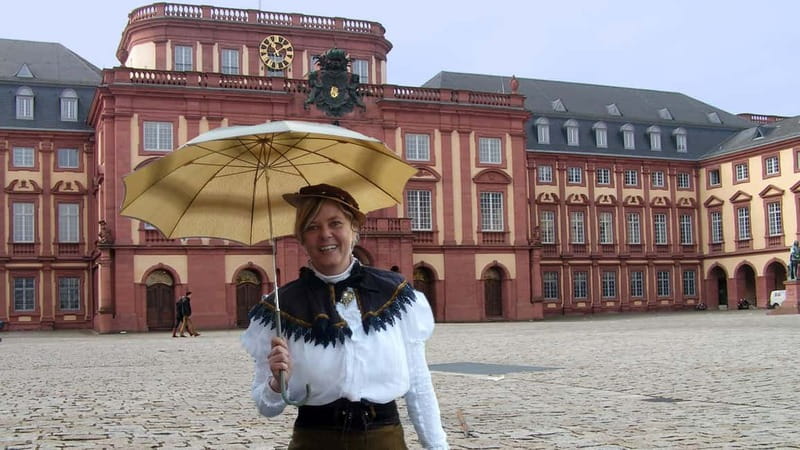
The walk is scheduled to finish at Mannheim Baroque Palace. That gives the route a strong final landmark and ties the industrial city to its older political and architectural setting.
The palace also returns the tour to the Elector and Mannheim’s earlier city story. After hearing about factories, vehicles, and industrial progress, you end with a building associated with the city’s ruling past.
There is a small practical point here. The route description names Baroque Palace as the end point, while the meeting-point information says the activity ends back at the meeting point. Because those details do not match exactly, check the current confirmation before planning your next appointment or transport connection.
What makes the costume format work
Costume tours can feel forced when the character is only a prop. Here, Bertha’s identity has a real purpose. She is not an invented narrator attached to a random subject. She was directly involved in proving the motor car could make a meaningful journey.
That gives the guide a natural voice. Bertha can talk about Carl’s early setbacks, defend the machine, and explain why someone had to take practical action. The format also makes room for jokes and audience participation.
The strongest praise for this experience focuses on three things: it is interesting, entertaining, and funny. The guide Maria is described as involving the audience and using plenty of wordplay. That matters because a two-hour city walk can become tiring if every stop follows the same lecture pattern.
Families may find the character approach helpful. The references to chickens, milk carts, and unusual early driving problems offer simple, memorable images. The tour has also been specifically recommended as suitable for children, although the German language remains an important condition.
The walking effort and timing
Two hours is enough time for a substantial introduction to central Mannheim, but not enough for long indoor visits at every landmark. Think of this as a moving city performance with stops, not as a sequence of museum entries.
The route covers about 4 kilometers. That is manageable for most people who are comfortable walking, but it is worth planning for steady movement. You will get more from the experience if you wear practical shoes and avoid scheduling a tight appointment immediately afterward.
Starting times vary, so you need to check availability for the date you want. The live guide speaks German. No other language is listed, and no translation service is specified.
Group size is not provided. That means you should not assume a private or small-group format. This is a public tour, so the atmosphere may depend on the size and mix of the group on your chosen date.
Is $17 a fair price?
At $17 per person, I see this as good value if you want a guided introduction to Mannheim rather than a quick photo walk.
You receive two hours with a live costumed guide, a route through several central landmarks, and a subject that links local city history to an invention with worldwide importance. The automobile story alone gives the tour a clear hook, while the material about the wheel, tractor, music, theater, and industrial progress adds breadth.
The value is strongest for first-time visitors who want orientation and storytelling at the same time. You are not paying only to look at the Water Tower or palace from outside. You are paying for the connections between places, people, and inventions.
The value is weaker if you need an English tour, dislike theatrical guiding, or want extensive access inside buildings. In those cases, the format may not fit your needs even at a modest price.
The booking terms also make planning easier. You can reserve and pay later, and cancellation is free up to 24 hours before the tour for a full refund. Check the current booking page for the exact meeting and finishing instructions.
Who should book this Mannheim walk?
I would choose this tour for:
- Visitors interested in Carl and Bertha Benz
- Families looking for a city walk with humor and a clear story
- People who enjoy costume interpretation and audience participation
- Anyone wanting a broad introduction to Mannheim’s central sights
- German speakers who like local history presented in an informal way
- Visitors interested in the link between transport, industry, culture, and city growth
I would think twice if you want a quiet, highly academic lecture. The tone is lively and interactive, with funny stories and wordplay. That is a benefit for many people, but not everyone wants a performance during sightseeing.
I would also avoid it if you cannot follow German. The experience depends heavily on spoken explanation. Landmark views alone will not provide the full value.
Should you book the Bertha Benz costume tour?
Book it if you want Mannheim explained through a memorable local character rather than a standard list of dates. The combination of Maria’s Bertha Benz, the 4-kilometer central route, and the mix of automobile, city, cultural, and industrial history gives you a useful first look at the city.
The best reason to go is the way the tour makes invention feel practical. You hear about ridicule, road problems, carts, chickens, and the brave decision to test a new machine in real life. That is more revealing than simply being told who invented the automobile.
Just confirm the language and end point before booking. If German works for you and you are happy to walk for two hours, $17 is a sensible price for an engaging, family-friendly introduction to Mannheim.
FAQ
Where does the tour start?
The tour starts at the Carl Benz memorial near the Mannheim Water Tower and Augustaanlage.
Where does the tour finish?
The route information gives Mannheim Baroque Palace as the end point. The meeting-point information also says the activity ends back at the meeting point, so check the current confirmation for the exact finish.
How long is the tour?
The tour lasts two hours.
How far does the walking route cover?
The route covers about 4 kilometers through Mannheim.
What language is the tour conducted in?
The live tour guide speaks German. German is the only language specified.
Is the tour private?
No. It is described as a public city tour.
What sights are included on the route?
The route includes the Carl Benz memorial, Mannheim Water Tower, Friedrichsplatz, Planken, Marktplatz, Schillerplatz, Jesuit Church, Lanz Stadthaus, and Mannheim Baroque Palace.
Can I cancel the booking?
You can cancel up to 24 hours in advance for a full refund. You can also reserve now and pay later, subject to the booking terms.
Just added around Germany
- Aachen old town tour – GERMAN (public)★ 5.0 · 24 reviews
- Aachen Private Walking Tour With A Professional Guide★ 5.0 · 11 reviews
- Cologne Highlights: Exclusive Private Tour★ 5.0 · 5 reviews
- Bremen Private Walking Tour With A Professional Guide★ 5.0 · 7 reviews
- Private Walking Tour through the Fascinating Bremen’s City Center★ 5.0 · 5 reviews
- Explore Cologne’s best Street Art Quarter★ 4.5 · 4 reviews
- Bremen Exploration Private Game and City Tour on your Phone★ 4.5 · 7 reviews
- e-Scavenger hunt Bremen: Explore the city at your own pace★ 4.0 · 24 reviews
City Tours, compared.

1-Hour City Tour by Boat with Guaranteed Seating
Read our review →
City History Canal Sightseeing Tour on a Motorboat
Read our review →

Browse the lists this tour appears in