
Reviewed · CITY TOURS
Düsseldorf: E-Scooter City Tour
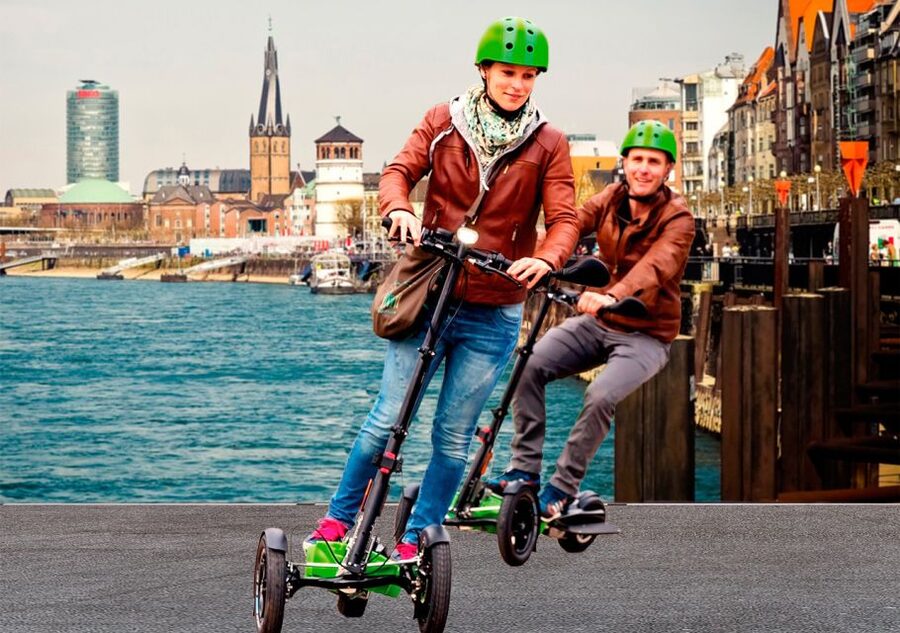
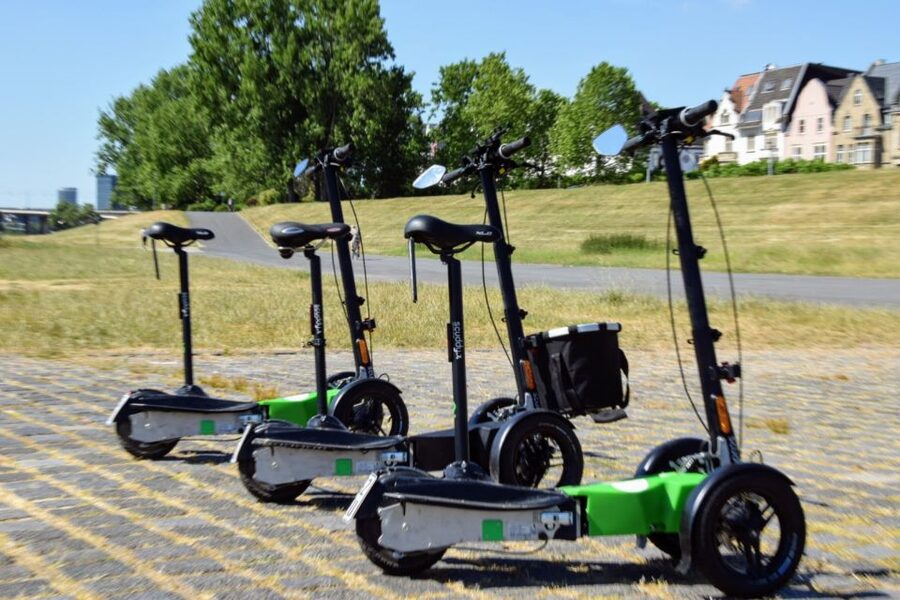
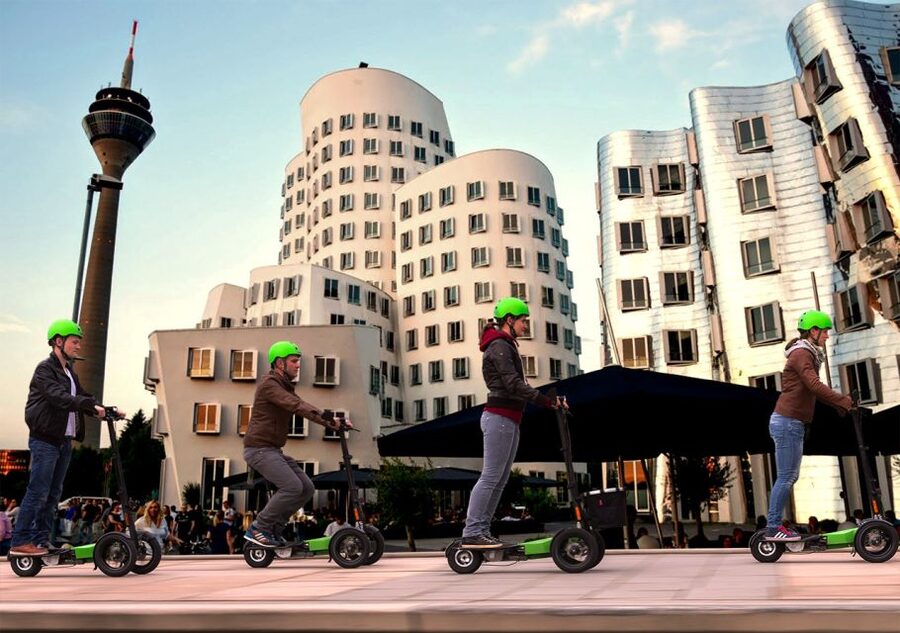
Düsseldorf is made for a tour that keeps moving. On this two-hour ride, you use a Scuddy e-scooter that can be ridden sitting or standing, starting at the Rhine Tower and gliding along the Rhine, through the old town, and past some of the city’s boldest modern buildings. I like the small group of no more than seven people, and I like the relaxed route, which mixes river views, old churches, art, shopping streets, and contemporary architecture.
I also like that the guide stops regularly instead of talking nonstop while you roll. Guide Dieter is praised for being funny, warm, and easygoing, with jokes mixed into explanations about buildings and Düsseldorf’s past. The main drawback is clear: the tour is only in German, and it is not meant to be a formal art-history or architectural lecture.
In This Review
- Key points at a glance
- Starting beneath the Rhine Tower
- Along the Rhine to Burgplatz
- Old Düsseldorf and the leaning tower of St. Lambertus
- Andreas Quartier, Düsseldorf’s social heart
- K20, Hofgarten, and the green wall at Kö-Bogen II
- Schauspielhaus and the Drei-Scheiben-Haus
- Schadowstraße and the return to the Rhine
- What the small group adds
- German language and guide style
- Is $69 a fair price?
- Who should book this Scuddy ride?
- Should you book it?
- FAQ
- Where does the Düsseldorf E-Scooter City Tour start?
- How long does the tour last?
- How much does the tour cost?
- What language is the tour offered in?
- How many people are in each group?
- Do I need a driver’s license?
- Is a helmet included?
- Can I sit or stand while riding?
- What sights does the route include?
Key points at a glance
- Ride from the Rhine Tower: Begin beneath Düsseldorf’s tallest building, with the state parliament and Rheinknie Bridge nearby.
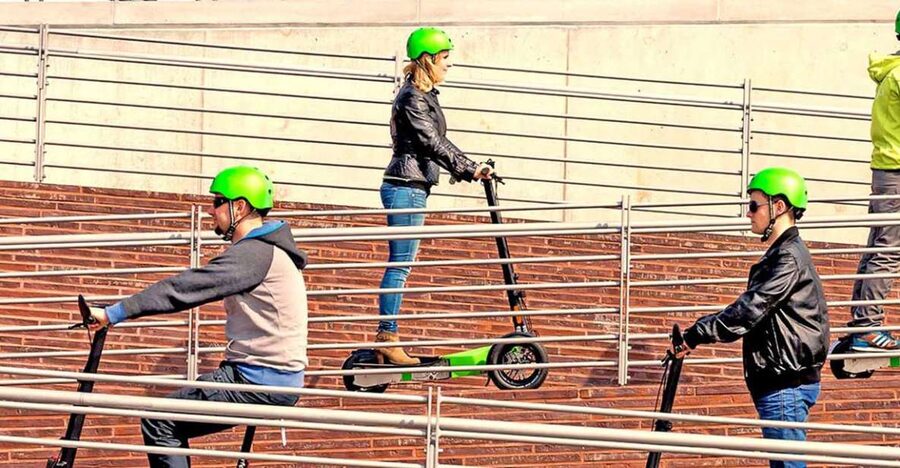
- Sit or stand on the Scuddy: The scooter offers a more comfortable position than a standard standing-only e-scooter.
- Small groups of two to seven: Expect a personal outing rather than a large procession.
- A varied central route: See Burgplatz, St. Lambertus, Andreas Quartier, K20, Hofgarten, Kö-Bogen II, and Schadowstraße.
- German-speaking local style: Dieter and other guides focus on humor, local color, and relaxed storytelling.
- Bring your driver’s license: It is required, and the tour is not suitable for people without one.
Starting beneath the Rhine Tower
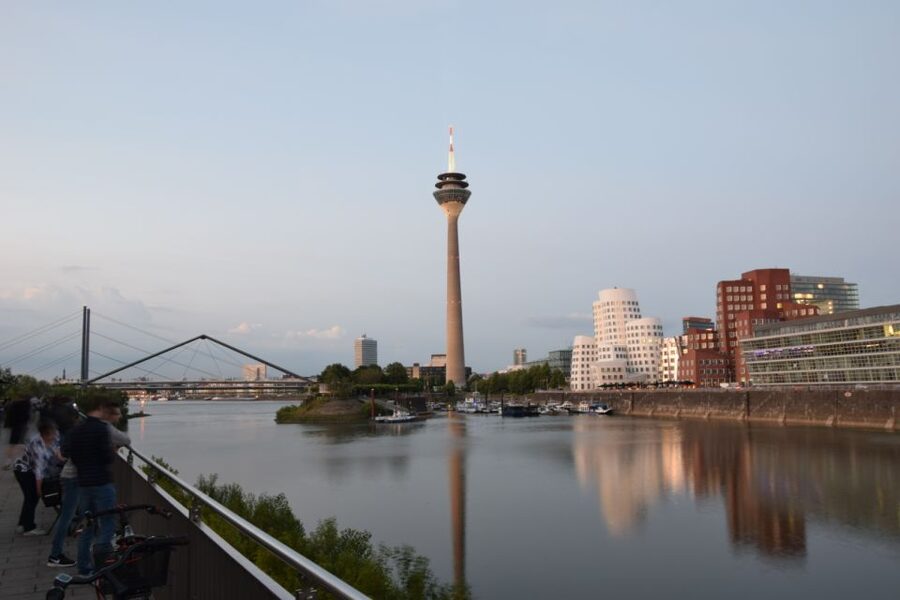
The meeting point is easy to identify: the guide waits in the parking lot near the entrance barrier, directly in front of the Rheinturm, or Rhine Tower. This landmark rises above the Düsseldorf riverfront and gives the tour a useful sense of place from the first minute.
The opening section sets up the city well. You ride near the state parliament building and the sweeping Rheinknie Bridge, where the Rhine bends through Düsseldorf. This is also the point where you get used to the Scuddy. The scooter is described as easy to handle, and the choice to ride sitting or standing makes it different from a regular rental e-scooter.
That choice matters. Standing gives you a better view and a more active feel, while sitting may suit you if you prefer a steadier, less tiring ride. You will receive a helmet and scooter, but you should bring your driver’s license. The license requirement is not a small footnote. Without one, you cannot take part.
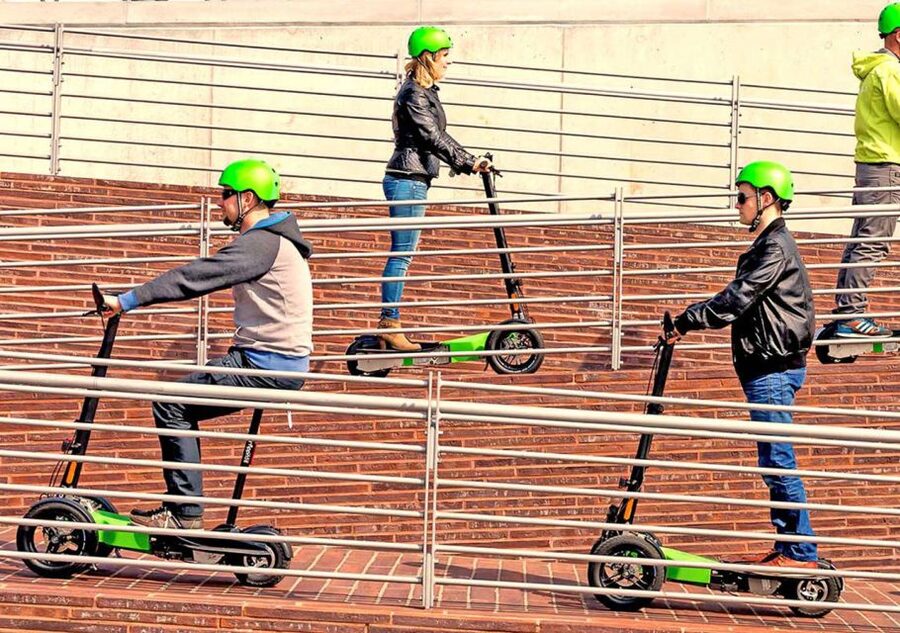
The first few minutes are also when the guide helps you feel comfortable with the controls. The group size ranges from two to seven people, so you should have room to learn without being lost in a crowd. A group of two can feel almost private, while seven is still small enough for regular stops and conversation.
A few more Dusseldorf trips to weigh up
- 2 Hours Hamburg E-scooter Tour
★ 4.2 · 103 reviews - Cologne: Guided E-Scooter Tour
★ 4.7 · 90 reviews - Berlin: Thrilling E-Scooter Adventure Tour
★ 4.4 · 66 reviews
Along the Rhine to Burgplatz
The route begins with a ride beside the Rhine. This is a strong choice for a city introduction because the riverfront gives you open views and a clear sense of Düsseldorf’s layout. Instead of starting in a tight shopping lane, you get room to move and time to settle into the scooter.
The ride continues to Burgplatz, one of the old town’s most recognizable squares. The castle tower remains here as a reminder of Düsseldorf’s earlier civic center. You stay close to the Rhine, which helps connect the old town to the river rather than treating them as separate sights.
I would not expect a long historical lecture at Burgplatz. This tour is built around seeing the city while moving through it. The guide may stop to explain a building, a local detail, or a piece of the city’s story, but the tone is informal. That works well if you want an overview before exploring on foot later.
It may be less satisfying if you are looking for dates, dynasties, and detailed architectural analysis. One review specifically found the city information limited and not always fully verified. That criticism is worth taking seriously. The value here comes from the route, the local personality, and the unusual transport, not from a specialist-level history course.
Old Düsseldorf and the leaning tower of St. Lambertus
From Burgplatz, the route takes you toward St. Lambertus Church in the old town. Its tower leans noticeably, giving you one of Düsseldorf’s most memorable visual details. The church helps anchor the older side of the city before the route turns toward newer districts and modern design.
Seeing St. Lambertus from a Scuddy has a practical advantage. You can approach the old town without spending the whole tour on foot, then pause for an explanation before continuing. The stop also breaks up the ride and gives you a chance to take in the surroundings without trying to steer and listen at the same time.
The route does not appear to include an extended interior visit. You should think of St. Lambertus as an outside stop and part of the moving city picture. That keeps the two-hour schedule realistic, but it also means you should not book this experience expecting a church tour.
The guide’s local manner is part of the appeal here. Dieter, named in several recent bookings, is described as funny and relaxed, with jokes between explanations. That style can make the ride feel more like an outing with a local than a formal lesson. It also means the quality of your experience may depend on how much you enjoy informal humor.
Andreas Quartier, Düsseldorf’s social heart
The next section brings you to Andreas Quartier, a former court and urban complex now associated with living, art, culture, and food. The route presents it as a part of Düsseldorf’s everyday city center rather than a single monument to check off.
This is one of the better reasons to choose the tour over a simple river ride. You get a glimpse of how the city uses old urban spaces in newer ways. The contrast between traditional streets, renovated quarters, galleries, and places to eat gives you a fuller idea of Düsseldorf than a list of famous buildings would.
The guide stops along the way to explain what you are seeing. A recent booking described regular pauses with information about buildings, Düsseldorf, and its past. That pattern is useful because you are not left trying to absorb every detail while moving.
Still, keep your expectations in line with the format. The experience is a relaxed city ride, not a carefully researched academic tour. If you want exact architectural dates or a full account of the quarter’s development, you will need another source or a more specialized tour.
Same city, a completely different kind of day:
- Düsseldorf: City Sightseeing Cruise on the Rhine
★ 4.1 · 2,954 reviews - Düsseldorf: 24-Hour Hop-On Hop-Off Ticket
★ 4.2 · 1,685 reviews - Düsseldorf: Brewery Tour with Alt Beer Tastings
★ 4.7 · 1,523 reviews - Düsseldorf: Altbier-Safari Beer Walking Tour
★ 4.4 · 1,150 reviews
K20, Hofgarten, and the green wall at Kö-Bogen II
After Andreas Quartier, the route passes the K20 art collection. K20 is one of the city’s key modern-art addresses, but the tour treats it as an exterior landmark on the route. You get the location and the wider setting, not a museum visit.
That distinction is important for planning. If you want to see the collection itself, set aside separate time. The Scuddy tour lets you connect the art district with the rest of central Düsseldorf without using up the two-hour outing indoors.
The route then enters Hofgarten, the city’s central park. A ride through the park changes the pace. After the old town and city streets, you get a greener, quieter section before returning to major architecture and shopping areas. Since the group moves at a relaxed pace, this part should feel like a transition rather than a race.
Next comes Kö-Bogen II, known for its huge planted façade. The building’s exterior is one of the most striking modern sights on the route. It shows Düsseldorf’s interest in pairing large-scale urban construction with greenery, and it gives you a strong photo stop without requiring a long detour.
The exact appeal will depend on your taste. If modern architecture interests you, this is one of the tour’s best sections. If you mainly want medieval streets and traditional buildings, the later route may feel less compelling, though the mix is what makes the outing more useful as a first look at the city.
Schauspielhaus and the Drei-Scheiben-Haus
The route makes a detour to the Schauspielhaus, Düsseldorf’s major theater building. This stop adds another layer to the city’s cultural identity. You are not only seeing shops and old town sights. You are also passing venues connected with theater, art, and public life.
From there, you see the Drei-Scheiben-Haus, a landmark office building from the 1960s. Its clean, bold form offers a sharp contrast to St. Lambertus and the castle tower. This change in style is one of the tour’s strongest features because Düsseldorf can shift from historic to modern within a short ride.
The guide’s role is especially useful in this section. Modern buildings can be easy to overlook when you explore alone, especially if you do not know which structures matter. A stop and a few local comments can turn an ordinary office block into part of the city’s story.
Again, this is not an architecture seminar. The experience gives you visual context and a local explanation, but the supplied information does not promise detailed design analysis. I would book it for the broad city view, not for technical discussion of postwar building design.
Schadowstraße and the return to the Rhine
The return route moves slowly through Schadowstraße, a major pedestrian shopping area. This gives you a look at Düsseldorf’s current commercial center after the historic and cultural stops earlier in the ride.
Schadowstraße is useful for orientation. If you plan to shop or simply want to understand where the central retail streets are, you can note the area for a later walk. The Scuddy lets you pass through without committing a large part of your day to browsing.
The final stretch returns toward the Rhine promenade and then back to the starting point. Ending by the river brings the route full circle. You begin with Düsseldorf’s waterway and finish there after seeing the old town, park, art district, theater area, modern offices, and shopping streets.
The pace is described as relaxed, especially on the return. That is good for taking in the city, but you should not expect to cover every neighborhood. The tour stays focused on the center and nearby riverfront, which is the right choice for a two-hour introduction.
What the small group adds
A maximum of seven people is a real advantage here. E-scooter groups can become awkward when too large, especially in central streets and around busy public spaces. A smaller group is easier to keep together and gives the guide a better chance to answer questions.
The group can also be as small as two people. That creates a more personal experience and may make it easier to ask about places you want to revisit later. The December 2024 booking described a private-feeling outing for two people with plenty of information and an enjoyable ride.
You should still remember that this is a shared tour unless your booking confirms otherwise. The group size is small, but the guide’s attention is shared. The pace may also reflect the needs of the least confident rider.
The overall rating is 4.5 from 70 ratings, and 86 percent of ratings give the transport a perfect score. Those figures point to a strong response to the unusual vehicle and the easygoing format. They do not mean every person will want the same balance of driving and commentary.
German language and guide style
The tour is offered only in German. This is the most important booking decision. If you do not understand German well enough to follow spoken explanations while riding, much of the guide’s contribution will be lost.
For German speakers, the format has real charm. The guide supplies local humor and Rhenish character, and Dieter is singled out for mixing jokes with explanations. The experience is intended to feel relaxed and personal rather than stiff or scripted.
I like that the tour does not pretend to be an art-historical city tour. That honest focus helps set the right expectations. You get a guide-led ride with local color, stops, and a route that connects many parts of central Düsseldorf.
The tradeoff is that the information may be uneven. One recent rating gave only three stars because the city details felt sparse and partly insufficiently checked. I would treat that as a reason to pair the tour with your own reading, a museum visit, or a more formal walking tour if history is your main goal.
Is $69 a fair price?
At $69 per person, this is not the cheapest way to see Düsseldorf. You are paying for the vehicle, helmet, guide, small-group format, and the novelty of riding a Scuddy rather than simply walking or taking public transport.
The price makes more sense if you value three things: a guided route, a small group, and an active way to cover several central areas in two hours. You see the Rhine, old town, park, art district, theater area, modern buildings, and shopping center without arranging the route yourself.
It is weaker value if you mainly want detailed history or a museum visit. The tour does not include admission to K20, and the commentary is intentionally informal. In that case, a walking tour or museum ticket may serve you better.
For a first afternoon in Düsseldorf, I can see the appeal. The route gives you a practical map of the center, and you can mark places to revisit on foot. The fun of the Scuddy is not just decoration. It is the reason the experience feels different from a standard sightseeing walk.
Free cancellation is available up to 24 hours before the start for a full refund, and you can reserve now while paying later. Availability and start times should be checked for your chosen date.
Who should book this Scuddy ride?
I would recommend it to German-speaking visitors who want a light, active introduction to Düsseldorf and enjoy unusual city transport. It suits couples, friends, and small groups who prefer a local guide with humor over a formal lecture.
It is also a good fit if you have limited time. In two hours, you reach several parts of the center that would take longer to connect on foot. The sit-or-stand design may appeal to you if a standard standing e-scooter sounds uncomfortable.
I would be cautious if you do not have a driver’s license, since one is required. I would also choose another format if you need English commentary, detailed art history, or a tour built around interior visits.
Should you book it?
Book this Düsseldorf E-Scooter City Tour if you want a small, funny, German-speaking ride that links the Rhine, old town, art quarter, park, shopping streets, and modern architecture. The Scuddy is the main attraction, and the route gives you a useful first look at the city.
Skip it if the German-only format is a problem, if you do not hold a driver’s license, or if precise historical detail matters more to you than local character. For the right audience, the $69 price pays for a memorable way to get oriented, with enough stops to make the ride more than simple transportation.
FAQ
Where does the Düsseldorf E-Scooter City Tour start?
The guide waits in the parking lot near the entrance barrier, in front of the Rheinturm, or Rhine Tower.
How long does the tour last?
The tour lasts two hours.
How much does the tour cost?
The listed price is $69 per person.
What language is the tour offered in?
The tour is offered only in German.
How many people are in each group?
The group size ranges from two to seven people.
Do I need a driver’s license?
Yes. You must bring a driver’s license, and the tour is not suitable for people without one.
Is a helmet included?
Yes. The tour includes an e-scooter, helmet, and guide.
Can I sit or stand while riding?
Yes. The Scuddy can be ridden in either a sitting or standing position.
What sights does the route include?
The route includes the Rhine Tower, state parliament building, Rheinknie Bridge, Rhine riverfront, Burgplatz, castle tower, St. Lambertus Church, Andreas Quartier, K20, Hofgarten, Kö-Bogen II, Schauspielhaus, Drei-Scheiben-Haus, Schadowstraße, and the Rhine promenade.
Just added around Dusseldorf
- (H)Alt! 4 Bier! Brauhaus! Führung!★ 4.3 · 27 reviews
- Filmtour Düsseldorf: From Hollywood to Netflix★ 4.9 · 4 reviews
- Explore Düsseldorf with Passionate tour guides!★ 4.0 · 69 reviews
- DüsseldorfCard Plus★ 4.1 · 14 reviews
- Düsseldorf: The Wehrhahn Line Metro Guided Tour★ 4.5 · 29 reviews
- Düsseldorf: The Ultimate Team event (3 rooms – 9 games)★ 3.4 · 5 reviews
- Düsseldorf: Scavenger Hunt Self-Guided Tour★ 4.6 · 127 reviews
- Düsseldorf: Private pub crawl with insider-guide & shots★ 4.1 · 18 reviews
City Tours, compared.

1-Hour City Tour by Boat with Guaranteed Seating
Read our review →
City History Canal Sightseeing Tour on a Motorboat
Read our review →

Browse the lists this tour appears in