
Reviewed · OLD TOWN WALKING TOURS
Aachen – Old town Guided tour
Aachen packs a surprising amount into a compact Old Town. In 90 minutes, this private walk links Charlemagne’s cathedral, medieval town buildings, thermal fountains, and a surviving city gate, giving you a useful first look without spending half your day with a map in your hand. One especially nice touch is the way the route mixes grand monuments with odd little details, such as the bronze figures at Puppenbrunnen.
I like the private format, which lets your group move at its own pace and ask questions without sharing the walk with strangers. I also like the clear historical thread, from Aachen’s role in the Holy Roman Empire to its textile trade, market life, religion, and French occupation. The main consideration is value: at $406.51 for up to 15 people, it makes better financial sense for a full group than for one or two people, and entrance fees are not included.
In This Review
- Key points to know before you book
- Why this Aachen walk works well with limited time
- Aachen Cathedral and the world of Charlemagne
- Puppenbrunnen turns city history into bronze
- Elisenbrunnen and Aachen’s thermal water
- Grashaus and the city’s earliest civic life
- Haus Löwenstein and a surviving Gothic mystery
- City Hall and the Granus Tower
- Ponttor closes the route with a piece of the city wall
- What $406.51 means for your group
- Who will get the most from this walk
- Should you book the Aachen Old Town Guided Tour?
- FAQ
- How long does the Aachen Old Town guided tour last?
- Where does the tour begin?
- Where does the activity end?
- How many people can join the private tour?
- Is Aachen Cathedral admission included?
- Is City Hall admission included?
- Can I cancel or change the booking?
Key points to know before you book
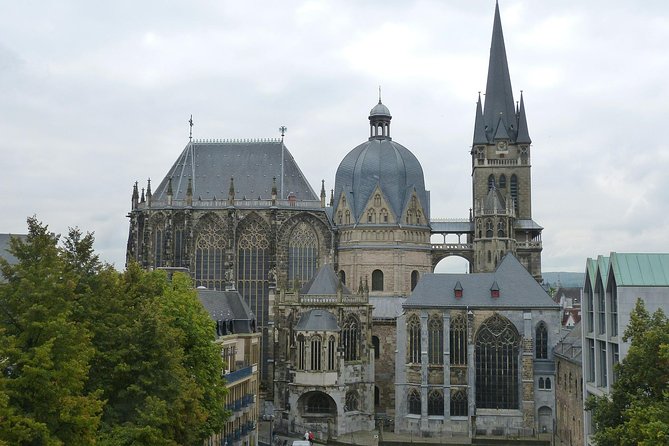
- Charlemagne’s cathedral anchors the walk: Aachen Cathedral is one of Europe’s oldest cathedrals and the seat of the Diocese of Aachen.
- The route covers seven notable sights: You’ll see the cathedral, Puppenbrunnen, Elisenbrunnen, Grashaus, Haus Löwenstein, City Hall, and Ponttor.
- Puppenbrunnen adds playful local detail: Bronze marionettes represent parts of Aachen life, and the figures move.
- The tour is private for up to 15 people: Your group receives the guide’s attention without a shared tour crowd.
- The walk is short but information-heavy: The advertised duration is about 1 hour 30 minutes, with roughly 10 minutes assigned to several main stops.
- The price favors larger groups: The $406.51 group rate works out far better when divided among several people.
Why this Aachen walk works well with limited time
Aachen is easy to underestimate. The center is compact, but its monuments belong to very different chapters of European history. You can pass from Charlemagne’s cathedral to a fountain about local trades, then to a former town hall and a medieval gate within a short walk.
That is where a private guide earns the fee. You do not need to stop every few minutes to work out where the next sight is, and you get a connecting story rather than a string of unrelated photographs. The guide’s job is not just to point at buildings. It is to explain why Aachen became important and how ordinary city life appears in its public art and old houses.
The route begins at the Dominformation at Johannes-Paul-II-Straße 1, 52062 Aachen, near Aachen Cathedral. It also ends at the meeting point, according to the provided details. The activity is near public transportation, so it fits neatly into a day built around the city center.
The total duration is about 90 minutes. The listed stops account for around an hour, leaving time for walking between them and for the guide’s explanations. This is a sightseeing walk, not a long museum visit. You should expect a brisk overview with several stops rather than a slow examination of every interior.
More Old Town Walking Tours in Cologne
- Cologne: The Night Watchman Old Town Walking Tour in German
★ 4.6 · 1,395 reviews - Cologne: Old Town Highlights Walking Tour
★ 4.6 · 1,093 reviews - Cologne Cathedral and Old Town Tour with 1 Kölsch
★ 4.8 · 674 reviews
Aachen Cathedral and the world of Charlemagne
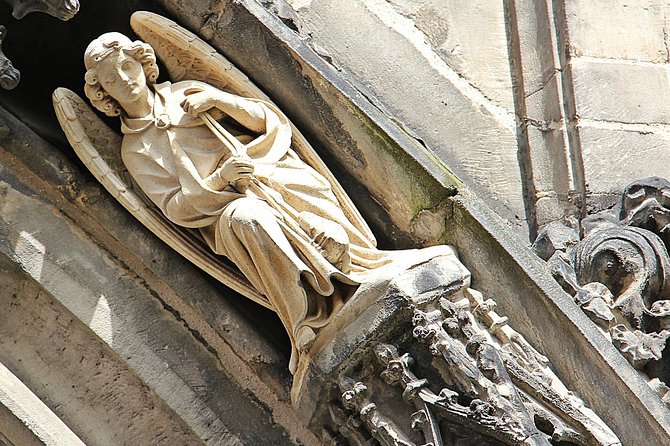
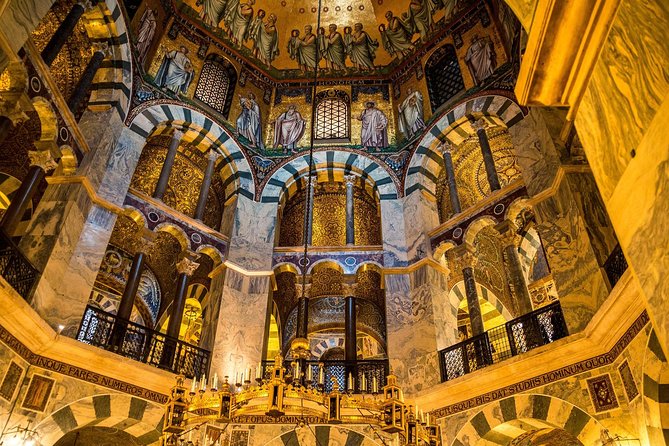
The cathedral is the natural opening act. Known in French as the Cathedral of Aix-la-Chapelle, it is one of the oldest cathedrals in Europe and serves as the seat of the Roman Catholic Diocese of Aachen.
The building matters for more than its age. Aachen is closely tied to Charlemagne, and the cathedral gives the guide a strong place to explain the city’s role in medieval Europe. One available assessment praised the way the tour placed Charlemagne and Aachen’s important past in context. That is the central strength of this experience: the buildings become easier to understand when you know why they were built and what power they represented.
The cathedral stop is listed at about 10 minutes, with admission marked as free. That is enough time for an introduction and a look around, but it is not a full cathedral study. You should not expect the guide to cover every chapel, architectural feature, and work of art in that short window.
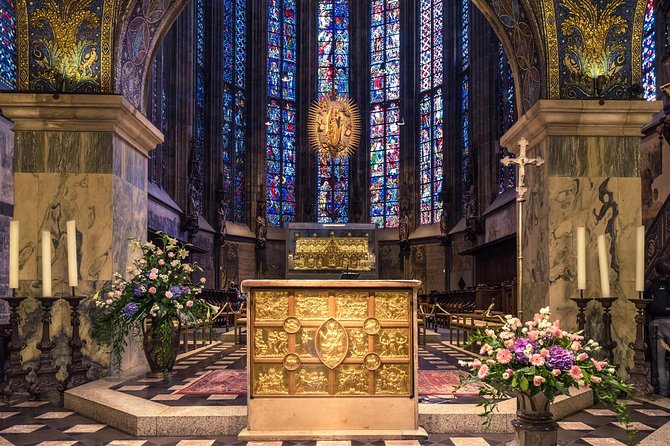
You may also have the chance to visit the cathedral Treasury. It contains important medieval church works, including the Cross of Lothair, the Persephone sarcophagus, and the Bust of Charlemagne. These objects add weight to the cathedral’s story, but keep the tour’s admission note in mind: entrance fees are not included in the overall booking. The cathedral stop itself is listed as free, while the Treasury may be handled separately.
For a first visit, this arrangement works well. You get the cathedral’s main story from the guide, then you can decide if you want to return for more time inside. If sacred art and medieval objects are a major reason for your visit, you may want to plan extra time beyond the scheduled walk.
Puppenbrunnen turns city history into bronze
After the cathedral, the route continues to Puppenbrunnen, also called the Dolls Fountain. This is one of the more distinctive stops because it explains Aachen through moving figures rather than through a single grand building.
The fountain was created by Bonifatius Stirnberg in 1975. Its bronze figures form pairs connected with Aachen life: the textile industry and a doll, a horse and rider, a bishop and church, a market woman, a professor and harlequin, doctrine and culture. A clock at the top refers to the French occupation.
The figures can move like marionettes, making this an especially appealing pause for children. It also gives adults something useful: a compact lesson in the city’s trades, social groups, and public identity. The fountain is not ancient, yet it points back toward older parts of Aachen’s story.
The guide spends about 10 minutes here. That is enough to identify the figures and explain their meaning. You will want to look closely, since the fountain rewards observation more than a quick photograph. This is also a good example of why a guide helps. Without context, it can look like a playful collection of bronze characters. With context, it becomes a picture of how Aachen saw itself.
Admission is free. Since the fountain is outdoors, the stop does not depend on an interior opening schedule in the way a museum visit does.
Elisenbrunnen and Aachen’s thermal water
Elisenbrunnen introduces another side of the city: its springs and spa tradition. The fountain has two drinking fountains supplied by healing thermal water. The water is described as having a high sulphur content and medicinal properties.
That sulphur content is not a minor detail. It explains the fountain’s distinctive purpose and why thermal water became part of Aachen’s identity. The guide can connect this stop to the city’s long interest in bathing and health, giving you a different angle after the cathedral’s religious and imperial story.
The stop lasts about 10 minutes and is free to visit. You may find the water’s smell and taste unusual because of the sulphur. The information provided does not give specific instructions about drinking it, so treat the fountains as a place to learn about Aachen’s springs rather than assuming the water is part of a tasting activity.
I like the change of pace here. The cathedral looks toward power and faith. Puppenbrunnen looks toward city life. Elisenbrunnen shows how natural resources helped shape Aachen’s public image.
Same city, a completely different kind of day:
- Cologne: Panoramic City Cruise
★ 4.3 · 5,698 reviews - Cologne: Brewery Tour with 3 Kölsch Beer Tastings
★ 4.7 · 3,108 reviews - Cologne: Top Sights Rhine River Cruise – Skyline Tour
★ 4.4 · 3,030 reviews - Cologne: Chocolate Museum Entrance Ticket
★ 4.4 · 2,790 reviews
Grashaus and the city’s earliest civic life
The walk then reaches the Grashaus at the Fish Market. It is one of Aachen’s oldest houses and served as the city’s first town hall. Construction was completed in 1267, although the building goes back to an even older settlement.
The Grashaus is valuable because it shifts attention from emperors and cathedrals to local government. This was a working civic building, not only a decorative landmark. Its earlier setting also carried a darker detail: the medieval village included a prison.
You should expect to see the building from the outside as part of the walking route. The supplied schedule does not assign a separate admission or interior visit. That makes the guide’s explanation particularly useful, since the building’s importance is easy to miss if you only glance at its facade.
The Fish Market setting helps show how civic buildings were tied to daily trade and public activity. It is a small stop, but it gives the route a stronger sense of how Aachen functioned as a town.
Haus Löwenstein and a surviving Gothic mystery
Across from the town hall is Haus Löwenstein, built around 1344. It is one of the few Gothic buildings to survive the great fire of 1656.
The building’s most intriguing feature is what remains unknown. No one knows why it was originally built, and that mystery has lasted for centuries. That uncertainty gives the stop a human quality. Medieval buildings are often presented as if every fact is settled, but sometimes the honest answer is that the original purpose has been lost.
Haus Löwenstein is also a reminder that survival can be as important as age. The great fire changed Aachen, yet this Gothic structure remained. Your guide can use it to explain how much of the old town has been altered, rebuilt, or preserved.
There is no listed entrance here, so this is another exterior viewing stop. You will not spend long inside, but the building is a worthwhile pause for anyone who enjoys architecture and incomplete stories.
City Hall and the Granus Tower
Aachen City Hall brings the route back to the city’s imperial role. The Gothic building was built in the 14th century under Gerhard Chorus to host the traditional coronation feast of the Holy Roman Empire. Construction finished in 1349, after which the building served as an administrative center.
This is not simply a town hall with a handsome facade. Its original purpose connected Aachen to the ceremonies surrounding imperial coronations. The guide can help you picture the difference between a building used for ordinary administration and one prepared for a major political and ceremonial event.
The nearby Granus Tower reaches 20 meters high. It was also used to store weapons, adding a practical military function to the civic setting.
The stop is listed at about 10 minutes. Admission is not included, so you should treat the scheduled visit primarily as an exterior look unless your guide provides more specific access details on the day. If entering City Hall is important to you, budget for the separate fee and confirm how it fits with the 90-minute route.
For many people, the exterior explanation will be enough. The main value here is the connection between architecture, administration, ceremony, and defense. Aachen’s past becomes less abstract when one building held all these roles.
Ponttor closes the route with a piece of the city wall
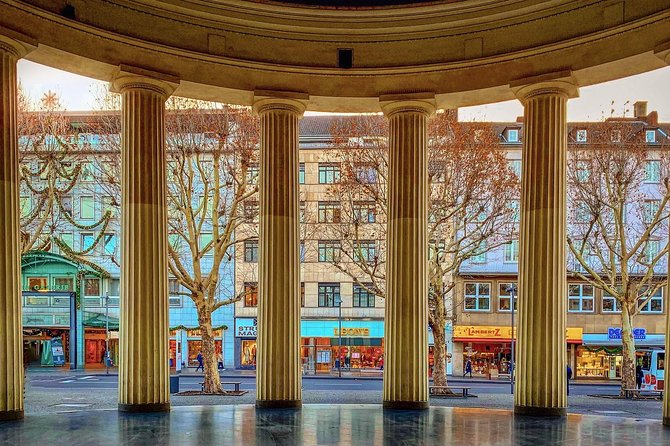
The final stop is Ponttor, one of the remaining gates from Aachen’s 14th-century city wall. It was previously known as the Brückenpforte. The route also refers to Marschiertor, another surviving city gate, although the listed finish is Ponttor.
City gates make a useful ending because they show where the old town met the world beyond its walls. After seeing the cathedral, civic buildings, and public fountains, you finish with a reminder that Aachen was once a fortified city with controlled entrances.
Ponttor is now used by the German Scout Club and the German Scout Association Saint George. That modern use gives the old structure a continuing role rather than leaving it as a frozen monument.
The stop lasts about 10 minutes and is free. Since the activity ends back at the original meeting point according to the details provided, check the exact route with your guide if the listed finish at Ponttor seems different from the stated return arrangement. The supplied information gives both points, so it is sensible to clarify this before setting another appointment immediately afterward.
What $406.51 means for your group
The price is $406.51 per group, with up to 15 people included. That works out to about $27.10 per person for a full group of 15. For 10 people, it is about $40.65 each. For four people, the cost rises to roughly $101.63 per person, and for two people it is more than $203 each.
Those figures tell you how to judge the experience. A large family group, corporate group, or party of friends can get solid value from a private guide, especially if several people would otherwise need to coordinate their own route and research. A couple may find the price harder to justify unless personal attention and a short, organized introduction matter more than keeping costs low.
The fee covers the official tour guide. Entrance fees are not included. The main sightseeing points on the route are outdoors or viewed from outside, but the cathedral Treasury and City Hall may require separate consideration. Confirm those details if you want interior access rather than an exterior overview.
The rating supplied for the experience is 3.5 from four assessments. That is a modest sample, so I would not treat it as a strong prediction of your exact experience. The clearest positive point is the historical context, especially the explanation of Charlemagne and the importance of the sites.
Who will get the most from this walk
I would choose this tour if you have only a short window in Aachen and want the major Old Town sights arranged into one clear route. It also suits anyone who prefers asking a guide questions instead of reading plaques or planning directions alone.
The private setup is useful for families. Puppenbrunnen gives children something visual and moving to watch, while the cathedral, old town hall, and city gates give adults plenty of historical material. A group of up to 15 can also keep the per-person cost reasonable.
You may want a different plan if you prefer long museum visits, detailed architectural study, or a slow photography walk. Ninety minutes is enough for orientation, not exhaustive inspection. You will see several places, but the schedule does not leave much time to linger at each one.
Most people can participate, and the activity is near public transportation. The information provided does not give a detailed accessibility assessment, so ask the provider about route conditions if that is important for your group.
BlackBuck Travels operates the experience. Confirmation is received at booking, but the non-refundable policy deserves attention. You cannot change or cancel the booking for a refund, so make sure your date and group size are settled before paying.
Should you book the Aachen Old Town Guided Tour?
Book it if you want a private, fast-moving introduction to Aachen and your group can share the cost. The best reason to choose it is the combination of efficient navigation and useful context. You will see the cathedral, fountains, medieval houses, City Hall, and Ponttor without having to build the route yourself.
The strongest parts are the Charlemagne connection at Aachen Cathedral and the unusual Puppenbrunnen, where local life is represented by moving bronze figures. The Grashaus, Haus Löwenstein, and Granus Tower add smaller details that you could easily miss on a casual walk.
Think twice if you are traveling alone or as a couple on a tight budget. The flat group price becomes expensive for a small party, and separate entrance fees may add to the total. For a larger group with limited time, though, this is a practical way to get your bearings and understand why Aachen matters.
FAQ
How long does the Aachen Old Town guided tour last?
The tour lasts approximately 1 hour 30 minutes.
Where does the tour begin?
It begins at the Dominformation, Johannes-Paul-II.-Straße 1, 52062 Aachen, Germany.
Where does the activity end?
The provided details state that the activity ends back at the meeting point. The route also lists Ponttor as the final sightseeing stop, so confirm the exact return arrangement with the guide.
How many people can join the private tour?
The price covers one private group of up to 15 people.
Is Aachen Cathedral admission included?
The cathedral stop is marked as free admission. Entrance fees are not included in the overall activity, so ask about any separate charge for the Treasury or other interior access.
Is City Hall admission included?
No. Admission to Aachen City Hall is listed as not included.
Can I cancel or change the booking?
No. The experience is non-refundable and cannot be changed for any reason.
Just added around Cologne
- Aachen old town tour – GERMAN (public)★ 5.0 · 24 reviews
- Cologne Highlights: Exclusive Private Tour★ 5.0 · 5 reviews
- Aachen Private Walking Tour With A Professional Guide★ 5.0 · 11 reviews
- Explore Cologne’s best Street Art Quarter★ 4.5 · 4 reviews
- The rather unknown Melaten★ 4.9 · 26 reviews
- Rickshaw Glühwein Ride★ 4.6 · 24 reviews
- Public brewhouse tour Cologne in English★ 4.9 · 154 reviews
- Informative and fun brewery tour in German, public★ 4.9 · 47 reviews
Old Town Walking Tours, compared.
Old Town & Viktualienmarkt City Walk in German
Read our review →
The Night Watchman Old Town Walking Tour in German
Read our review →
Browse the lists this tour appears in