
Reviewed · OLD TOWN WALKING TOURS
Weimar: Old Town Tour Classical Weimar
Classical Weimar comes into focus on this 90-minute old-town walk, where the streets themselves tell the story. You move from the market square to the squares and houses linked with Goethe, Schiller, Herder, and Wieland, seeing the places where Weimar’s great cultural age took shape.
I like the clear route and the low $11 price, which makes this a sensible first look at the city. I also like the outside-only format: you keep moving, see many major sights, and can choose your own museum visits afterward. The main catch is that the tour is in German, and the walk is not suitable for people with mobility impairments.
In This Review
- Key things to know before you book
- Why this short Weimar walk works well
- Starting at Markt 4 and the market square
- Herderplatz and the church at its center
- Democracy Square and the library facade
- Goethe’s house and the literary heart of Weimar
- Schiller’s residence and the route toward Theaterplatz
- What the guide adds to the experience
- Price, timing, and practical value
- Who should book this old-town tour
- Should you book it?
- FAQ
- How long does the Weimar old-town tour last?
- Where does the tour start?
- Where does the tour finish?
- Is the tour conducted in English?
- What sights are included?
- Can I go inside Goethe’s house or the library?
- How much does the tour cost?
- How large is the group?
- Can I cancel the booking?
Key things to know before you book
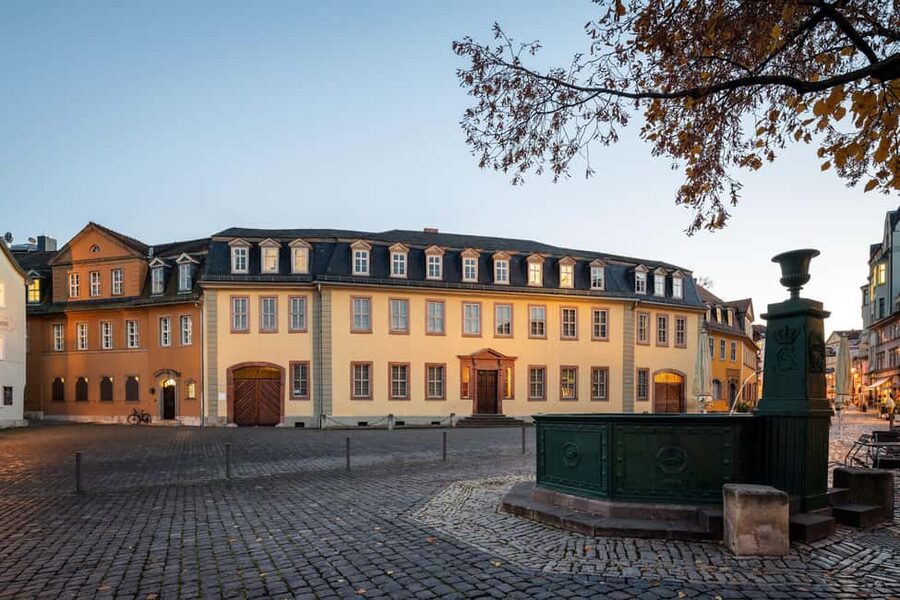
- The tour connects Weimar’s main classical landmarks: You see the market square, Herderplatz, Democracy Square, Goethe’s house, Schiller’s house, the City Palace, and Theaterplatz.
- The walking time is about 90 minutes: The booking information lists a duration of one day for scheduling, but the tour description gives the actual city walk as an hour and a half.
- Every sight is viewed from outside: This is an orientation tour, not an admission ticket to Goethe’s house, the library, the palace, or the churches.
- The guide speaks German: No other tour language is provided.
- The advertised group size is small: The activity is limited to six participants, although one booking experience involved groups being divided and still ending up at roughly a dozen people per section.
- You start at the Neptune Fountain by the Tourist Information Office: The route is centered on the old town and is designed to give you a quick sense of Weimar’s major cultural sites.
Why this short Weimar walk works well
Weimar is easy to underestimate. The old town is compact, but its importance is not. Within a fairly small area, you find the homes and workplaces of writers, musicians, teachers, rulers, and artists who helped shape German culture.
That makes a guided walk useful. Without context, a square can look like a square, and a handsome old house can look like only another handsome old house. A guide can explain why the building matters, who used it, and how it fits into the story of classical Weimar.
This tour keeps its focus narrow. It does not try to cover every museum or every period of Weimar’s past. Instead, it concentrates on the classical period and the people most closely tied to it: Goethe, Schiller, Herder, and Wieland.
I like that focus for a first visit. You get the basic map of the center, then you can decide where to spend more time. The outside-only approach also keeps the walk moving, though you should not book it expecting a full visit inside the Duchess Anna Amalia Library or Goethe’s house.
The guide speaks German, so you need enough German to follow a live explanation. One German-language tour experience was praised for being informative, well presented, engaging, and open to questions. That is exactly the kind of guide you want on a short city walk, since the quality of the explanation matters as much as the route.
More old town walking tours in Germany:
- Dresden: Semperoper and Old Town Tour
★ 4.8 · 5,735 reviews - Nuremberg: Old Town Guided Walking Tour
★ 4.6 · 2,416 reviews - Munich: Old Town & Viktualienmarkt City Walk in German
★ 4.7 · 2,304 reviews
Starting at Markt 4 and the market square
The walk begins at the Weimar Tourist Information Office, beside the Neptune Fountain at Markt 4. This is a practical starting point because you are already in the middle of the historic center, with the town’s most important civic buildings close at hand.
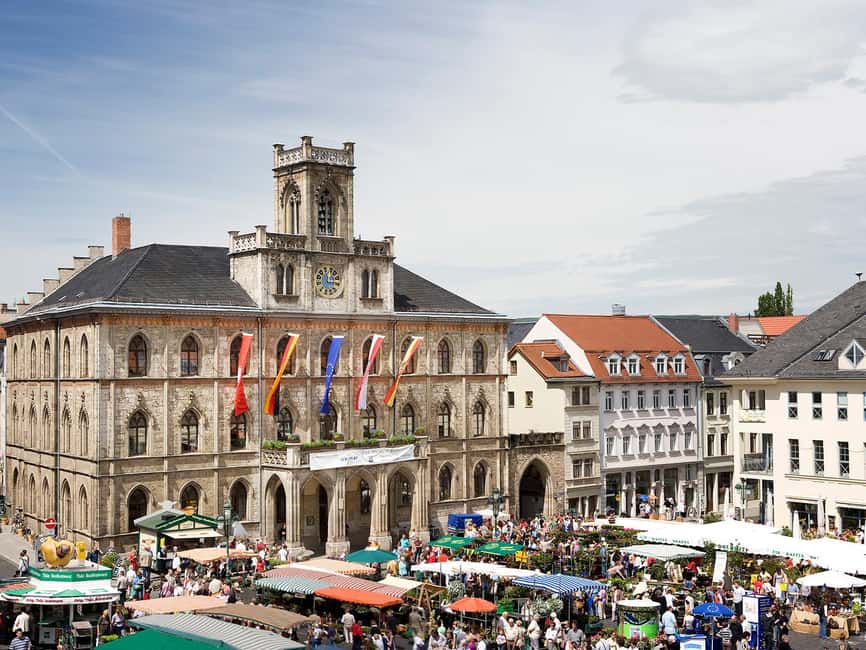
The market square introduces Weimar’s public face. You see the town hall, the Cranach House, and Hotel Elephant. Each gives the guide a different way to explain the city.
The town hall represents Weimar as a working civic center rather than only a place of monuments and literary pilgrimage. The Cranach House connects the square with Lucas Cranach the Elder, the painter associated with the Reformation era. Hotel Elephant adds another layer, since it is one of the familiar historic buildings on the square and helps show how the center has long served as a place for public life and lodging.
Allow about 20 minutes here according to the planned route. That is enough time for an overview, photos, and an explanation of the main buildings, but not enough for detailed interiors or a long architectural lecture.
I like starting here because it gives you visual landmarks that are easy to remember. If you return to the square later, you will know what you are looking at instead of simply passing through on the way to another sight.
Herderplatz and the church at its center
From the market square, the route continues to Herderplatz. This is one of the most meaningful stops for understanding the connection between Weimar’s religious, educational, and intellectual life.
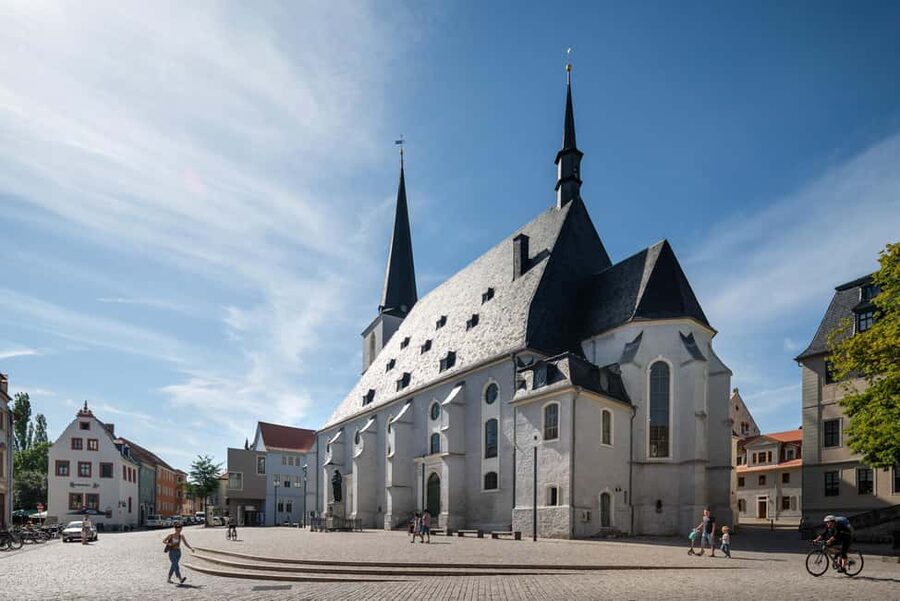
The square is linked with Johann Gottfried Herder, one of the major thinkers associated with Weimar’s classical period. You also see St. Peter and Paul’s Church, often called the Herder Church, along with the Wilhelm Ernst Gymnasium.
The church gives the stop a strong visual anchor. The school building adds a useful reminder that Weimar’s story was not created only inside royal residences or private literary homes. Education and public institutions helped shape the city too.
The stop includes a photo opportunity and a guided explanation. Since the tour views the church from outside, you should think of this as a setting and context visit rather than a church interior tour.
For me, Herderplatz is the kind of stop that makes a walking tour worthwhile. It links a person’s name to a real urban setting. You are not just memorizing Herder as a historical figure. You are seeing the square, church, and school environment connected with his work.
Democracy Square and the library facade
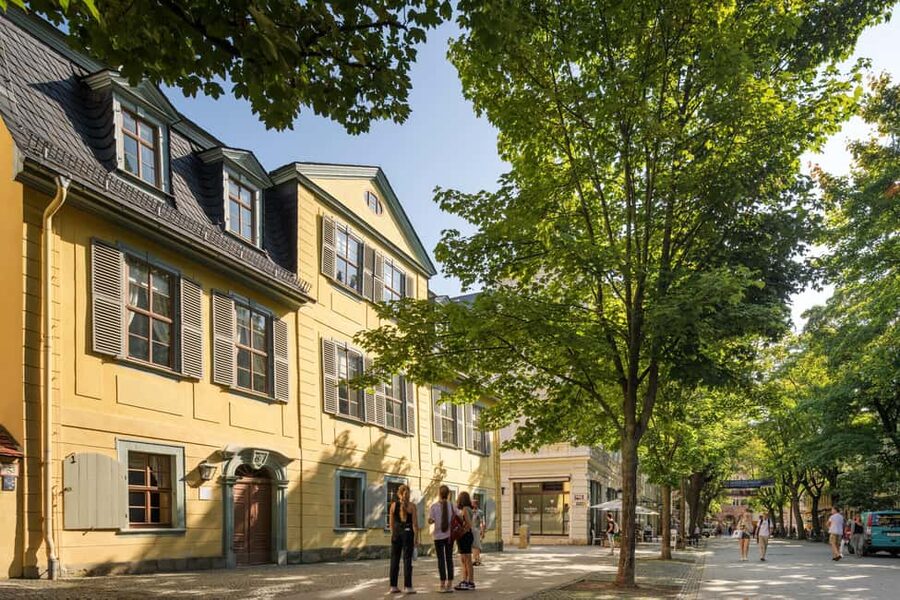
The next major section is Democracy Square, where the Duchess Anna Amalia Library and the Princely House come into view. This is one of the tour’s strongest stops for anyone interested in books, learning, and the court culture that supported Weimar’s intellectual life.
The library is one of Weimar’s best-known buildings, but this tour does not include entry. You see it from the outside and hear how it fits into the city’s classical story. That distinction matters. If the library is high on your list, you will need a separate visit and ticket.
The Princely House adds the political side of the picture. Together, the buildings show how scholarship and power sat close together in Weimar. The classical period was not simply the product of isolated writers working alone. It grew within a city shaped by its rulers, institutions, schools, and public spaces.
This square also provides a useful pause in the route. The guide can draw together the people and places already introduced, then connect them with the residences and theater area still ahead.
I recommend taking notes here if you plan to visit Weimar’s museums afterward. Names and buildings can blur together during a fast tour. A short note about the library, Princely House, and Herderplatz will help you sort out your sightseeing later.
Same city, a completely different kind of day:
- Berlin: Reichstag, Dome and Government District Guided Tour
★ 4.7 · 18,288 reviews - Berlin: 1-Hour City Tour by Boat with Guaranteed Seating
★ 4.3 · 16,993 reviews - Hamburg: Sex and Crime in St. Pauli Tour for Ages 18+
★ 4.7 · 15,447 reviews - Hamburg: 1.5-Hour Harbor and Speicherstadt Day Cruise
★ 4.6 · 14,200 reviews
Goethe’s house and the literary heart of Weimar
Goethe’s house is one of the central stops. The guide shows you the exterior and explains its connection with Johann Wolfgang von Goethe, the best-known figure in Weimar’s classical circle.
You should keep your expectations clear. This is not an interior tour, and the activity does not include entry to the house. You get the location, the facade, and the story told by the guide. If you want to see Goethe’s rooms and collections, plan a separate visit.
That outside view still has value. A writer’s home is more meaningful when you understand where it sits in relation to the market square, the court buildings, Schiller’s residence, the theater, and the park by the Ilm. The walk supplies that geographic connection.
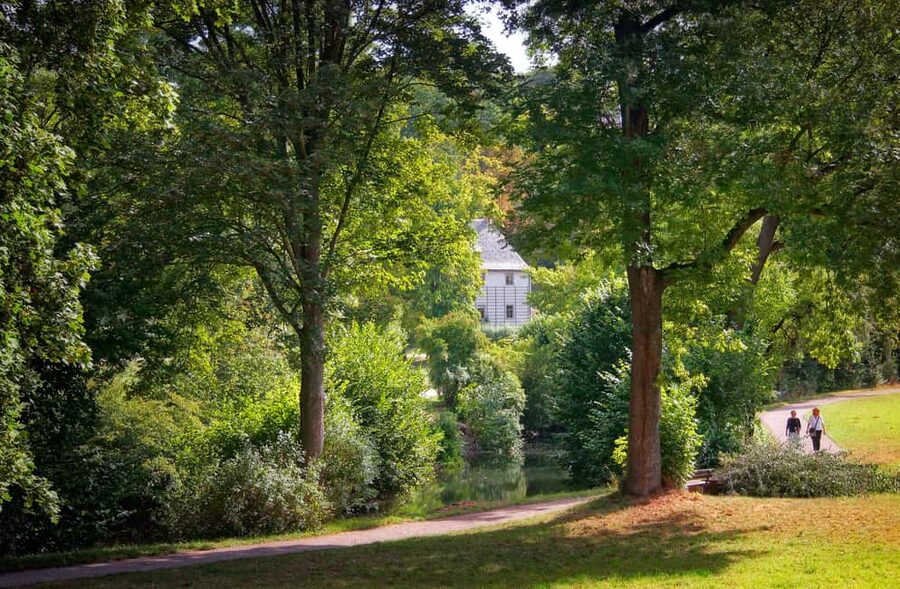
The planned route also refers to the park on the Ilm and Goethe’s garden house. These places are part of the wider classical Weimar picture. Read the timing carefully, however, because the stop list emphasizes the old town and the finish at Theaterplatz, while the full route description includes the park and garden house. Ask the guide at the start exactly how much time will be spent there.
This is one of the few points where the published route can feel broader than a straightforward 90-minute old-town circuit. You may see the relevant areas or receive an explanation of them, but you should not assume a long park walk or an interior visit.
Schiller’s residence and the route toward Theaterplatz
Schiller’s residence adds the second major literary home to the walk. Seeing Goethe’s and Schiller’s homes on the same tour helps explain why Weimar is remembered as a place of close creative exchange rather than only as Goethe’s city.
Again, the house is viewed from outside. That keeps the pace brisk, but it also means you will not get the full museum experience here. If Schiller is your main interest, use this stop to decide if the residence deserves a return visit.
The route then leads toward Theaterplatz, one of Weimar’s most recognizable public spaces. The Goethe and Schiller monument is the natural visual finish. The two figures stand together in a way that has become a shorthand for Weimar’s classical identity.
Theaterplatz is a good ending point because it pulls the main story into one image. By this stage, you have seen the civic center, Herder’s square, the library district, and the homes associated with Goethe and Schiller. The monument gives you a final point of reference and an easy place to continue exploring.
The activity information names Theaterplatz as the finish, while the meeting-point information says the activity ends back at the starting point. Because those details do not match perfectly, confirm the ending location with the guide before you set off. Either way, you remain in the central Weimar area.
What the guide adds to the experience
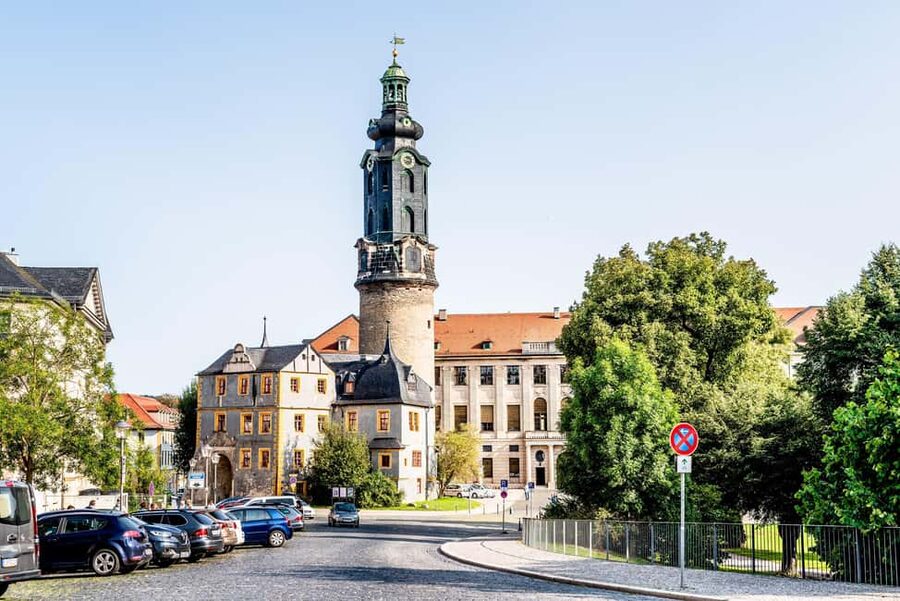
A 90-minute city walk depends heavily on the guide. The route is strong, but the buildings are more useful when someone explains the links between them.
The available tour language is German. One German-language guide was described as very informative and clear, with a good way of presenting the material. Another guide on a separate experience was praised for being engaged, funny, and happy to answer questions, though that comment also referred to a different tour with a winery and driver. I would not assume those same features apply here, but the practical lesson is still useful: ask questions early, while the guide has time to connect the answers to the route.
The advertised group limit is six people, which would make it easier to hear the guide and ask questions. Yet one experience booked as a small group was divided into sections that still had about a dozen people each. Group size can therefore vary in practice.
If your group is larger than expected, stay near the guide at each stop. The old town has active public spaces, and a soft-spoken explanation can be hard to catch from the back. A small group is a real benefit only if the group remains small enough for easy conversation.
Price, timing, and practical value
At $11 per person, this is an inexpensive way to get oriented in Weimar. The value is strongest if you are visiting for the first time, want a quick explanation of the classical sights, or prefer to save museum admissions for the places that interest you most.
The price does not include entry to the buildings. That is not a problem if you want a street-level introduction, but it can feel limiting if you expected to go inside Goethe’s house or the Duchess Anna Amalia Library.
The actual walk lasts about 90 minutes. The booking information displays a duration of one day for availability, so check the selected starting time carefully. You should also leave room afterward for a museum visit, lunch, or a slower return to the sights that caught your attention.
Cancellation is flexible up to 24 hours before the activity for a full refund, and you can reserve without paying immediately. Those terms are useful if your schedule in Weimar depends on train times or changing weather.
The tour is not suitable for people with mobility impairments. The information provided does not give a detailed surface description or distance, so contact the provider if you need more precise advice before booking.
Who should book this old-town tour
I would choose this walk for a first visit to Weimar, especially if you want the main classical landmarks explained in one sitting. It also suits anyone who prefers a short, focused introduction before deciding which houses, churches, or libraries deserve a full visit.
It is a good fit if you:
- Want to see Goethe’s, Schiller’s, and Herder’s Weimar in one route
- Prefer a German-speaking guide
- Like outside views and historical context more than long museum visits
- Have about 90 minutes available
- Want a low-cost orientation walk
- Are comfortable walking through the old town
I would look for another option if you need an English-language tour, require step-free access, or want entry to several sights included. This activity does not provide those features.
Should you book it?
Book this tour if you want a short, affordable introduction to classical Weimar and you are happy to experience the major sights from the street. The route gives you a useful mental map, and the best part is the way the squares, homes, schools, library, palace, and theater connect into one story.
Skip it if your priority is going inside the buildings or receiving the tour in a language other than German. Also confirm the exact group size and finishing point when you arrive, since the advertised small-group limit has not always meant a group of only six, and the route information gives both Theaterplatz and the starting point as the endpoint.
For most German-speaking first-time visitors, the $11 cost is easy to justify. Use the walk to get your bearings, then spend the rest of your day inside the two or three places that interest you most.
FAQ
How long does the Weimar old-town tour last?
The city walk is described as lasting 90 minutes, or one and a half hours. The booking information also displays a one-day duration for availability, so check the starting time and activity details when you reserve.
Where does the tour start?
The meeting point is the Weimar Tourist Information Office beside the Neptune Fountain at Markt 4.
Where does the tour finish?
The route information lists Theaterplatz as the finish. The meeting-point information also says the activity ends back at the meeting point, so confirm the exact endpoint with the guide at the start.
Is the tour conducted in English?
No. The listed tour language is German.
What sights are included?
The outside route includes Market Square, Democracy Square, the Duchess Anna Amalia Library, the Princely House, the City Palace, St. Peter and Paul’s Church, Goethe’s house, Schiller’s house, and Theaterplatz.
Can I go inside Goethe’s house or the library?
No. All sights are viewed from outside as part of the guided old-town walk.
How much does the tour cost?
The listed price is $11 per person.
How large is the group?
The activity is advertised as a small group limited to six participants. One booking experience involved a larger group being divided into sections of about a dozen people, so the actual size may vary.
Can I cancel the booking?
Yes. You can cancel up to 24 hours in advance for a full refund. The reserve-now, pay-later option also lets you hold a place without paying immediately.
Just added around Germany
- Aachen old town tour – GERMAN (public)★ 5.0 · 24 reviews
- Aachen Private Walking Tour With A Professional Guide★ 5.0 · 11 reviews
- Cologne Highlights: Exclusive Private Tour★ 5.0 · 5 reviews
- Bremen Private Walking Tour With A Professional Guide★ 5.0 · 7 reviews
- Private Walking Tour through the Fascinating Bremen’s City Center★ 5.0 · 5 reviews
- Explore Cologne’s best Street Art Quarter★ 4.5 · 4 reviews
- Bremen Exploration Private Game and City Tour on your Phone★ 4.5 · 7 reviews
- e-Scavenger hunt Bremen: Explore the city at your own pace★ 4.0 · 24 reviews
Old Town Walking Tours, compared.

Old Town & Viktualienmarkt City Walk in German
Read our review →

The Night Watchman Old Town Walking Tour in German
Read our review →
Browse the lists this tour appears in