
Reviewed · OLD TOWN WALKING TOURS
Premiumstadtführung (historische Altstadt und Schlossberg)
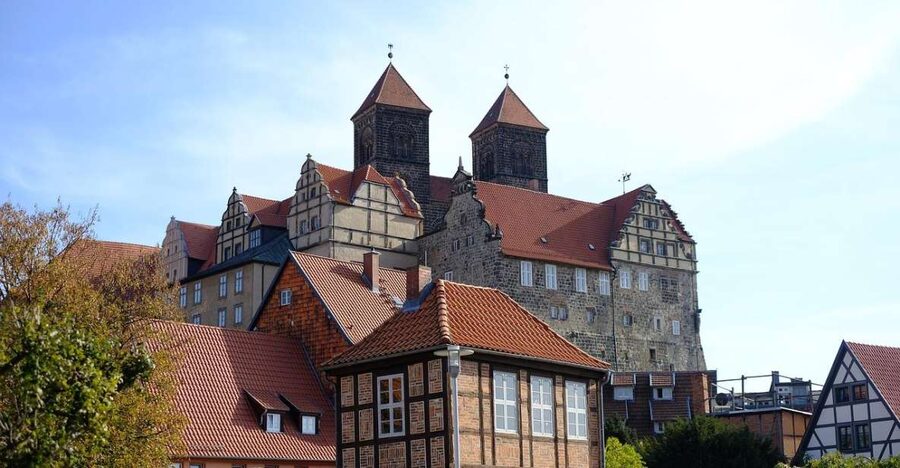
Quedlinburg’s story is written in its crooked lanes, timber-framed houses, and hilltop church. This two-hour walk links the market square with the UNESCO World Heritage old town and Schlossberg, giving you a useful first look at more than 1,100 years of local history.
I like the route for two clear reasons: it covers both the compact old town and the hilltop sights, and it adds practical tips about places to eat. The guide also points out famous people connected with Quedlinburg, including the poet Klopstock and the artist Lyonel Feininger.
The main drawback is the Schlossberg climb. Cobblestones and a steeper section can be awkward, especially in wet, icy, or snowy weather. One winter tour was canceled because the hill was dangerously slippery, so sturdy shoes and a little flexibility are wise.
In This Review
- Key points at a glance
- Starting at Quedlinburg’s market square
- Reading Quedlinburg through its half-timbered houses
- Churches, civic life, and the old-town route
- The Schlossberg climb and St. Servatii
- Klopstock, Feininger, and Quedlinburg’s famous names
- Food advice that can save you time
- What two hours really gives you
- Price, family value, and booking flexibility
- Who should take this Quedlinburg walk?
- Should you book the Premiumstadtführung?
- FAQ
- Where does the Quedlinburg tour begin?
- How long does the tour last?
- What language is the tour conducted in?
- What places are included in the old-town section?
- What places are included on Schlossberg?
- Can I go inside St. Servatii Collegiate Church during the tour?
- Is the tour suitable for children?
- Does the tour run in bad weather?
- Are cancellations allowed?
Key points at a glance
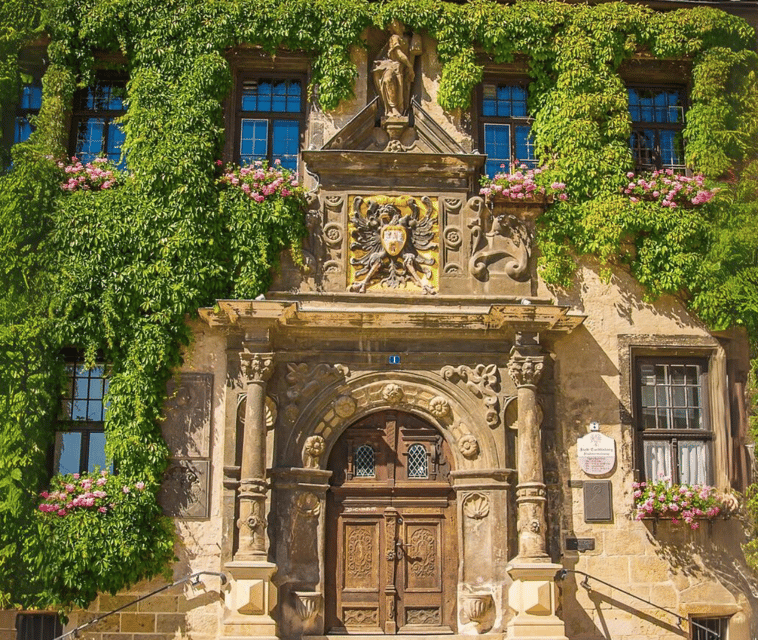
- A full old-town and hilltop route: You see the market square, town hall, churches, medieval lanes, museums, castle garden, and St. Servatii Collegiate Church.
- More than 1,100 years of history: The walk connects Quedlinburg’s medieval past with its famous residents and distinctive building traditions.
- Half-timbered houses take center stage: The route includes the atmospheric Schuhhof, Hölle, and the Half-Welfare Museum.
- The Schlossberg is the grand finale: The hilltop church and castle garden give the tour its strongest sense of place.
- German-speaking live guide: The tour is conducted in German, with time for questions.
- Good family value: Children and adolescents up to age 16 join free of charge.
Starting at Quedlinburg’s market square
The tour begins in front of the Quedlinburg city information office on the Marktplatz. Look for the green sign, then show your ticket at the agreed meeting time. This is an easy place to find in the center, and starting here gives you a quick orientation before the walking begins.
I like this opening because the market square puts Quedlinburg’s public life and architecture in one frame. The town hall is among the first major sights, and the guide uses the surrounding buildings to explain how the town developed.
The guide speaks German, so you will get the most from the tour if you understand conversational German. The group setting also allows questions, and the two-hour length is long enough for detail without taking over your entire day.
A practical tip: arrive ready to walk rather than treating this as a short stroll around the square. The route includes old paving, narrow lanes, and the rise to Schlossberg. Comfortable shoes matter more here than smart city footwear.
More old town walking tours in Germany:
- Dresden: Semperoper and Old Town Tour
★ 4.8 · 5,735 reviews - Nuremberg: Old Town Guided Walking Tour
★ 4.6 · 2,416 reviews - Munich: Old Town & Viktualienmarkt City Walk in German
★ 4.7 · 2,304 reviews
Reading Quedlinburg through its half-timbered houses
Quedlinburg is famous for its variety of half-timbered architecture, and this is one of the strongest reasons to take a guided walk instead of simply wandering with a camera. Timber frames can look decorative at first glance, but the guide helps you notice their different patterns, ages, and uses.
The route passes through medieval alleys where the buildings feel close and the streets bend unpredictably. That irregular shape is part of the town’s appeal. You are not walking through a neatly planned modern center. You are following the form of an old settlement that grew over centuries.
The Schuhhof and Hölle are particularly atmospheric parts of the old-town section. Their names alone hint at Quedlinburg’s unusual character, and the narrow spaces offer a change from the open market square.
The Half-Welfare Museum is also included. The supplied description does not specify how much time is spent inside, so I would treat it as a stop for context rather than plan your entire museum visit around the tour. If a particular exhibition matters to you, check the day’s opening details separately.
The guide’s value here is not simply naming buildings. You get a way to read the town. Look for how the timber is arranged, how the upper floors project over the street, and how different facades sit beside one another. You may notice more on a later independent walk because the tour gives you a vocabulary for what you are seeing.
Churches, civic life, and the old-town route
The itinerary includes the Market Church of St. Benedikti and Blasii Church. These stops add a religious and civic layer to the half-timbered streets. Quedlinburg is not only a collection of attractive facades. Its churches help explain how the town’s institutions shaped daily life.
The town hall provides the civic counterpart. Starting with this building makes sense because the market square is the town’s natural reference point. From there, the route moves into smaller streets and more intimate corners.
I appreciate this balance. Some walking tours race from one famous facade to the next. Here, the old-town route includes public buildings, churches, lanes, and museum material. That makes the two hours feel like an introduction to how Quedlinburg works as a historic town, not just a photo stop.
You should keep your expectations realistic. The tour is conducted in German, and the exact amount of time at each church or museum can depend on the guide and group. The experience is primarily a walking tour, not a series of long interior visits.
The Schlossberg climb and St. Servatii
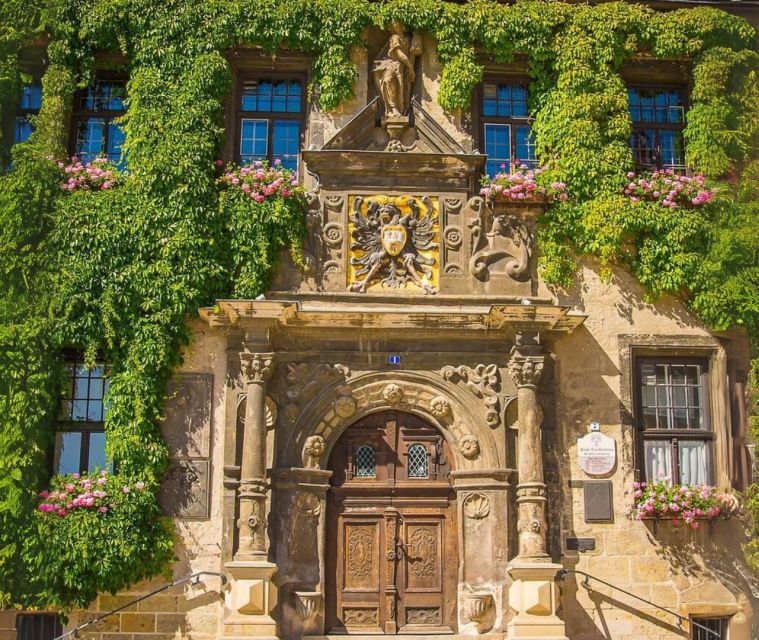
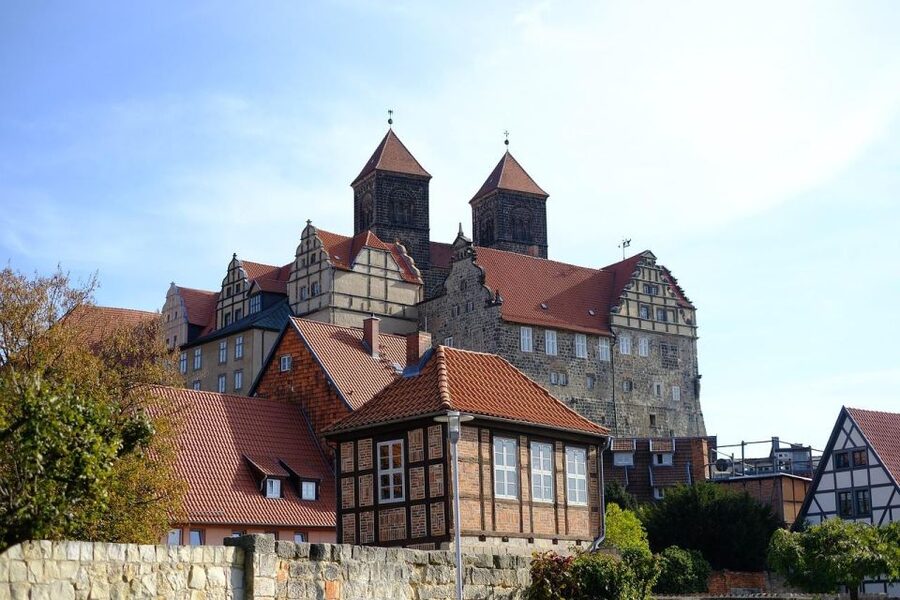
The route’s high point is the Schlossberg, where St. Servatii Collegiate Church crowns the hill. This is the part that gives the tour its strongest visual and historical focus.
The climb is also the main physical challenge. You will encounter cobblestone paths and a steeper section, so the hill can be uncomfortable for anyone with limited mobility or uncertain footing. The tour runs in rain or sunshine, but winter conditions deserve special attention.
One scheduled winter walk was canceled after the guide judged the Schlossberg too slippery. The booking was offered a later alternative, and a refund was issued, though the amount did not match the full amount reportedly paid. I would not treat this as proof of a routine problem, but it is a useful reminder that safety can override the advertised all-weather approach.
If you visit in cold weather, check the forecast and wear shoes with good grip. It is also sensible to keep some flexibility in your plans. The old town remains worth seeing if the hill is closed, but the tour’s advertised route is built around reaching Schlossberg.
At the top, the Collegiate Church of St. Servatii is viewed from the outside. Entry into the church is not included. That distinction matters because the church is the climax of the route, and you may want to return later if you wish to see the interior.
The Schlossberg section also includes the castle garden. This adds a little breathing room after the tight lanes below and helps you understand how the hilltop relates to the town around it.
Same city, a completely different kind of day:
- Berlin: Reichstag, Dome and Government District Guided Tour
★ 4.7 · 18,288 reviews - Berlin: 1-Hour City Tour by Boat with Guaranteed Seating
★ 4.3 · 16,993 reviews - Hamburg: Sex and Crime in St. Pauli Tour for Ages 18+
★ 4.7 · 15,447 reviews - Hamburg: 1.5-Hour Harbor and Speicherstadt Day Cruise
★ 4.6 · 14,200 reviews
Klopstock, Feininger, and Quedlinburg’s famous names
The hilltop route passes Klopstock-Haus and the Museum Lyonel Feininger. These places connect Quedlinburg with two very different cultural figures.
Klopstock-Haus points to the poet Friedrich Gottlieb Klopstock, one of the notable personalities associated with the town. The Museum Lyonel Feininger brings in the modern artist Lyonel Feininger, giving the tour a wider time frame than a purely medieval walk.
I like this part because it prevents the experience from becoming a lesson only about stone walls and old timber. Quedlinburg’s identity includes people who lived, worked, or became associated with the town, and the route shows how those names fit into the physical streets.
Do not expect a full museum tour from either stop. The information provided describes them as places along the Schlossberg route, not as included interior museum visits. If art or literary history is your main reason for coming, you may want to return independently after the walk.
Still, the brief introduction can help you choose what deserves more of your time. A good town tour should not try to replace every museum. It should help you decide what to explore next.
Food advice that can save you time
The guide also presents culinary hotspots and offers restaurant recommendations. This is a small inclusion, but I find it useful in a compact historic town, where attractive places can be busy or closed on certain days.
January can be especially difficult. Several restaurants may close at the same time, leaving limited choices for lunch. One local visitor reported finding only a café open for a midday meal during a January visit. That is not a reason to avoid the tour, but it is a reason to ask the guide for current options before you leave the market square.
The food advice is most valuable if you take the tour early in your stay. You can use the suggestions for lunch or dinner afterward, then return to the places that caught your eye. If you already know where you want to eat, the recommendations are simply a useful local check.
What two hours really gives you
Two hours is a sensible length for this route. You get enough time to move from the market square through the old town and up Schlossberg, but the schedule is not so long that every cobblestone starts to feel like a personal enemy.
The tour is best understood as a framework. You receive the basic story, see the major areas, learn which buildings deserve a closer look, and get suggestions for food and further visits. You will not absorb every detail of 1,100 years in one sitting, and you are not meant to.
The recent feedback supports that balance. High marks often focus on the tour being interesting, detailed, and led by a friendly city guide. One particularly positive assessment noted that the group size was comfortable and that questions were easy to ask. Since group size can vary by departure, I would not count on having a tiny group, but the format is designed to allow interaction.
The German-only format remains the biggest factor in deciding if this is right for you. If you follow German explanations, the tour should give you much more than a self-guided walk. If you do not, you may still enjoy the sights, but the historical content will be harder to use.
Price, family value, and booking flexibility
The stated price is $10 per person, which is a strong value for a two-hour guided route covering both the old town and Schlossberg. Children and adolescents up to age 16 are free, making this especially appealing for families.
The value is not just the number of stops. You are paying for the structure: a local guide connects the town hall, churches, half-timbered houses, museums, cultural figures, and hilltop church into one story. That can save you time and help you avoid walking past details you would otherwise miss.
Price information deserves a small caution. One winter booking reported a payment of 28.50 euros and a refund of 27 euros after cancellation. I cannot tell from the supplied details why that amount differed from the stated price, so check the final total and refund terms before paying.
You can cancel up to 24 hours in advance for a full refund, and the reserve-now, pay-later option keeps your plans flexible. Those terms are useful if weather may affect the Schlossberg section, though you should still check the exact conditions attached to your booking.
Who should take this Quedlinburg walk?
I would choose this tour if you are visiting Quedlinburg for the first time and want a clear introduction before exploring alone. It suits people who care about architecture, local history, churches, and literary or artistic connections.
Families get particularly good value because young people up to 16 join free. The route can also work well for couples and solo visitors who prefer a guided start rather than reading plaques at every corner.
You should think twice if you dislike uneven paving or steep streets. The old town section is not the whole story, and skipping Schlossberg would mean missing the tour’s main climax.
I would also skip it, or choose another format, if you need an English-language guide. This experience is in German only. The guide may be friendly and open to questions, but the tour’s central information is delivered in German.
Should you book the Premiumstadtführung?
Book it if you want a reasonably priced, two-hour overview that joins Quedlinburg’s half-timbered old town to the Schlossberg and St. Servatii. The combination is the real strength. You get streets, civic buildings, churches, museums, cultural figures, food advice, and a hilltop finish in one outing.
Before booking, confirm that German works for you and plan for cobblestones. In winter, allow some flexibility because icy conditions can cancel the hilltop section or the entire walk.
I would take this tour early in a Quedlinburg visit, then return to the places that caught my attention. It gives you the town’s basic map and story without asking for a full day. For $10, and with free admission for children up to 16, that is a sensible way to get your bearings in one of northern Germany’s most distinctive historic towns.
FAQ
Where does the Quedlinburg tour begin?
The tour begins at the Quedlinburg city information office on Quedlinburger Marktplatz. Look for the green city information sign and show your ticket to the guide at the agreed time.
How long does the tour last?
The walking tour lasts two hours.
What language is the tour conducted in?
The live tour guide speaks German.
What places are included in the old-town section?
The old-town route includes the town hall, the Market Church of St. Benedikti, Schuhhof, Hölle, Blasii Church, and the Half-Welfare Museum.
What places are included on Schlossberg?
The Schlossberg route includes Klopstock-Haus, the Museum Lyonel Feininger, the castle garden, and St. Servatii Collegiate Church.
Can I go inside St. Servatii Collegiate Church during the tour?
No. Entry into St. Servatii Collegiate Church is not included. The church is viewed as part of the Schlossberg route.
Is the tour suitable for children?
Yes. Children and adolescents up to age 16 can join free of charge.
Does the tour run in bad weather?
The tour is scheduled to run in rain or sunshine. However, a winter tour was canceled because the Schlossberg was considered too slippery, so icy conditions can affect the experience.
Are cancellations allowed?
You can cancel up to 24 hours in advance for a full refund. A reserve-now, pay-later option is also available.
Just added around Germany
- Aachen old town tour – GERMAN (public)★ 5.0 · 24 reviews
- Aachen Private Walking Tour With A Professional Guide★ 5.0 · 11 reviews
- Cologne Highlights: Exclusive Private Tour★ 5.0 · 5 reviews
- Bremen Private Walking Tour With A Professional Guide★ 5.0 · 7 reviews
- Private Walking Tour through the Fascinating Bremen’s City Center★ 5.0 · 5 reviews
- Explore Cologne’s best Street Art Quarter★ 4.5 · 4 reviews
- Bremen Exploration Private Game and City Tour on your Phone★ 4.5 · 7 reviews
- e-Scavenger hunt Bremen: Explore the city at your own pace★ 4.0 · 24 reviews
Old Town Walking Tours, compared.

Old Town & Viktualienmarkt City Walk in German
Read our review →
The Night Watchman Old Town Walking Tour in German
Read our review →
Browse the lists this tour appears in