
Reviewed · DRESDEN TOURS
Dresden: Virtual Reality Time Travel Experience Ticket
Dresden’s past comes alive in a 45-minute virtual reality journey set in 1719, when Augustus the Strong ruled Saxony and court life filled the Zwinger with ceremony. You begin in a Hall of Mirrors, meet a master of ceremonies, watch digital scenes of everyday amusements, then ride through Baroque Dresden in a virtual carriage.
I like the clear three-part design: courtly welcome, popular entertainment, royal carriage ride. I also like the live guide, available in German or English, since a human voice gives the animated history some shape and keeps the technology from feeling like a video game.
The main drawback is time. Each section lasts about 15 minutes, and one five-star comment still found the VR time travel too short. At $23 per person, this is a fair add-on to a Dresden sightseeing day, but it is not a substitute for seeing the city’s real palaces, churches, and museums.
In This Review
- Key points about the Dresden time-travel ride
- Starting in Augustus the Strong’s Hall of Mirrors
- Meeting the jugglers in the suburb
- Riding through the golden city of 1719
- What the guide adds to the technology
- Is $23 a good value for 45 minutes?
- Who should book this Dresden attraction?
- Practical details before you go
- How to fit it into a Dresden day
- Should you book the Baroque VR ride?
- FAQ
- How long does the Dresden Virtual Reality Time Travel Experience last?
- What period does the VR experience show?
- Where does the activity begin?
- Where does the activity end?
- What languages are available?
- Is the experience wheelchair accessible?
- Are children under six allowed to participate?
- Is food or drink included?
- Can I cancel my reservation?
Key points about the Dresden time-travel ride
- 1719 Dresden: See the city during the Baroque era, when Augustus the Strong’s court shaped Dresden’s image.
- Three distinct scenes: Move from the Hall of Mirrors to a juggler’s stage and then into a virtual carriage.
- The royal wedding: Attend the marriage of Friedrich August III and Maria Josepha inside the Dresden Zwinger.
- A lively welcome: The master of ceremonies introduces the Wettin dynasty with animation and Baroque music.
- Short but focused: The full activity lasts 45 minutes, with roughly 15 minutes devoted to each section.
- Accessible planning: SENSEUM is at ground level, but the physical Baroque carriages cannot take wheelchair users.
Starting in Augustus the Strong’s Hall of Mirrors
Your visit begins directly behind the Cholera Fountain, at SENSEUM Dresden. The venue is at ground level, which makes arrival simple if you are already exploring central Dresden.
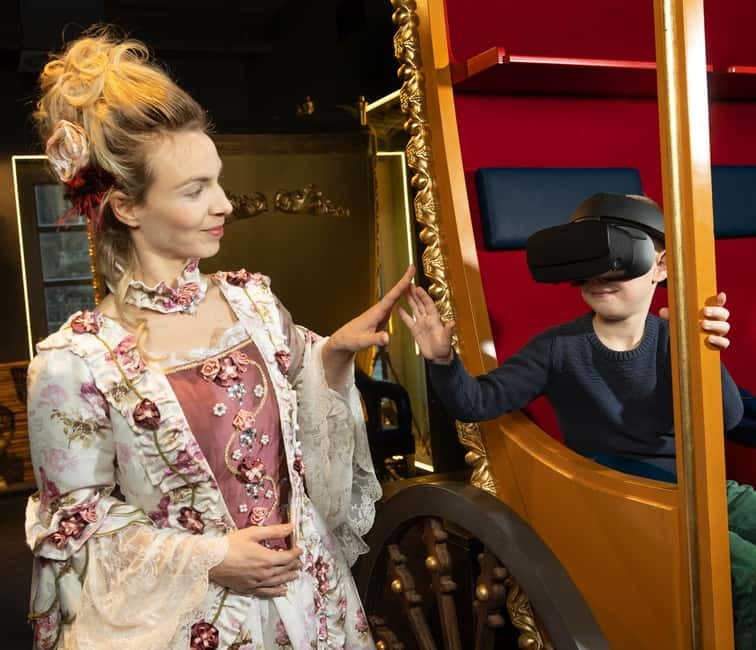
The first room is the Hall of Mirrors. Here, a master of ceremonies welcomes you in the name of Augustus the Strong, the powerful ruler from the House of Wettin. His introduction gives you a quick sense of the world you are about to enter: royal ceremony, dynastic ambition, music, and spectacle.
The Wettin family story is presented with animation and Baroque music. This is not a long history lecture, and that works in the tour’s favor. You receive just enough context to understand why Dresden looked the way it did and why court life mattered so much in 1719.
The tone is ceremonial but playful. One five-star comment specifically praised the guide’s humor and amusing presentation. That detail matters because a VR attraction can sometimes feel cold or mechanical. Here, the live host helps connect the digital scenes to the people and customs behind them.
The master of ceremonies also explains the route of the carriage ride. While the virtual carriages are prepared, jugglers entertain the audience in the suburb. This transition keeps the opening from becoming a simple orientation talk.
You should expect a performance rather than a conventional museum tour. The presentation uses music, animation, and theatrical hosting to set the mood. If you want long explanations about architecture, politics, or military campaigns, this is not the right format. If you want a brisk introduction to Dresden’s Baroque court, it works well.
A few more Dresden trips to weigh up
- Dresden: Semperoper Tickets and Guided Tour
★ 4.7 · 12,102 reviews - Dresden: Zwinger Museum Entry Ticket
★ 4.7 · 1,436 reviews - Dresden Castle General Admission Ticket
★ 4.6 · 1,328 reviews
Meeting the jugglers in the suburb
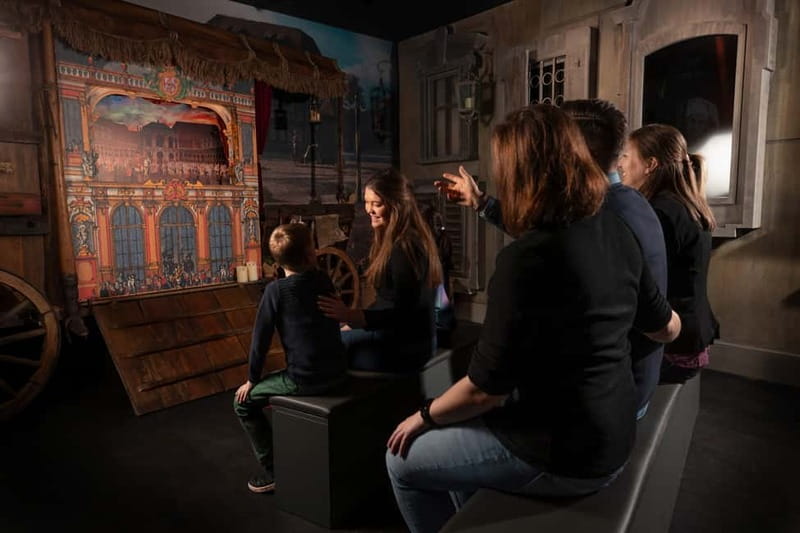
The second part takes place at the Juggler’s Stage. You become part of a digital paper theater that presents the life and amusements of ordinary people in the Baroque era.
This section is useful because the story does not stay inside the palace. Court culture is only one side of Dresden in 1719. By shifting to the suburb, the tour gives you a glimpse of public entertainment and everyday life beyond the royal rooms.
The paper-theater style also changes the pace. The Hall of Mirrors is formal and polished. The juggler’s stage is more direct and popular, with contemporary amusements at its center. You are not simply looking at a static historical display. The animated setting gives the common people a place in the story.
Expect about 15 minutes here. That is enough time to establish the mood, but not enough to develop a detailed social history. The section is best treated as a lively snapshot rather than a complete portrait of working life in Dresden.
I like this middle section because it prevents the experience from becoming only a royal fantasy. The contrast between the court and the suburb gives the final carriage ride more meaning. You have seen both the official world of the palace and a more public form of entertainment before moving on to the grand spectacle.
Still, the compact format means you may want more. The attraction gives you a taste of Baroque society, not a full account of how people lived, worked, or organized the city. For that, pair the VR experience with Dresden’s real historic center and museums.
Riding through the golden city of 1719
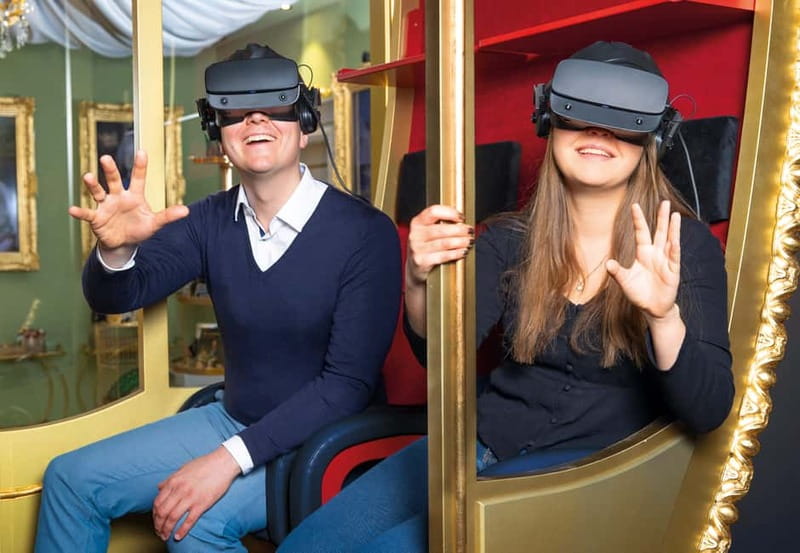
The carriage ride is the main event. You take a seat in a decorative Baroque carriage, put on the VR glasses, and travel through Dresden as it appeared in 1719.
The physical carriage helps your body understand the scene. You are not only watching a screen from a standing position. Sitting in the carriage makes the virtual journey feel like a change of place, even though you remain inside SENSEUM.
You can look around as the ride unfolds. The attraction encourages you to notice what is happening on all sides, rather than stare straight ahead. That is where the VR format earns its keep. A book or ordinary film can describe old Dresden, but the headset lets you inspect the city from within the moving scene.
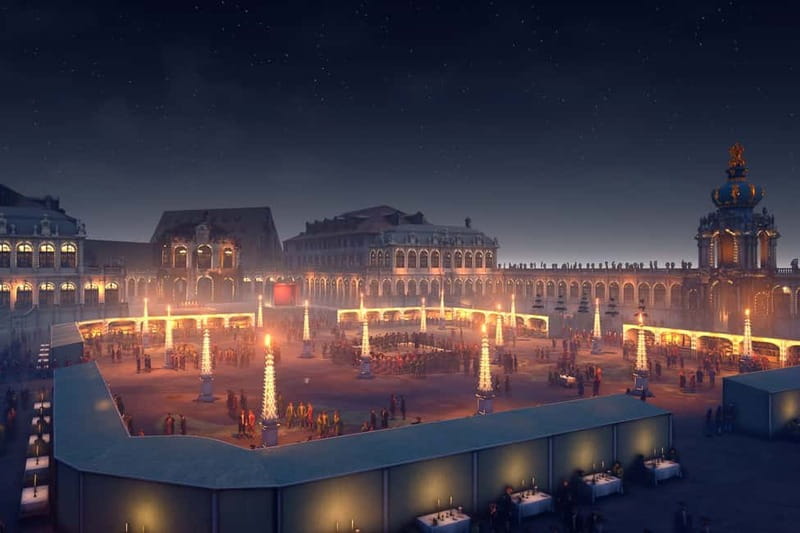
The route shows the golden Dresden of the Baroque era, then gives you an impression of life in the suburbs. The change from grand center to outer districts helps you compare the city’s polished court image with its less formal edges.
The major set piece is the wedding of Friedrich August III and Maria Josepha. You attend the celebrated marriage inside the Dresden Zwinger as an honored participant. This scene brings together the parts introduced earlier: the Wettin dynasty, royal ceremony, music, architecture, and public spectacle.
The wedding is also a smart choice for a virtual tour. A major ceremony offers movement, costumes, formal spaces, and a clear story. Instead of wandering through a reconstructed city with no purpose, you have an event to follow.
Look around during the carriage ride. The attraction is built for 360-degree viewing, so the most interesting details may not be directly in front of you. The supplied description promises that every direction offers something to see, and the format makes that advice practical rather than decorative.
The ride lasts about 15 minutes. One important expectation to set is that this is a short theatrical sequence, not an open-ended virtual city you can explore at your own pace. You follow a planned route, and the carriage moves the story along.
That limited time is the clearest weakness. A five-star assessment still described the VR time travel as too short. If you are eager to spend a long time examining reconstructed Dresden, you may leave wanting more. The benefit is that the compact ride fits easily into a busy sightseeing day.
What the guide adds to the technology
The live guide is available in German and English. The host’s role is more than pressing a button. The master of ceremonies welcomes you, explains the dynasty, introduces the route, and helps the three scenes feel like parts of one story.
The humor is worth noting. One five-star comment praised the guide as funny and entertaining, while another found the presentation and animation very well done. Those details point to the strongest human quality of the activity: it is designed to be performed, not merely operated.
A good guide also helps first-time VR users. You know what is coming, when the carriage begins, and how the sections fit together. That can make the technology feel less awkward, especially if you have not used a VR headset before.
The guide’s language choice matters for families and mixed groups. You can book a German or English presentation, but the supplied information does not identify individual guides by name. Do not expect a private tour or a personal historian assigned just to you. This is a scheduled attraction with live hosting.
Same city, a completely different kind of day:
- Dresden: The Original Night Watchman Tour in Lantern Light
★ 4.6 · 6,653 reviews - Dresden: Semperoper and Old Town Tour
★ 4.8 · 5,735 reviews - Dresden: River Sightseeing Boat Cruise
★ 4.3 · 5,323 reviews - Dresden: Tour of VW’s Transparent Factory
★ 4.5 · 4,058 reviews
Is $23 a good value for 45 minutes?
At $23 per person, the experience costs about the same as a modest museum visit or a short paid attraction in a major European city. The value depends on what you want from Dresden.
I think the price is reasonable if you enjoy visual storytelling and want historical context before or after visiting the city’s real Baroque sights. You receive a live presentation, animated scenes, music, a paper-theater sequence, and a VR carriage ride. The attraction also skips the ticket line, which saves a little time during a busy day.
The value is less convincing if you measure an attraction by length alone. Forty-five minutes passes quickly, and about one-third of that time is the carriage sequence. You are paying for a designed performance, not a full museum collection or a guided walking tour through Dresden.
The experience makes the most sense as a supplement. Visit the actual Zwinger, look at Dresden’s palaces and churches, then use the VR ride to picture how the city might have felt in 1719. Or do the VR experience first, then walk outside with a better sense of what the Baroque court was trying to display.
The reservation terms also help protect the purchase. You can reserve now and pay later, and cancellation is free up to 24 hours before the scheduled time for a full refund. Check the available start times when booking because the activity runs in timed sessions.
Who should book this Dresden attraction?
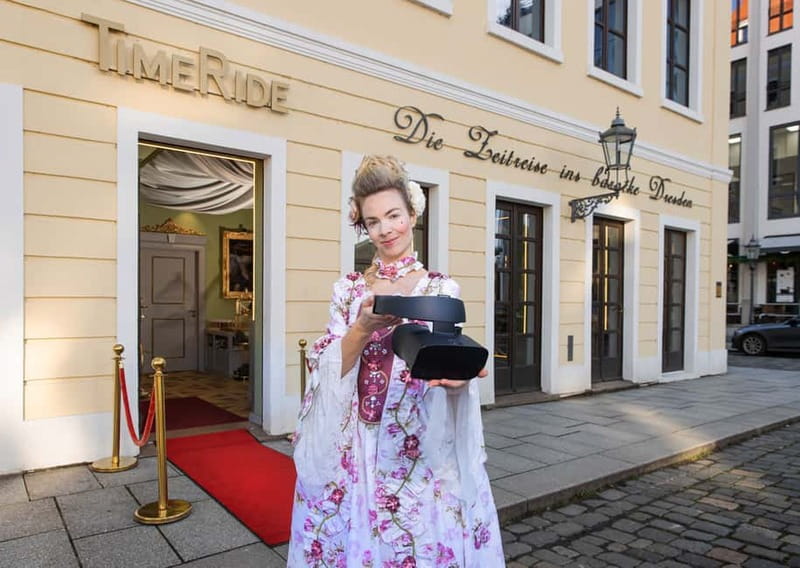
I would recommend it to several types of visitors:
- First-time Dresden visitors who want a quick introduction to the city’s Baroque identity.
- Families with children aged six and older who prefer history presented through movement, music, and animation.
- Museum fans who enjoy reconstructed settings and want to see the past from inside a scene.
- Short-stay visitors who need a compact activity that fits between larger sights.
- People curious about VR who want a guided experience rather than a standalone game.
Children under six are not permitted. Older children may enjoy the spectacle, but the historical detail and ceremonial opening may appeal more to school-age children than toddlers.
I would be more cautious about recommending it to visitors who dislike headsets, theatrical presentations, or tightly timed attractions. The physical carriage is part of the setup, but the main journey remains virtual. You will not be walking through an actual palace or riding through the real city.
It is also not the best choice for someone seeking a long academic account of Dresden. The attraction gives you atmosphere and broad context. It does not claim to replace a museum, a local history book, or a detailed walking tour.
Practical details before you go
The meeting point is directly behind the Cholera Fountain. The activity ends at the same location, so you do not need to arrange transport back to your hotel or another part of the city.
Food and drinks are not included. Since the program lasts only 45 minutes, this is easy to manage. Eat before or after the session rather than expecting a snack stop during the presentation.
Flash photography is not allowed. Keep your camera away during the show and follow the guide’s instructions around the VR equipment.
SENSEUM Dresden is at ground level. However, wheelchair users cannot access the physical Baroque carriages. A wheelchair user can still take part in the VR tour alongside the carriage, but you must tell the venue in advance so the staff can prepare the arrangement.
The activity has a 4.5 rating from 748 reviews, which suggests broad satisfaction, but the most useful lesson is the balance between strong presentation and limited duration. The guide’s humor and the animation receive clear praise, while the short VR segment is the one concern to keep in mind.
How to fit it into a Dresden day
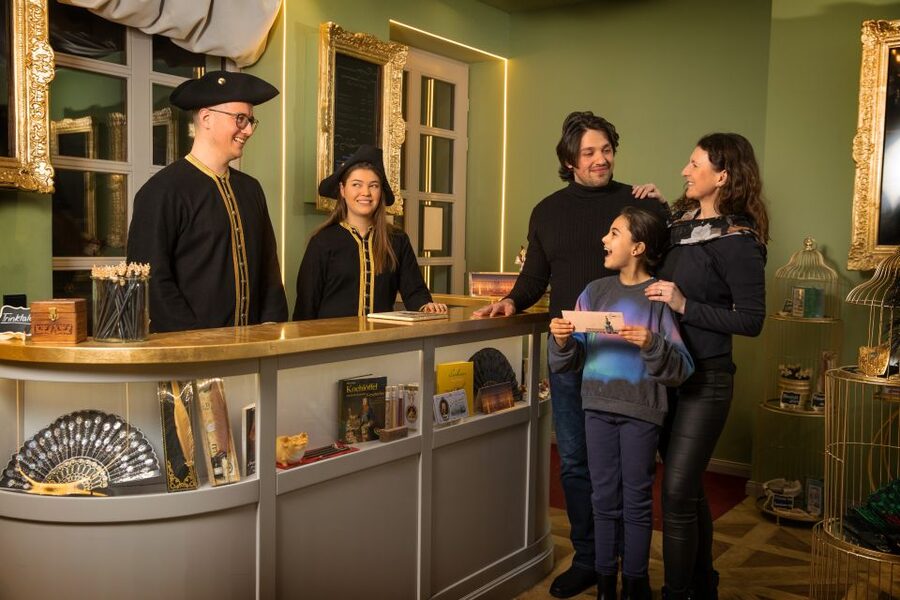
Set aside a full hour around the experience, even though the official duration is 45 minutes. You need a little breathing room to arrive at the meeting point, check in, and move through the sections without rushing to your next appointment.
The attraction pairs naturally with a day focused on Dresden’s historic center. You can use it as an introduction, then visit the real Zwinger and other Baroque buildings with the 1719 scenes fresh in your mind. You can also schedule it after sightseeing, when your feet need a break but you still want one more look at the city’s past.
Because the start time must be selected from availability, plan this before building a tightly packed itinerary. The flexible cancellation policy gives you some protection, but a timed VR session is still less forgiving than wandering into a public square.
Think of the activity as a compact story with three chapters:
- The Hall of Mirrors explains the ruling family and court.
- The Juggler’s Stage shifts attention to ordinary public amusements.
- The carriage ride connects the city, the suburbs, and the royal wedding.
That structure is the reason the experience feels fuller than a simple VR film. Each part prepares you for the next, even though the whole program is brief.
Should you book the Baroque VR ride?
Book it if you want a lively, easy-to-follow view of Dresden in 1719 and like the idea of attending a royal wedding from a virtual carriage. The live English or German host, funny presentation, animated scenes, and clear three-part structure give the activity real personality.
Skip it if you want hours of exploration, a traditional guided tour, or a fully accessible physical carriage ride. The 45-minute length is the key trade-off, and the VR portion may leave history fans wishing for a longer route.
For most visitors, $23 is a sensible price for a short cultural break, especially when combined with a visit to the actual Zwinger and Dresden’s historic center. Go in expecting a polished theatrical snapshot, not a complete lesson in Saxon history, and you are likely to get good value from the hour.
FAQ
How long does the Dresden Virtual Reality Time Travel Experience last?
The activity lasts 45 minutes. The Hall of Mirrors, Juggler’s Stage, and virtual carriage ride each take about 15 minutes.
What period does the VR experience show?
The experience focuses on Dresden in 1719, during the Baroque era and the rule of Augustus the Strong.
Where does the activity begin?
It begins directly behind the Cholera Fountain at SENSEUM Dresden.
Where does the activity end?
The activity ends back at the meeting point.
What languages are available?
The live tour guide is available in German and English.
Is the experience wheelchair accessible?
SENSEUM Dresden is at ground level, but wheelchair users cannot access the physical Baroque carriages. A wheelchair user can join the VR tour alongside the carriage if the venue is informed in advance.
Are children under six allowed to participate?
No. The activity is not suitable for children under six.
Is food or drink included?
No. Food and drinks are not included in the ticket.
Can I cancel my reservation?
Yes. You can cancel up to 24 hours in advance for a full refund. You can also reserve now and pay later.
Just added around Dresden
- Test Drive Electric Vehicles from the VW brand (ID. model)★ 4.8 · 190 reviews
- SRF CoBi | City Tour by ConferenceBike★ 4.7 · 38 reviews
- Dresden: Scavenger Hunt to Elbe River & Castles★ 4.7 · 15 reviews
- Dresden: Bike Rental – City Bike with Option Children Seat★ 4.5 · 13 reviews
- Moritzburg: Scavenger Hunt Self-Guided Walking Tour★ 4.8 · 12 reviews
- Historical tour of the old town including a Saxon dinner★ 4.7 · 23 reviews
- Climb the mountains together with goats★ 4.8 · 8 reviews
- From Prague: Day trip to Dresden★ 4.3 · 4 reviews
Dresden Tours, compared.

The Original Night Watchman Tour in Lantern Light
Read our review →


Browse the lists this tour appears in