
Reviewed · OLD TOWN WALKING TOURS
Dresden: Classic Old Town Tour
Dresden’s historic center packs an unusual amount into a short walk. In two hours, you’ll move from the baroque Zwinger and grand Semperoper to the rebuilt Frauenkirche, the Fürstenzug mural, Dresden Castle, and Brühl’s Terrace above the Elbe. Frau Tröster is specifically noted for her deep command of Dresden’s past.
I like the private-group format, which lets your guide shape the pace for up to 20 people, and I like the mix of famous sights with less obvious stops such as the New Synagogue and the state ministries. The main drawback is simple: entry fees are not included, so this is primarily an orientation walk, not a tour of every interior.
In This Review
- Key points at a glance
- Why Dresden’s old town works so well on foot
- The Zwinger and Kronentor gate
- Semperoper and Theaterplatz
- Taschenbergpalais, cathedral, and Dresden Castle
- The Fürstenzug and Dresden’s Saxon rulers
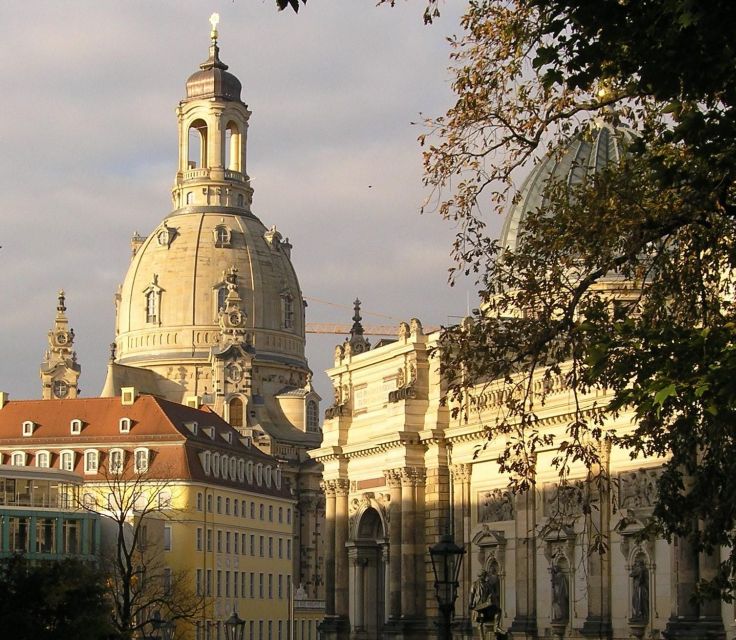
- Frauenkirche and the rebuilt Neumarkt
- Brühl’s Terrace and the state ministries
- The New Synagogue and Altmarkt
- The guide’s style and language options
- Is $212 good value for a private group?
- Who should book this Dresden walk?
- Should you book it?
- FAQ
- How long does the Dresden Classic Old Town Tour last?
- How much does the tour cost?
- Is this a private tour?
- Which languages are available?
- Is hotel pickup included?
- Are admission tickets included?
- Does the tour visit the Frauenkirche interior?
- Is the tour wheelchair accessible?
- Can I cancel the tour for a full refund?
Key points at a glance
- Zwinger to Semperoper: Begin with two of Dresden’s finest baroque and opera landmarks in the city’s grand Theaterplatz area.
- Frauenkirche interior: The route includes a visit inside the rebuilt church, not just an exterior photo stop.
- Fürstenzug mural: See Dresden’s long procession of Saxon rulers along the Castle district.
- Brühl’s Terrace views: Look toward the state ministries and the Elbe from Dresden’s elevated riverside promenade.
- Private two-hour walk: A group of up to 20 receives a live guide in English, French, Italian, or German.
- Central hotel pickup: Pickup is possible from centrally located hotels, which can save time at the start.
Why Dresden’s old town works so well on foot
Dresden’s center is compact enough to cover on foot, yet varied enough to keep the walk from feeling repetitive. A single route brings together court architecture, religious buildings, royal residences, public squares, and reminders of the city’s more recent rebuilding.
I see the value here in the sequence. You are not simply ticking off isolated buildings. The guide can explain how Dresden’s Saxon court shaped the city, how baroque design changed its appearance, and how key parts of the center were rebuilt.
The tour lasts two hours, so you should expect a brisk overview rather than a slow architectural study. That is a good fit for a first morning in Dresden, especially if you want a clear map of the center before returning on your own.
This is also a private group experience. Your party can include up to 20 people, and that gives you more control than a large public walk. A group of 20 will still feel fairly substantial, but you can ask questions directly and request clarification without competing with a crowd of strangers.
More Old Town Walking Tours in Dresden
- Dresden: Semperoper and Old Town Tour
★ 4.8 · 5,735 reviews - Dresden: Segway Tour Along the Elbe and Old Town
★ 4.9 · 392 reviews - Dresden: Old Town Self-Guided Scavenger Hunt Tour
★ 4.5 · 151 reviews
The Zwinger and Kronentor gate
The baroque Zwinger is one of the visual stars of Dresden. Its courtyards, pavilions, and ornate details were designed to impress, and the Kronentor gate gives the complex a memorable focal point.
I would pay close attention here rather than rushing toward the next stop. The Zwinger shows how Dresden’s rulers used architecture to project power and taste. Its elaborate decoration makes more sense when you understand it as a court setting built for display and ceremony.
The tour focuses on the historic center, so you will see the Zwinger as part of the larger city story. That is useful because it places the building beside the opera house, cathedral, castle, and major public spaces instead of treating it as a separate museum stop.
Entry fees are not included. The practical effect is that you should not assume the walk includes access to all museums or paid rooms within the Zwinger. You will still get the exterior setting and the guide’s explanation, then you can decide if you want to return later for a longer visit.
Semperoper and Theaterplatz
From the Zwinger, the route continues to the Semperoper at Theaterplatz. This is the place to look beyond the famous facade and consider the square as a complete architectural scene.
The opera house is part of Dresden’s cultural identity, and its position near the Zwinger makes the transition from courtly display to performing arts feel natural. Your guide is expected to cover architecture and culture as well as political history, so this stop should help connect the building to Saxon life.
Theaterplatz is also a useful orientation point. From here, the surrounding buildings help you understand the old town’s scale and layout. I like having this early in the walk because you quickly see why Dresden is often associated with monumental architecture.
A two-hour route cannot provide a full opera-house visit. Think of the Semperoper stop as a guided exterior view with context, not a performance or backstage experience.
Taschenbergpalais, cathedral, and Dresden Castle
The walk then moves through the royal heart of the city. The Taschenbergpalais, Dresden Cathedral, and Dresden Castle sit close enough together to create a dense run of historic sights.
The Taschenbergpalais adds another layer to the story of court Dresden. Dresden Cathedral brings religious architecture into the picture, while the castle represents the ruling house and the city’s political center. Seen together, these buildings show how power, faith, and ceremony were concentrated in a small area.
I find this part especially useful for first-time visitors because it gives you several landmarks to return to later. The guide can point out what belongs to the royal complex and what serves a different purpose, which helps prevent the old town from becoming a blur of grand facades.
The information provided does not promise entry into the cathedral, castle, or Taschenbergpalais. If you want interior visits, ask about timing and admission during booking or at the start of the walk. The listed entry fees remain your responsibility.
Same city, a completely different kind of day:
- Dresden: Semperoper Tickets and Guided Tour
★ 4.7 · 12,102 reviews - Dresden: The Original Night Watchman Tour in Lantern Light
★ 4.6 · 6,653 reviews - Dresden: River Sightseeing Boat Cruise
★ 4.3 · 5,323 reviews - Dresden: Tour of VW’s Transparent Factory
★ 4.5 · 4,058 reviews
The Fürstenzug and Dresden’s Saxon rulers
The Fürstenzug is one of Dresden’s most distinctive outdoor sights. This long mural presents a procession of Saxon rulers, giving the route a direct visual link to the people who shaped the city.
It is an excellent place for the guide to explain Saxon history without putting you in a museum room. You can stand in front of the artwork, take in its scale, and hear how the ruling dynasty fits into Dresden’s story.
I would allow yourself a few minutes to study the details. The mural is easy to pass quickly, especially when walking with a group, but it rewards a pause. Its location along the Castle district also makes it a natural bridge between the royal buildings and the Frauenkirche area.
This stop is one reason the tour offers more than a standard postcard circuit. The famous landmarks draw you in, but the Fürstenzug gives the historical narrative a clear cast of characters.
Frauenkirche and the rebuilt Neumarkt
The Frauenkirche is the emotional center of the walk for many people. The tour includes an interior visit, allowing you to see the space rather than stopping only outside for photographs.
The church’s presence in the rebuilt Neumarkt makes Dresden’s wartime destruction and later reconstruction impossible to ignore. You will see a historic setting that has been brought back into the city center, and the guide can place that work within Dresden’s wider past.
I like that the Frauenkirche is not treated as just another grand facade. Going inside gives you a better feel for its scale and design. It also adds a quieter moment after the large public spaces and ornate royal buildings.
Still, timing matters. The tour is only two hours and includes many stops, so the interior visit may be brief. If you want a long look at the church, time for prayer, or a detailed examination of every architectural feature, plan to return independently.
The rebuilt Neumarkt surrounding the church is also worth noticing. It helps you understand how Dresden has worked to restore the visual character of its central squares while creating a functioning modern city around them.
Brühl’s Terrace and the state ministries
Brühl’s Terrace provides a change of mood. Known for its riverside position, the terrace gives you a view toward the state ministries and a broader sense of Dresden beyond the tight lanes of the old town.
I value this stop because it breaks up the architecture with open space. After several courtyards, facades, and historic walls, you can look outward and see how the city sits along the Elbe.
The view is part of the experience, but the terrace also carries its own place in Dresden’s civic story. Your guide can explain how the area relates to the city’s government and public life. It is a good moment to ask practical questions about what you are seeing across the river.
Weather will affect how much you enjoy this section. On a clear day, the outlook should be one of the walk’s visual highlights. In poor weather, it remains useful for orientation, but you may want a warm layer and comfortable shoes.
The New Synagogue and Altmarkt
Two stops add needed range to the route: the New Synagogue and Altmarkt. They keep the tour from presenting Dresden as only a baroque court city.
The New Synagogue brings Jewish history and modern Dresden into the conversation. Its inclusion matters because a useful city tour should address more than royal architecture. You will see a different part of Dresden’s identity and get a broader cultural picture.
Altmarkt offers another shift. With the Kulturpalast nearby, the square connects the historic center with a more recent period of public architecture and city life. This helps show that Dresden’s story did not end with the baroque era.
I appreciate these stops because they add contrast, though they may feel less immediately dazzling than the Zwinger or Frauenkirche. If your sole goal is a parade of ornate landmarks, the New Synagogue and Kulturpalast may seem like detours. If you want a more honest account of the city, they strengthen the route.
The guide’s style and language options
The experience promises a spirited and humorous approach, with explanations of Saxon lifestyle, architecture, culture, and history. That tone can make a long list of dates and buildings easier to follow, particularly when the route moves quickly.
Frau Tröster is noted for an especially strong command of Dresden’s history. If she leads your group, you can expect the historical side of the walk to be a major feature. Guide assignment may vary, so confirm the available guide when arranging your booking if that matters to you.
You can take the tour in English, French, Italian, or German. That choice is important in a private setting because the guide’s language affects how easily you can ask questions and follow the humor.
The guide is included in the price, while admissions are not. This makes the walk best suited to people who want interpretation, orientation, and exterior access, with the option to choose their own paid interiors afterward.
Is $212 good value for a private group?
The listed price is $212 for a group of up to 20 people. I would judge that price by the size and makeup of your party rather than by comparing it with a per-person group walk.
For a couple or a small family, $212 is a noticeable expense for two hours. You are paying for a private guide, central hotel pickup possibility, language choice, and a route through nearly all of Dresden’s key old-town sights. A smaller party should consider how much personal attention and scheduling freedom matter.
For a larger group, the calculation improves. At the full capacity, the cost works out to about $10.60 per person, before any admission fees. That can be fair value for a private overview, especially when splitting the cost among friends, relatives, or a tour group.
You should also budget separately for any paid entries you choose. The walk itself includes the guide, not admission tickets. The advertised skip-the-ticket-line feature may help with eligible entry arrangements, but it does not mean entry is free.
Who should book this Dresden walk?
I would recommend it to first-time visitors who want the city’s major sights explained in a single, efficient route. It also suits families or private groups that prefer their own guide and do not want to follow a large public tour.
The walk works well early in a Dresden stay. You can use it to identify the Zwinger, Semperoper, Frauenkirche, castle district, and riverside terrace, then return to the places that deserve more time.
History-minded visitors should value the range of subjects. The route covers Saxon rulers, baroque design, religious architecture, Jewish history, public culture, and reconstruction. It is not just a pretty-building walk.
I would be more cautious if you want extensive interior access or a slow photography tour. Two hours and many landmarks require steady movement. People with mobility needs should note that the tour is wheelchair accessible, but the route is still a walking experience, so confirming the exact pickup and meeting arrangements remains sensible.
The tour has a 4.4 rating from 33 reviews, and the named praise for Frau Tröster points to the importance of the guide. Since guide style can shape the whole experience, ask who will lead your group if you have a strong preference.
Should you book it?
Book this tour if you want a private, well-packed introduction to Dresden’s old town, with a guide who can connect famous buildings to Saxon culture and the city’s difficult past. The Frauenkirche interior, Fürstenzug, New Synagogue, and Brühl’s Terrace give the route more range than a simple list of postcard stops.
Skip it if you want museum admissions included, extensive time inside each building, or a low-cost walk for just one or two people. For a larger group, the $212 flat rate makes better sense. For a small party, the value depends on how much you prize private guiding and a fixed two-hour overview.
FAQ
How long does the Dresden Classic Old Town Tour last?
The walking tour lasts two hours.
How much does the tour cost?
The price is $212 per private group of up to 20 people.
Is this a private tour?
Yes. It is offered as a private group experience.
Which languages are available?
The live guide is available in English, French, Italian, and German.
Is hotel pickup included?
Pickup is possible from centrally located hotels. The guide is included, while entry fees are not.
Are admission tickets included?
No. Entry fees are not included in the tour price.
Does the tour visit the Frauenkirche interior?
Yes. The route includes an interior visit to the Frauenkirche.
Is the tour wheelchair accessible?
Yes. The activity is listed as wheelchair accessible.
Can I cancel the tour for a full refund?
Yes. You can cancel up to 24 hours in advance for a full refund.
Just added around Dresden
- Test Drive Electric Vehicles from the VW brand (ID. model)★ 4.8 · 190 reviews
- SRF CoBi | City Tour by ConferenceBike★ 4.7 · 38 reviews
- Dresden: Scavenger Hunt to Elbe River & Castles★ 4.7 · 15 reviews
- Dresden: Bike Rental – City Bike with Option Children Seat★ 4.5 · 13 reviews
- Moritzburg: Scavenger Hunt Self-Guided Walking Tour★ 4.8 · 12 reviews
- Historical tour of the old town including a Saxon dinner★ 4.7 · 23 reviews
- Climb the mountains together with goats★ 4.8 · 8 reviews
- From Prague: Day trip to Dresden★ 4.3 · 4 reviews
Old Town Walking Tours, compared.

Old Town & Viktualienmarkt City Walk in German
Read our review →
The Night Watchman Old Town Walking Tour in German
Read our review →
Browse the lists this tour appears in